





Most teams treat the vendor onboarding process as a checklist to clear before the real work starts. Contracts signed, systems connected, access granted, done. The thing almost nobody plans for is that how you bring a vendor in ends up shaping how much friction you deal with for the next two years. I've watched companies spend weeks haggling over rates and then skip the parts that actually protect them when things fall apart. So that's what I want to dig into here: designing your vendor onboarding around how the relationship ends, not just how it starts.
Some of you are building your first vendor program from nothing. Others are cleaning up something that got messy after years of shortcuts. Either way, if you're standardizing all of this, our IT onboarding and offboarding checklist maps the full lifecycle in one place, the right it procurement software keeps every step in a single system, and a repeatable approach to supplier onboarding traces back to that same source of truth.
TL;DR
Short on time? Here's the argument in six points.
- Most vendor onboarding fails because teams optimize for speed at signup and ignore what happens at renewal, dispute, or exit.
- Offboarding terms, data return clauses, and access revocation should get defined during onboarding, not scrambled for later.
- Documentation gaps like undefined ownership and missing escalation paths create the delays teams love to blame on vendors.
- Security and compliance checks belong at the front, not as an afterthought once a vendor already holds access.
- Clear performance baselines set at the start separate managing a vendor from guessing about one.
- Automation removes the repetitive coordination work that drains IT and procurement teams.
Handled well, supplier onboarding stops being a scramble. Done badly, every round of vendor onboarding just adds risk you'll pay for later.
Why the Finish Line Belongs in Your First Meeting
Ask most procurement folks what a good vendor onboarding process looks like and they'll say fast. Contract signed, tools live, done by Friday. I used to think the same, right up until a vendor sat on our data during a renewal negotiation and I realized we'd never written down how to leave. The strongest agreements get written when both sides still want the deal to work, which means the moment you sign someone on is also the moment you have the most leverage to set the terms of departure. That window doesn't come back. A vendor onboarding process built only for speed spends that leverage on nothing.
The Speed Trap Nobody Admits To
Procurement teams get measured on how fast they close, so onboarding becomes a race. Sign the contract, unlock the tools, move on to the next fire. And when everyone's chasing the start date, the terms that actually matter at month eighteen never make it onto the page. The cost of rushing shows up in the numbers, too: one analysis found manual vendor onboarding runs more than $35,000 per supplier, while an automated process brings that below $2,500, and most of that gap is process, not technology. In other words, the vendor onboarding process itself is the cost driver.
So here's the thing to sit with. If this vendor relationship went bad tomorrow, could you pull your data back and cut access cleanly? Most teams honestly can't say. The pressure creating those gaps is real, too, not something I'm inventing to sound dramatic. Hiring deadlines, budget cycles, quarterly targets, they all push exit terms right off the table. When that pressure builds, our guide to fixing IT procurement delays for global teams shows where the time actually goes and how a tighter process claws some of it back. Deadline pressure is exactly why the vendor onboarding process needs written exit terms.
What "Later" Actually Costs
Deferred decisions don't vanish. They come back as disputes. A vendor holding your data hostage during a renewal. An ex-contractor whose credentials still work months after they walked out the door. Invoices for services you stopped using ages ago. Every one of those traces back to a term that should've been settled at the start.
One SaaS company I know kept paying for a monitoring tool for the better part of a year after they'd already switched providers. Nobody had defined a cancellation trigger, so the auto-renewal fired, the invoice landed in a shared inbox, and finance approved it without blinking, partly because the person who approved it had started that month and had no idea it was dead weight. By the time anyone connected the dots, the wasted spend had crept into five figures.

Writing the Ending First
Both sides are motivated to make things work when they're signing. That's precisely when you negotiate the exit. Data return format and timeline, transition assistance, notice periods, and who owns what when it's over. None of this is adversarial, it's just clarity, and clarity written into the agreement upfront is worth far more than any clause you try to bolt on after a relationship has already gone sour.
The Documentation Gaps That Cost You Later
Paperwork gets treated as a formality, something you file and forget. That habit is where the trouble starts. A vague supplier onboarding process produces the exact vendor delays teams complain about, and most of those delays have nothing to do with the vendor. The real move is getting from "we have a contract" to "we have a functioning operational record," and that includes something as basic as a vendor onboarding form that captures who's responsible before anyone touches your systems. Documentation is not overhead on a vendor onboarding process, it is the deliverable.
Ownership Nobody Claimed
"IT will handle it" isn't an owner. Neither is "procurement." When a vendor issue surfaces and no single person is on the hook for it, the ticket just sits there and nobody follows up. Ownership belongs in the vendor onboarding process, not in a hallway conversation.
I've seen deployment delays pinned on vendors that were really internal handoff failures, plain and simple. Assign a named owner for each vendor relationship and a good chunk of your coordination headaches disappear. For a wider view of the discipline, our overview of IT vendor management best practices pairs neatly with these ownership fixes.
Here's the ownership record I'd fill out for every relationship before access gets granted, and it belongs in your vendor onboarding checklist:
- Primary owner: a named individual, not a department
- Backup owner: who covers when the primary is out
- Escalation contact: the person authorized to invoke penalty or exit clauses
- Renewal decision-maker: who signs off on continuing or cutting the relationship
- Data return coordinator: who confirms retrieval and revocation on exit
- Review scheduler: who owns booking and running the recurring check-ins
Drop that into a shared vendor onboarding template and you've already closed the most common accountability gap before it opens.
The Escalation Path Test
Quick one. Can you name the escalation contact for your top vendor right now, plus the response time they're contractually bound to? If you paused even a little, that's your gap.
Escalation paths and service level agreements defined during vendor setup turn a bad day into a manageable one. If service levels are where you keep slipping, our guide on how to track and manage order timelines with SLAs shows what tight escalation actually looks like.
Records People Can Actually Use
A contract buried in someone's inbox isn't documentation. It's a liability waiting to surface the day that person leaves. Pricing terms, renewal dates, contacts, SLAs, asset assignments, all of it needs to live somewhere everyone can reach.
When records scatter across tools and inboxes, you're back to guessing, which defeats the point of onboarding vendors properly in the first place. Centralizing them in a proper IT asset management process turns loose paperwork into a record you can actually use.
| Record type | Where teams usually keep it | Why that fails | Where it should live |
|---|---|---|---|
| Signed contract | Individual email inbox | Inaccessible when that person leaves | Central repository with permissions |
| Renewal dates | Personal calendar reminders | Silent auto-renewals slip through | Shared system with automated alerts |
| SLA terms | Buried in contract PDF | Nobody references them during disputes | Summarized in a searchable vendor record |
| Escalation contacts | Tribal knowledge | Lost the moment staff turns over | Documented owner record |
| Asset assignments | Ad hoc spreadsheet | Drifts out of date, no audit trail | Tracked lifecycle platform |
Building Exit Terms Into Day One
Good intentions don't count for much without clauses you can actually implement. Turning "plan for the ending" into specific, negotiable terms is the part of any vendor onboarding process most contracts leave blank.

The Three Clauses Worth Fighting For
Three terms carry most of the weight when a relationship ends:
- Data portability. Define the format, the timeline, and the fee, ideally none. Vague language here is how vendors keep you locked in long after you've decided to walk.
- Access revocation. Specify how fast credentials, integrations, and physical assets get pulled once notice is given. Loose timelines leave security holes open for weeks.
- Transition support. Require a defined handoff period with named deliverables. Without it, you inherit chaos the day the contract lapses.
Make these three non-negotiable and your vendor onboarding checklist already outperforms most enterprise procurement templates. Tight access revocation is really an offboarding discipline, and our guide to secure offboarding automation shows how to close those credential gaps quickly.
Recent enforcement activity around data portability has pushed these clauses from nice-to-have to necessary. The exposure is no longer hypothetical: the Verizon 2025 Data Breach Investigations Report found that 30% of breaches now involve a third party, roughly double the 15% recorded the year before. Regulators keep tightening their expectations on how fast and how completely a company can retrieve its own data from a departing provider. Coverage of how evolving data protection enforcement is reshaping vendor contracts (Reuters) is a good reminder that the format and timeline of data return now belongs in writing from the first draft, not the eleventh-hour negotiation.
Notice Periods That Protect Both Sides
Notice periods aren't about tying anyone's hands. A reasonable window gives you time to migrate cleanly and gives the vendor time to wind down without cutting corners. Rushed exits produce the same errors rushed onboarding does, so build the runway in from the start. Treating the vendor fairly here isn't generosity on your part, it protects you from inheriting a sloppy, half-finished handoff, which is why a mature supplier onboarding process always spells out the exit window in plain terms.
Access, Security, and the Compliance Layer People Skip
Security tends to get treated as a box you tick after access is already flowing. That order is backwards, and for distributed teams it's actually dangerous. Front-loading the security work is the only version of onboarding that holds up when someone starts asking hard questions.
Granting Access Before Vetting Is Backwards
Vendors get system access on day one, and their security review happens, if it happens at all, weeks later. Sequencing it that way is asking for trouble.
Vetting a vendor's data handling, certifications, and access controls belongs before the first credential is issued, not after they've already been poking around your environment. Building identity and access management for remote teams into your vendor onboarding form and intake flow is what makes that sequencing enforceable rather than a nice idea.
A retail operations team I heard about granted a fulfillment vendor API access to their inventory system to hit a launch deadline, fully planning to run the security review afterward. It never got scheduled. Six months later that vendor's own breach turned the connection into an open door straight into the retailer's systems. The access had sat live and unaudited the whole time, precisely because vetting got treated as a follow-up task instead of a gate you don't get past without clearing. The bill for that shortcut is steep: IBM's 2025 research pegs the average third-party and supply-chain compromise at $4.91 million, the second costliest breach type of all.
The Distributed Team Complication
Onboarding a vendor across borders piles on layers most single-country processes never touch. Data residency rules differ by region, local compliance requirements shift, and physical device logistics get complicated fast.
Teams running lean tend to underestimate this right up until an order stalls at customs or a regulation trips them up. For a closer look at how one company handles procurement across regions, how Vividly runs IT across six countries with a team of one is worth reading. The same regional pitfalls show up in our breakdown of global IT procurement compliance, which I'd flag before you sign any cross-border vendor.
Cross-border data residency requirements keep multiplying, with more jurisdictions passing localization rules that dictate where vendor-held data can physically sit. Reporting on the widening patchwork of national data localization laws (Reuters) makes the point that any process ignoring regional compliance can strand a distributed team the moment a new rule takes effect.
Compliance That Reports Itself
Compliance checked once at onboarding drifts out of date within months. What you want is monitoring that runs continuously and surfaces problems before an auditor does.
SOC 2 Type 2 certification, automated reporting, and clear audit trails should be table stakes for any vendor touching sensitive systems, and for the platforms you use to manage those vendors too. If you're mapping which standards actually apply to your vendor setup, our overview of IT compliance standards sorts the baseline expectations from the nice-to-haves. And for the bigger picture on how procurement, security, and lifecycle decisions connect, our State of IT Lifecycle Management report makes a useful companion.

Measuring a Vendor Before You Trust Them
You can't evaluate what you never defined. Baselines set at the start make later reviews objective instead of emotional, and that's the whole reason to bother with them during onboarding rather than after the first problem blows up.
Baselines Beat Gut Feeling
"They seem slow lately" isn't a performance review. It's a hunch. Without baselines set during onboarding, every evaluation turns subjective and every renewal conversation gets awkward, because now you're arguing about impressions instead of pointing at a number.
Define delivery windows, response times, and acceptable error rates in the agreement itself. Then you're measuring against something real. Bake those numbers into your vendor onboarding checklist and the next review runs itself. Skip the upfront rigor and the risk surfaces too late to act on: a Gartner study found 83% of legal and compliance leaders only identified vendor risks after due diligence was already complete.
The Metrics Worth Tracking
Track fewer things, but track them well:
- SLA adherence rate
- Time from order to fulfillment
- Average issue resolution time
- Billing accuracy against agreed terms
These four surface trouble early, long before it becomes a renewal crisis.
| Metric | What good looks like | Warning sign | Where it usually shows up first |
|---|---|---|---|
| SLA adherence rate | Consistently at or above the agreed threshold | Slipping response times on routine tickets | Support and escalation logs |
| Time from order to fulfillment | Stable and within the committed window | Widening gap between order and delivery | Procurement and shipping records |
| Average issue resolution time | Trending flat or downward | Same issues reopening repeatedly | Ticket resolution history |
| Billing accuracy | Invoices match agreed terms every cycle | Unexplained line items or creeping fees | Finance reconciliation |
Review Cadence That Doesn't Slip
If you only review a vendor when something's already on fire, you're not managing them, you're just running a postmortem and hoping the next one goes smoother.
Schedule reviews at onboarding, run them quarterly for critical vendors, and hold the line even when everyone's slammed. Regular check-ins catch drift while it's still fixable, which is exactly why you book them before there's a problem to react to. Building that rhythm into vendor onboarding is how you avoid getting blindsided by a vendor you thought was fine.
Automating the Parts Humans Keep Fumbling
A well-designed process still breaks down when it leans on manual coordination. Even the sharpest vendor onboarding collapses under the weight of forgotten follow-ups, and no amount of supplier onboarding discipline survives a fully manual handoff.
Where Manual Onboarding Breaks
Someone forgets to revoke access. A device ships to the wrong country. An approval sits in an inbox for three days. None of these are strategy failures, they're execution failures, and they eat your team's time in ways nobody ever budgets for.
Handing these repeatable steps to IT automation tools is how teams stop bleeding hours into coordination they never should've owned. Reliable vendor setup is a lot easier when the system, not a person, remembers every step.
A fast-growing startup I came across onboarded a hardware vendor to equip new hires across four countries, coordinating every single shipment by hand through email threads and one increasingly chaotic shared spreadsheet. Two laptops meant for engineers in Portugal shipped to the wrong address. One turned up after the employee's start date, which is its own special kind of awkward for a new hire staring at an empty desk. A returning contractor's device sat uncollected for a month because nobody actually owned the return step. Each slip was small, but stacked together they cost the IT lead the better part of a week per hiring cycle.
Handing the Repetitive Work to a System
If your onboarding stalls because someone's manually coordinating device procurement, deployment, and returns across countries, that's exactly the friction we built GroWrk to remove. Zero-touch deployment to over 150 countries, two-click offboarding, and automated compliance reporting mean your IT team stops chasing tickets and gets time back for work that matters.
A clean supplier onboarding process shouldn't hinge on somebody remembering to chase a shipment. You can request a demo to see how the full device lifecycle runs on autopilot.
What Automation Can't Do
Automation handles the repeatable work, not the thinking. Deciding which vendors to keep, negotiating exit terms, judging whether a relationship still serves you, all of that stays human, and honestly it should.
The goal was never to remove people from vendor management. It's to free them from busywork so they can focus on the parts that actually need a brain. Anyone onboarding vendors at scale figures this out fast: the software carries the logistics, the people carry the judgment.
Final Thoughts
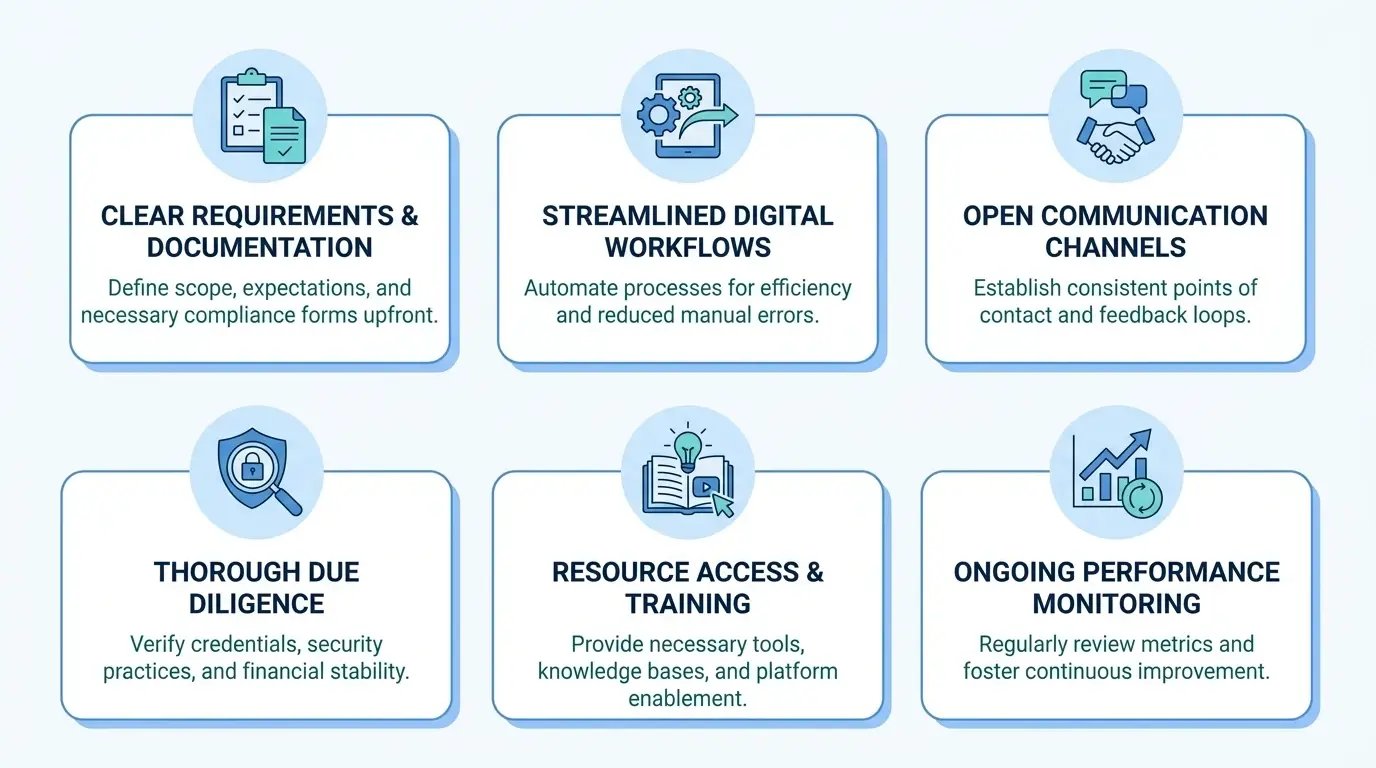
The best vendor onboarding process isn't the fastest one. It's the one that thought about the ending before the beginning, wrote down who owns what, vetted security before granting access, and set the numbers you'd measure against down the line. Teams that get this right spend less time firefighting and a lot more time on decisions that push the business forward.
Before you sign your next vendor, ask the awkward question early: how does this end, and are we ready for it? Answer that during supplier onboarding and almost everything downstream gets easier. The same principle carries straight into onboarding suppliers of every size, from a single SaaS tool to a global hardware program.
If the device logistics behind your vendor onboarding keep stalling on manual handoffs, that's the friction GroWrk was built to remove. GroWrk delivers zero-touch deployment to 150+ countries, so your IT team stops firefighting onboarding and starts focusing on what matters, with procurement, deployment, and retrieval running from one platform. Request a demo and see how the full device lifecycle runs on autopilot.