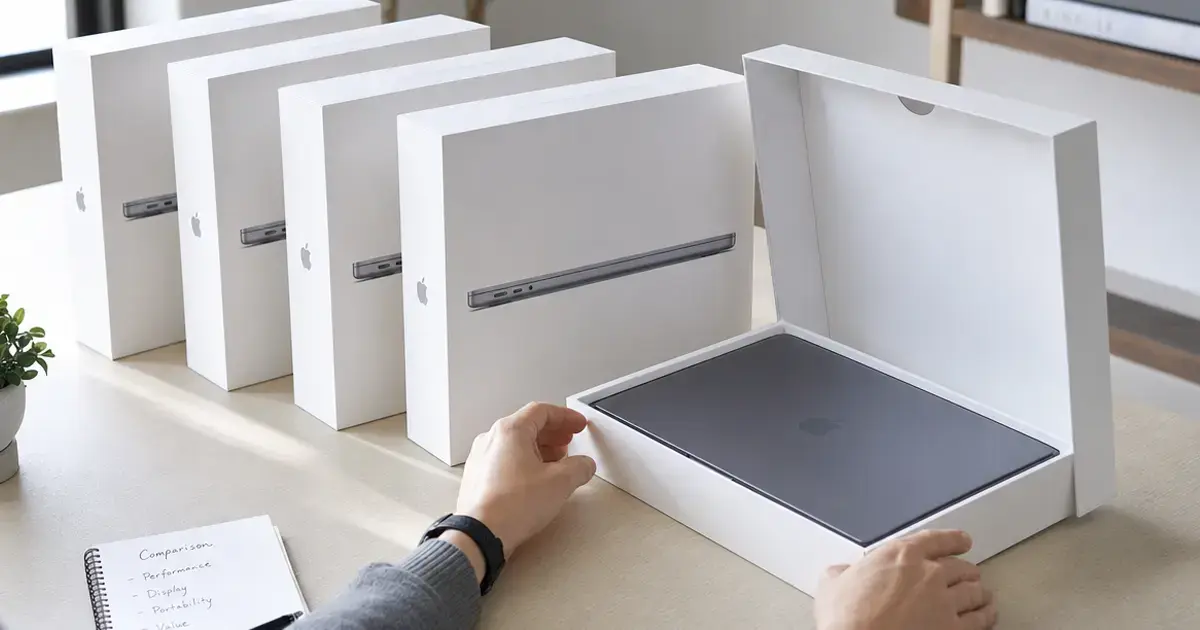





Remote employee laptop retrieval works when it starts before the last day, not after it: confirm what is actually assigned to the person, send a prepaid return kit with a scheduled door pickup, lock the device through MDM without wiping it, then log serial and condition on arrival and issue a certificate of sanitization before the machine is redeployed, stored, or sold. Retrieval fails on logistics and ownership, not on policy - which is why a working laptop retrieval process is a workflow with named owners and dates, not a paragraph in an employee handbook.
Key takeaways
- Retrieval is a mid-lifecycle problem, not an HR problem. Offboarding and retrieval was raised by the buyer, unprompted, in 22.6% of 3,977 analyzed customer calls - statistically tied with storage and MDM enrollment as the most-discussed topic in IT lifecycle management.
- The window is the last five days, not the last day. Every hour after final-day access revocation lowers your odds of getting the machine back.
- Lock, don't wipe - yet. A remote wipe issued before the device is in hand can strip your MDM enrollment, trip activation lock, and destroy the evidence you need for a legal hold.
- Chain of custody is the deliverable, not the box. “We got it back” is not an audit answer. Serial, condition, custody timestamps, and a sanitization certificate are.
- Cross-border is where the standard playbook collapses. A prepaid label works in Ohio and fails in Sao Paulo, Bengaluru, and Manila.
- The decision doesn't end at the warehouse door. Redeploy, store, buy back, or dispose — each has a different cost, and most companies default to the most expensive one.
What is remote employee laptop retrieval?
Remote employee laptop retrieval is the process of recovering company-owned devices from an employee who works outside a company office, from the moment notice is given through to the point the device is verified, sanitized, and returned to inventory or disposed of. It spans four things that most offboarding checklists treat separately: access revocation, physical logistics, chain of custody documentation, and the disposition decision.
It is distinct from IT asset recovery, which is the broader discipline covering all end-of-life assets, and from offboarding, which is the HR-owned process retrieval sits inside. Retrieval is the part that involves a courier.
Why laptop retrieval fails at mid-size companies
At 50 people, retrieval is somebody's side task. At 400 people with staff in six countries, it's a recurring operational failure that shows up in the audit. Here is what makes it break, in the order it actually breaks.
1. Nobody is certain what the person has. The asset register says one MacBook Pro. The employee has a MacBook Pro, a second monitor bought on a corporate card during the 2023 hiring push, a Yubikey, and a dock that was shipped directly from a reseller and never logged. You cannot retrieve an asset you don't know exists.
2. Ownership is split and therefore unowned. HR owns the departure date. IT owns the device. Finance owns the final paycheck. Payroll owns the deadline. Nobody owns the box. In GroWrk's call corpus, the recurring pattern isn't companies without a policy — it's companies with a policy and no single accountable owner for execution.
3. Access is revoked before the device moves. The one lever you have over a departing employee is that they still need something from you. Once SSO is dead and the final paycheck has cleared, your leverage is a strongly worded email.
4. The employee is asked to do work. “Please find a box, pack it securely, print this label, and drop it at a UPS Store” is four tasks for someone who no longer works for you. Every task added is a percentage of returns lost.
5. The device crosses a border. This is where every published playbook stops. More on this below.
What the data says
GroWrk analyzed 3,977 customer calls recorded between April 2024 and August 2026, counting only themes the customer raised before any GroWrk representative did — a distinction that matters, because counting raw mentions measures your own demo script as much as buyer interest.
| Theme raised first by the buyer | Calls | % of 3,977 |
|---|---|---|
| Storage / warehousing | 800 | 22.8% |
| Offboarding / retrieval | 795 | 22.6% |
| MDM enrollment before shipping | 773 | 22.0% |
| Speed / lead time | 629 | 17.9% |
| Certified wipe / SOC 2 / destruction | 425 | 12.1% |
| Buyback / resale / disposal | 375 | 10.7% |
Source: GroWrk Call Intelligence — analysis of 3,977 customer calls, April 2024 to August 2026. The top three are statistically tied; treat them as a tier, not a ranking.
The three biggest conversations in this market are all middle-of-lifecycle: where the laptop sits between one employee and the next. Procurement and disposal get the content. The middle gets the tickets.
The 9-step remote laptop retrieval workflow
This is the workflow, mapped to days relative to the employee's last working day (Day 0). Owners assume a mid-size company with a small IT team.
| Day | Step | Owner | Evidence produced |
|---|---|---|---|
| Day -5 | Reconcile the asset record | IT | Verified assigned-asset list |
| Day -3 | Confirm the shipping address and phone | HR | Signed return confirmation |
| Day -3 | Dispatch the return kit | IT / vendor | Outbound tracking number |
| Day -1 | Set device to locked-but-enrolled | IT | MDM lock timestamp |
| Day 0 | Staged access revocation | IT / Security | Access revocation log |
| Day 0 | Send one retrieval link | IT / vendor | Employee acknowledgment |
| Day +1 to +7 | Courier pickup from the door | Vendor | Pickup scan, in-transit tracking |
| Day +3 to +14 | Customs and cross-border handling | Vendor | Commercial invoice, clearance docs |
| On arrival | Intake, log, sanitize, decide | IT / warehouse | Chain of custody log + sanitization certificate |
Step 1 - Day -5: Reconcile what's actually assigned
Pull the asset register, then cross-check it against three other sources: your MDM enrollment list, the shipping records for that employee's address, and any expense reports for hardware. Mid-size companies almost always find a delta, which is why asset tracking that reflects reality is the precondition for everything downstream.
Write the reconciled list into the retrieval request itself. The employee should receive an itemized list — “MacBook Pro 14-inch, serial C02XXXXXXX; Dell U2723QE monitor; Anker 7-in-1 dock; Logitech MX Master 3” — not “your equipment.” Ambiguity is what lets a dock go missing.
Step 2 - Day -3: Confirm the address before you need it
The address in your HRIS is where you shipped a laptop 26 months ago. People move. Get a written confirmation of the current shipping address, a phone number the courier can call, and a two-hour pickup window preference. Do this while the person still has a reason to reply to you — and if your HRIS integration can trigger the request automatically on the notice date, it happens whether or not anyone remembers.
For international staff, also capture the national ID or tax ID number required on export paperwork in that country. Chasing this after the employee has gone dark is the single most common cause of a retrieval that stalls for six weeks.
Step 3 - Day -3: Send the kit before the last day, not after
Ship a return kit that arrives before Day 0. The kit should contain a right-sized box with foam or air-cushion inserts, a prepaid return label already affixed, and a one-page card listing the itemized contents and the pickup date.
The reason to send it early is behavioral, not logistical. A box sitting in the hallway on someone's last day is a reminder. A box that arrives four days after they've mentally left is a chore.
Step 4 - Day -1: Lock the device, do not wipe it
This is the step most guides get backwards. Lock is not wipe. Issuing a remote wipe before the device is physically recovered is a mistake for four reasons:
- On macOS, an erase can drop the device out of MDM supervision, and if the Apple ID hasn't been signed out, you inherit Activation Lock on a machine you now can't provision.
- A wiped machine is worth less to you and no less valuable to someone who decides not to return it — you've removed the only thing that made returning it necessary.
- If there is any chance of a legal hold, litigation, or an IP dispute, the wipe destroys the evidence.
- A wipe is not a sanitization event you can certify. Verified sanitization happens at intake, under controlled conditions, with a certificate attached to a serial number.
What to do instead: use MDM lost mode or a firmware lock with a lock-screen message showing the return instructions and a contact. The device is unusable and unsellable, the data is inaccessible, and your enrollment survives.
Step 5 - Day 0: Revoke access in stages
Revoke in this order, not all at once:
- Immediately at notice: privileged access, production systems, admin consoles, code repositories, financial systems.
- End of Day 0: SSO, email, chat, VPN.
- Only after the device is scanned as picked up: the retrieval portal login and the contact channel the employee uses to reach you.
Keeping one live channel open past Day 0 costs you nothing and preserves the only communication path you have during the window when the device is still in someone's apartment.
Step 6 - Day 0: Give them one link, not an email thread
The employee should receive a single URL that shows: what to pack, the pickup window, a button to reschedule it, the tracking status, and a contact for problems. Not a PDF policy. Not a five-email thread with a label attached to the third one.
Automated reminders at Day +2, +5, and +9 should come from that same link, and should escalate in specificity rather than in tone: “your pickup is scheduled for Thursday between 2 and 4pm” beats “as a reminder, per company policy.”
Step 7 - Day +1 to +7: Courier pickup at the door
Requiring a drop-off is where returns go to die. A scheduled door pickup removes the last task from the employee and gives you a hard scan timestamp — the moment custody transfers from a private individual to a carrier, which is the first defensible entry in your chain of custody log.
If pickup fails twice, escalate to a courier who will attempt a call-ahead window, and only then move to the enforcement path. Our action plan for equipment recovery after termination covers that escalation in detail, including where final-pay deductions are and aren't permitted.
Step 8 - Day +3 to +14: The cross-border step everyone skips
Every widely cited article on this topic — and we read them — explicitly does not cover international retrieval. That is not an accident. It is genuinely the hard part, and it is where a US-centric process silently fails.
What actually changes outside your home market:
- India requires an e-way bill for the movement of goods above a threshold value, plus GST documentation. A prepaid label with no commercial invoice will not clear. India is the most-discussed deployment market in GroWrk's corpus — named in 665 of 3,977 calls across 386 distinct accounts, more than any other country.
- Brazil applies import taxation and documentation requirements that make a returning laptop a customs event, not a parcel. Brazil appears in 430 calls across 275 accounts.
- Argentina, Colombia and Mexico each require locally compliant paperwork and, practically, a local entity or partner to receive the goods. Combined, they appear in over 1,000 calls.
- The Philippines and much of APAC frequently have no value-added reseller presence at all. As one IT buyer described it: “The issue we're having in El Salvador and the Philippines is there's no CDW, there's no VARs out there that could just ship the devices. And there's also no one to collect.”
The practical rule: in any country where you don't hold a legal entity, retrieval requires either a local partner who can receive on your behalf, or an in-country storage destination so the device never has to cross a border at all. Shipping a used laptop internationally to a warehouse in another country is usually the worst of the three options — highest cost, longest transit, most customs risk, and often a duty bill on your own property.
Step 9 - On arrival: Intake, log, sanitize, decide
Intake is the step that converts “we got it back” into an auditable fact. See the chain of custody section below for exactly what to record.
Five mistakes that cost mid-size companies devices
- Wiping before recovery. Destroys enrollment, evidence, and leverage in one command.
- Starting on the last day. By Day 0 you've already spent most of your leverage.
- Asking the employee to do logistics. Every task you add is returns you lose.
- Treating the asset register as truth. Reconcile it against MDM and shipping records first.
- Running the US playbook internationally. A prepaid label is not a customs strategy.
Chain of custody: what “recovered” actually means
A retrieval is complete when you can answer these questions from a record, not from memory. What to log at intake:
- Serial number, verified against the assigned-asset record
- Asset tag, if used
- Date and time of receipt, and the name of the receiving individual or facility
- Condition grade, with photographs — exterior, screen powered on, ports
- Accessories present versus accessories expected
- Power-on test result and battery cycle count
- Whether the device was still MDM-enrolled on arrival
- Legal hold status
- Sanitization method applied and the date it was applied
- Final disposition and the date
On sanitization, the reference standard is NIST Special Publication 800-88 Rev. 1, Guidelines for Media Sanitization, which defines three levels:
| Level | What it means | When to use it |
|---|---|---|
| Clear | Logical techniques that overwrite user-addressable storage | Device is being redeployed inside the same organization |
| Purge | Techniques such as cryptographic erase or block erase that resist laboratory recovery | Device is leaving your control — resale, donation, lease return |
| Destroy | Physical destruction: shred, disintegrate, incinerate | Media that failed, or data classified such that no reuse is acceptable |
Ask your vendor or ITAD partner for a certificate of sanitization per serial number, not a batch statement. A certificate that names 40 devices in a paragraph is not evidence about your device. Certified ITAD partners hold R2v3 or e-Stewards certification, and NAID AAA for data destruction specifically — ask which, and ask for the certificate number.
Certified wipe, SOC 2 and destruction were raised unprompted by buyers in 12.1% of 3,977 calls. Auditors ask; the answer needs to exist before they do.
The three ways mid-size companies do this
There is no universally correct answer here. There is a correct answer for your headcount, your geography, and how often you offboard.
| In-house | Reseller + ad hoc shipping | Lifecycle platform | |
|---|---|---|---|
| Best when | Single country, under ~100 staff, low turnover | Concentrated in one or two mature markets | Multi-country, or retrieval happens more than monthly |
| Domestic retrieval | Workable | Workable | Workable |
| Cross-border retrieval | Very difficult | Fails where no VAR exists | Core capability |
| Chain of custody | Whatever you build | Usually shipping tracking only | Should be per-serial and auditable |
| Storage between hires | Your office or someone's garage | Not typically offered | In-country warehousing |
| True cost | IT hours, hidden | Per-event fees plus your hours | Contracted; check the pricing shape |
| Main risk | Doesn't scale past one country | Country gaps you discover mid-offboarding | Paying for seats that don't hold devices |
On that last row — read the pricing shape, not just the price. The most consistent complaint in GroWrk's call corpus about lifecycle vendors is not that they cost too much in total. It's that they charge per employee rather than per device under management. One buyer at a global consultancy put it precisely:
“If you have a user in your system that you've imported by whatever means, even if they don't have a device associated to them, you still pay the per user licence.”
And on the shape of the commitment, an infrastructure services company weighing options:
“If I tell them in order to service EMEA, it's going to cost $100,000 a year. That's way different than saying, I'm just going to tack on $15 a month or whatever it is per user.”
Buyers resist the structure of an annual regional commitment far more than they resist the number. When you evaluate, model your actual device count and your actual retrieval volume, not your headcount.
The cost math nobody publishes
Most published guidance treats retrieval as free because the label is prepaid. The real per-event cost has five components:
- The kit and outbound shipping - box, inserts, label, dispatch.
- The retrieval leg - courier pickup, transit, and any customs charges. One buyer described a flat per-event structure: “Every time I want to deliver a laptop or retrieve it, I pay $85.”
- IT hours - reconciliation, chasing, intake, re-enrollment. This is the invisible line item and usually the biggest one.
- Storage - per device, per month, from arrival until redeployment or sale.
- Depreciation during the gap - the resale value lost between the day it arrived and the day you decided what to do with it.
Companies optimize component 1 and ignore components 3 through 5. That's backwards. A $40 saving on shipping is irrelevant next to six weeks of an IT manager's time and a device that lost 20% of its residual value sitting in a closet.
What to do with the laptop once it's back
Getting the device back is where every other guide ends. It's where the cost decision starts — and we've written about what nobody tells you about the post-return phase in more depth. The short version, four dispositions and how to choose:
Redeploy. Cheapest per unit if you have a hire waiting. The trap is enrollment: a machine that arrives un-enrolled and gets shipped straight to a new hire means that person's first day is spent on setup. Enrollment before shipping was raised unprompted in 22.0% of 3,977 calls — it's one of the three biggest conversations in this market for a reason. Re-enroll at the warehouse as part of IT onboarding, not at the new hire's kitchen table.
Store. The most-discussed theme in the entire corpus (22.8% of calls), and the one nobody plans for. If your hiring is lumpy, devices sit. The questions to answer before they do: where physically, in which country, who insures them, is the battery being cycled, and what does month 7 cost you. Storing in-country is usually the right answer — it avoids re-importing the device to redeploy it.
Buy back or resell. 375 buyers (10.7%) raised resale value without being asked. One IT lead described the problem plainly: “the vendor we're using now - the buyback option they're giving me is terrible.” Residual value decays fast; a laptop that sits in a closet for nine months has spent most of its resale value on nothing. If a device isn't redeploying within a defined window, decide.
Dispose. Use a certified ITAD partner, get per-serial certificates, and keep the records. This is the smallest cost decision and the largest compliance one.
A note on leasing: GroWrk offers leasing in the United States only. Outside the US, buyback is the equivalent lever.
Templates you can copy
Equipment agreement clause (add at onboarding)
Company-owned equipment issued to you remains the property of the Company. Within [7] days of your final working day, you agree to return all issued equipment, itemized in Schedule A, in working condition and free of personal data, using the prepaid return kit and pickup provided by the Company at no cost to you. Failure to return equipment or to make it available for scheduled collection may result in [jurisdiction-permitted remedies], and the Company reserves the right to remotely lock any unreturned device. You agree to keep your shipping address and contact telephone number current in [HRIS].
Have counsel review the remedies clause for each jurisdiction you employ in — permitted deductions from final pay vary widely and are prohibited outright in many places.
Retrieval message (Day 0)
Subject: Your equipment pickup — [Day], [Date]
Hi [Name],
Thanks for everything. One last thing and it should take five minutes.
A return box is on its way to [address] and should arrive [date]. Inside you'll find a prepaid label already attached and a card listing what to pack: [itemized list with serials]
A courier will collect it from your door on [date] between [window]. If that doesn't work, reschedule here: [single link]
Please don't erase the laptop - we handle that on our side once it arrives, and erasing it first can actually cause problems.
Any issues, reply here or use the link.
Chain of custody log - minimum fields
serial | asset_tag | employee_id | notice_date | kit_dispatched | lock_applied | pickup_scan | carrier_ref | received_date | received_by | condition_grade | photos_ref | accessories_received | mdm_status_on_arrival | legal_hold | sanitization_method | sanitization_cert_id | disposition | disposition_date
Frequently asked questions
What is the best way for a mid-size company to get laptops back from remote employees who quit?
Start five days before the last working day. Reconcile what's actually assigned, confirm the current shipping address in writing, send a prepaid return kit with a scheduled door pickup so the employee has nothing to arrange, lock the device via MDM without wiping it, and stage access revocation so one contact channel stays open until the pickup scan lands. On arrival, log serial and condition, sanitize to NIST 800-88 standard, and record the disposition. For staff outside your home country, use a partner who can receive locally rather than shipping the device across a border.
How long should employees have to return company equipment?
Seven days from the final working day is a common and workable window for domestic returns; 14 days is more realistic where a device has to clear customs. Whatever you choose, state it in the equipment agreement at onboarding, not in the offboarding email.
Should we wipe the laptop remotely before the employee ships it?
No. Lock it, don't wipe it. A remote lock renders the device unusable and the data inaccessible while preserving your MDM enrollment, avoiding Activation Lock complications, and keeping any data intact for a potential legal hold. Perform verified sanitization at intake, where you can certify it against a serial number.
Can we withhold a final paycheck until the laptop is returned?
This depends entirely on jurisdiction and is prohibited or tightly restricted in many US states and most European countries. Do not make this the default plan, and have local counsel confirm what's permitted in each country where you employ people before writing it into an agreement.
What if the employee simply doesn't return the laptop?
Escalate in this order: automated reminders through a single link, a rescheduled pickup with a call-ahead window, a formal written notice referencing the signed equipment agreement, then the enforcement path your counsel confirms is available in that jurisdiction. In parallel, keep the device in MDM lock, mark it in your asset register as unrecovered rather than lost, and if it's high-value, factor it into your next hardware budget rather than waiting indefinitely.
How do we retrieve a laptop from an employee in another country?
Assume a border crossing is a customs event, not a shipment. You need country-appropriate documentation — India's e-way bill and GST paperwork, Brazil's import documentation, and so on — and in practice you need someone with a local entity to receive the goods. The lower-friction approach in most cases is to retrieve to in-country storage so the device never crosses a border, then redeploy it locally to your next hire in that region.
What documentation do we need to prove a device was recovered and wiped?
A chain of custody record tying serial number to custody timestamps and condition, plus a certificate of sanitization issued per serial number naming the NIST 800-88 level applied (Clear, Purge, or Destroy). Batch certificates covering dozens of devices in one paragraph are not evidence about any individual device.
How much does remote laptop retrieval cost?
The visible cost is the kit and shipping. The full cost includes the retrieval leg and any customs charges, IT hours spent reconciling and chasing, monthly storage until redeployment, and residual value lost while the device sits. Per-event vendor fees in the tens of dollars per movement are common; the IT time is usually the largest component and the one nobody budgets.
Should we just let departing employees keep the laptop?
Occasionally defensible for a fully depreciated machine in a country where retrieval genuinely isn't viable — but treat it as a decision with a paper trail, not a default. You still need documented removal from your asset register, confirmed sanitization or a signed acknowledgment of data destruction obligations, and clarity on the tax treatment of the transfer in that jurisdiction.
What should we do with the laptop after we get it back?
Choose deliberately between four dispositions: redeploy (re-enroll in MDM at the warehouse, before it ships to the next hire), store (in-country, with a defined review date), buy back or resell (before residual value decays), or dispose through a certified ITAD partner. Storage and buyback were raised unprompted by buyers in 22.8% and 10.7% of 3,977 analyzed calls respectively — the post-retrieval decision is a bigger operational issue than the retrieval itself.
Who owns laptop retrieval — HR or IT?
Both are involved and that's exactly why it fails. Assign one accountable owner for the physical device — usually IT or IT operations — with HR responsible for triggering the process on the notice date and confirming the employee's current address. Split accountability without a named owner is the most common structural cause of unrecovered devices.
GroWrk manages the middle of the IT lifecycle - the part between one employee and the next. That means retrieval with door pickup, in-country warehousing so devices don't need to cross borders to be redeployed, MDM enrollment before a machine ships to its next owner, per-serial chain of custody, certified sanitization, and buyback where redeployment doesn't make sense. Pricing is per device under management, not per employee seat.
Methodology: buyer statistics in this article come from GroWrk Call Intelligence - analysis of 3,977 customer calls, April 2024 to August 2026. Themes are counted only where the customer raised the topic before a GroWrk representative did, and each pattern was precision-tested by hand-reading a random sample of matches. Customer quotes are used with company identities withheld. Nothing in this article is legal advice; employment and customs rules vary by jurisdiction.