



Last updated: June 8, 2026 | 7 min read | GroWrk Blog
Quipteams has carved out its niche in global IT logistics, a pay-per-use model, 133 countries, and an impressive client roster that includes Figma, Scale AI, and Revolut. But a zero-subscription model isn't the right fit for every IT team, and some organizations need deeper MDM capabilities, broader country coverage, or more predictable annual pricing.
If you're researching Quipteams competitors, this guide compares seven platforms on global reach, pricing model, MDM support, and lifecycle completeness. Each platform below was assessed using G2 reviews, vendor documentation, and publicly available pricing data current as of May 2026.
What is Quipteams? (a quick overview)
Quipteams is a global device lifecycle platform that procures, deploys, enrolls, retrieves, stores, and buys back IT equipment for distributed teams across 133 countries. What makes it distinctive in a crowded market is the pricing model: zero platform fees, zero subscriptions, zero minimum orders. You pay the local device price in each country and nothing else until you place an order.
That model is backed by a network of 400+ local vendors and logistics partners, which gives Quipteams genuine local-market depth, particularly in Latin America, where its coverage in markets like Mexico, Argentina, Colombia, Brazil, and Peru is stronger than most competitors. The global average delivery time is four business days, with 80% of devices arriving within two to four days. Clients include Figma, Scale AI, Webflow, Wise, Ramp, Revolut, and X, a roster that reflects both the quality of the product and its fit for fast-moving, globally distributed companies.
On the device side, Quipteams handles pre-configuration and zero-touch enrollment, Macs can be enrolled in Apple Business Manager and PCs in Microsoft Intune before shipping, so devices arrive ready for day-one use. Retrieval is also covered across all 133 countries, including markets where return-label shipping doesn’t exist, with certified data wiping and local storage for redeployment or buyback.
Where Quipteams doesn’t go is deeper IT management. There’s no built-in MDM layer, no SaaS governance, no native HRIS integration that triggers automated workflows, and no centralized IT dashboard beyond logistics tracking. For teams that need those capabilities, it’s not a gap that can be bridged within the platform; they’ll need to bolt on separate tooling, or move to a platform that covers the full stack.
Why teams look for Quipteams alternatives
Quipteams does what it does with genuine quality. When teams look elsewhere, it’s usually because their requirements have grown beyond the logistics layer. Based on G2, Trustpilot, and vendor documentation reviews, the most common reasons include:
- No built-in MDM or endpoint management: Quipteams handles procurement, shipping, and retrieval well, but once a device is in an employee’s hands, ongoing management (patch enforcement, security policy application, remote wipe, compliance monitoring) requires a separate tool. For IT teams managing a large distributed fleet, that gap creates real operational overhead.
- Pay-per-use economics at scale: The zero-subscription model is excellent for companies with low or variable device volumes. But for teams consistently deploying and managing hundreds of devices per quarter, subscription platforms often work out cheaper per action. The cost benefit of pay-per-use erodes as volume increases.
- Limited automation and HRIS integration: Quipteams doesn’t natively trigger device orders from a new hire event in your HRIS, or queue a retrieval when someone offboards. Those workflows require manual coordination or custom integration work, a meaningful friction point for teams trying to automate the full employee lifecycle.
- No centralized IT platform beyond logistics: There’s no SaaS management, no identity governance, no unified asset dashboard that spans software and hardware. Teams that want to manage their entire IT footprint from one place will need to look elsewhere.
- APAC and African coverage gaps: While 133 countries is a strong footprint, G2 reviewers note that certain APAC and African markets are less consistently served than Quipteams’ core Latin American and North American operations.
- Pricing predictability for finance teams: Some finance functions strongly prefer a fixed annual commitment they can model into a budget. Pay-per-use, however cost-effective it might be in practice, can be harder to forecast and present to leadership.
What to look for in a Quipteams alternative
Different alternatives solve different gaps. Before shortlisting, be clear on which of these dimensions matter most for your team:
- Geographic coverage (and the quality of that coverage): Country count is a starting point, not an answer. Ask specifically how each vendor operates in your key markets: direct local presence, owned warehouse infrastructure, or a thin reseller layer? The difference matters significantly for delivery speed, pricing transparency, and support quality when things go wrong.
- MDM and endpoint management: If you’re evaluating Quipteams alternatives because you need device management beyond logistics, pay close attention to whether MDM is a native capability or a third-party integration. Native MDM (built into the same platform as your logistics) means one fewer tool to manage and one fewer point of failure.
- Pricing model and predictability: Pay-per-use, subscription, per-seat, and PEPM models all have different implications for budget forecasting and how costs scale with headcount. Map your expected device volume to each model before making a decision, the gap can be significant.
- Lifecycle completeness: Can the platform handle the full arc (procurement, zero-touch provisioning, MDM enrollment, asset tracking, retrieval, storage, redeployment, and ITAD) without requiring you to manage separate vendors for different stages?
- Integration ecosystem: Does the platform connect natively with your HRIS (Rippling, BambooHR, Workday), your MDM (Jamf, Intune), and your identity tools (Okta)? And are those native integrations that trigger automated workflows, or simple data connectors that still require manual action?
The 7 best Quipteams alternatives in 2026
1. GroWrk: Best overall for global teams
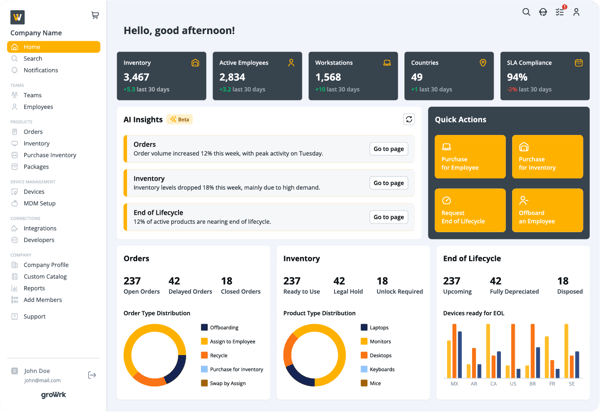
Overview: GroWrk is the most comprehensive alternative to Quipteams for IT teams that need more than logistics. Where Quipteams focuses on procurement and shipping, GroWrk delivers a full IT asset management platform, covering procurement, zero-touch provisioning, automated MDM enrollment (Windows, macOS, and Linux), retrieval, storage, and ITAD, all from a single, AI-powered dashboard.
Key strengths vs. Quipteams: 150+ countries, built-in MDM across Windows, macOS, and Linux, AI-powered ITAM, automated HRIS-triggered workflows, tiered subscription pricing with a pay-as-you-go option, and a unified platform that handles both logistics and endpoint management from one place.
Key features
- End-to-end device lifecycle management: procurement, zero-touch provisioning, tracking, retrieval, and disposal
- Centralized real-time asset dashboard with full fleet visibility across distributed teams globally
- AI-powered endpoint management with automated MDM enrolment across Windows, macOS, and Linux
- Native integrations with Okta, Jamf, Rippling, and BambooHR for automated onboarding and offboarding workflows
- Global device procurement through local vendor networks across 150+ countries
- Equipment retrieval, secure data wiping, local storage, and redeployment globally
- Compliance-ready ITAD with certified recycling, device buyback, and donation options
- Tiered subscription plans for SMBs, mid-market, and enterprise teams, plus a pay-as-you-go option
Best for
- IT teams that need logistics and MDM from a single platform, without managing separate tools
- Distributed companies with 100–500+ employees scaling across multiple countries simultaneously
- Organizations that need Linux fleet management alongside Windows and macOS
- Teams moving from a patchwork of tools toward a single consolidated IT management platform
Not ideal for
- Companies with very low or highly variable device volumes where pay-per-use economics work in Quipteams’ favour
- Organisations looking for bundled global payroll or EOR services alongside device management
Pricing
Offers tiered subscription plans for SMB, mid-market, and enterprise teams, along with a flexible pay-as-you-go option. Pricing is customized based on company size, geography, and service requirements, with quotes provided through the sales team. See pricing →
2. Workwize: Best for automated zero-touch workflows
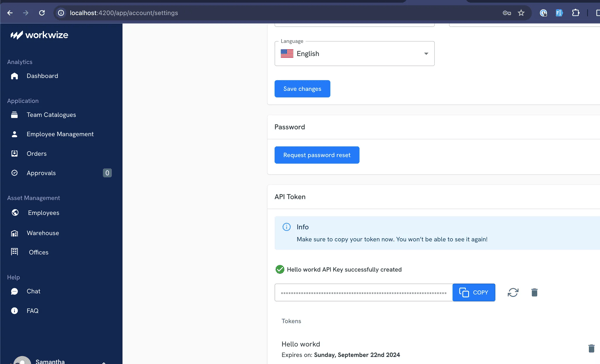
Overview: Workwize delivers zero-touch IT asset management across 100+ countries, with a strong emphasis on automating repetitive IT workflows. Where Quipteams is operationally transactional (order-based), Workwize leans into automation, triggering procurement, provisioning, and retrieval workflows automatically based on HR system events like new hires and offboarding.
Key strengths vs. Quipteams: HRIS-triggered automation across the full lifecycle, owned warehouse infrastructure, and a cleaner zero-touch experience for IT managers running high-volume onboarding. Customers report up to 70% reduction in manual IT work after adoption.
Key features
- End-to-end lifecycle management from procurement to retrieval and certified disposal
- Automation Suite OS for HRIS-triggered onboarding, retrieval, and device redistribution workflows
- Owned local warehouse and fulfillment facilities in 12+ countries for storage and redeployment
- Native MDM integrations with Apple Business Manager, Windows Autopilot, and Jamf
- HRIS integrations with HiBob, BambooHR, and others to trigger lifecycle events automatically
- Centralized asset tracking with real-time visibility across global teams
- Secure equipment retrieval, certified data wiping, and ITAD
- Per-employee-per-month (PEPM) pricing, custom-quoted based on volume and geography
Best for
- Mid-size and enterprise companies running high onboarding volumes that want to eliminate manual IT coordination
- Teams with stable, predictable headcounts where PEPM pricing is cost-effective
- Organisations where speed and consistency of provisioning are the primary IT metrics
Not ideal for
- Companies with variable or seasonal headcount where pay-per-use pricing works better than PEPM
- Teams that need Linux device support as part of the same managed workflow
- Organizations with significant operations in the Middle East or less-covered APAC markets
Pricing
Uses a per-employee-per-month (PEPM) pricing model tailored to factors such as headcount, geographic coverage, and support level. Pricing is quote-based and designed primarily for mid-market and enterprise organizations.
3. Firstbase: Best for predictable all-inclusive pricing
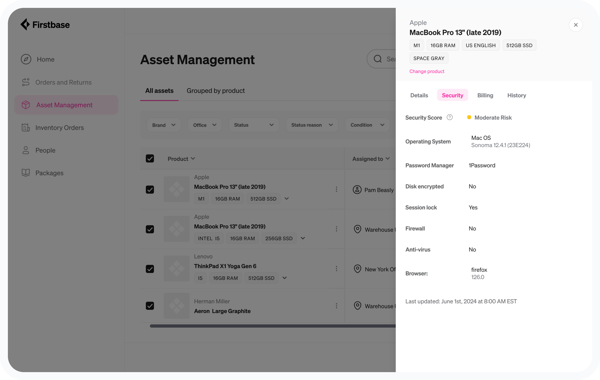
Overview: Firstbase bundles hardware, freight, duties, storage, and ITAD into a single per-seat annual fee. For finance teams that want one invoice and no per-action surprises, this is the clearest contrast to Quipteams' transaction-based model. Firstbase operates in 150+ countries and is Gartner MDLS recognised. See also: top Firstbase competitors.
Key strengths vs. Quipteams: Fully predictable billing, strong account management, and consolidated logistics that removes variable cost from IT budget forecasting — at the cost of flexibility.
Key features
- All-inclusive per-seat pricing bundling hardware, freight, duties, storage, and ITAD into one invoice
- Device procurement and deployment for distributed teams across 150+ countries
- Centralised asset dashboard for lifecycle and inventory tracking
- Equipment retrieval, redeployment, and disposal workflows
- Integration with select HR systems to support onboarding and offboarding automation
- Gartner-recognized MDLS classification, relevant for procurement and compliance benchmarking
Best for
- Mid-market companies (roughly 200–800 employees) in core markets that need billing predictability above all else
- Finance teams and IT leaders who need a single, forecastable annual number for device management costs
- Organizations with stable device volumes and a preference for managed, relationship-driven service
Not ideal for
- Teams with variable or seasonal headcount where all-inclusive per-seat pricing scales inefficiently
- Organizations needing Linux device support, Firstbase doesn’t cover it
- Teams that need deep API or webhook customization for non-standard HRIS tools
Pricing
Follows an all-inclusive per-seat annual pricing structure with customized enterprise contracts. Pricing varies depending on deployment size, services, and hardware requirements, with device procurement billed separately.
4. ZenAdmin: Best for hardware + SaaS in one platform
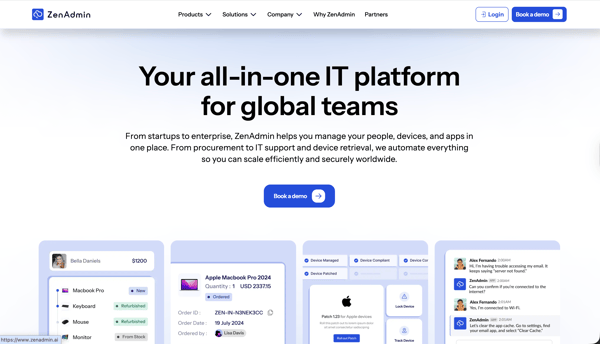
Overview: ZenAdmin combines IT equipment lifecycle management with SaaS application management, giving IT teams visibility across both physical and digital assets from a single dashboard across 150+ countries.
Key strengths vs. Quipteams: Hardware, SaaS, identity, and helpdesk management under one roof, a fundamentally broader scope that suits teams whose IT complexity has outgrown a pure logistics solution.
Key features
- End-to-end device lifecycle management: procurement, tracking, repair, retrieval, and reallocation
- SaaS license discovery and management, including shadow IT identification and spend optimization
- Built-in identity and access management with automated user provisioning and deprovisioning
- MDM integration for device security policy enforcement and compliance monitoring
- 24/7 global IT helpdesk included in the platform, not an add-on
- Automated onboarding and offboarding workflows triggered directly by HR system events
- 100+ application integrations including Google Workspace, Microsoft 365, Slack, Jira, and HubSpot
- Device procurement and delivery across 150+ countries with 5–7 business day target timelines
Best for
- IT teams that want device management and SaaS governance handled by the same platform and the same automations
- Startups, SMBs, and scaling tech companies trying to consolidate multiple vendor relationships into one
- Organizations without a dedicated IT department that need helpdesk coverage alongside asset management
Not ideal for
- Large enterprises with deeply entrenched ITSM workflows built around ServiceNow or similar platforms
- Teams that only need physical logistics and have no appetite for SaaS or identity management features
- Companies that have already invested heavily in best-of-breed IAM or MDM tools they want to retain independently
Pricing
Provides custom per-employee pricing based on selected modules and organizational scale. Costs vary depending on services such as device lifecycle management, SaaS management, identity management, and helpdesk support.
5. Allwhere: Best for US enterprise logistics
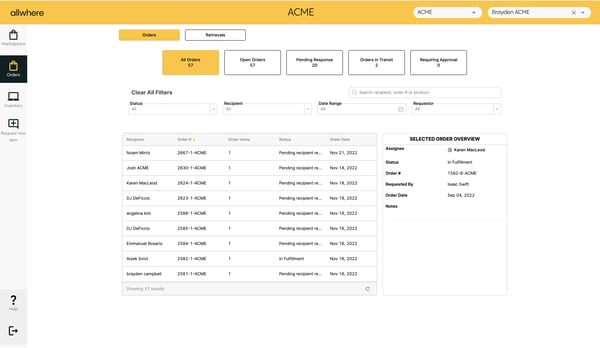
Overview: Allwhere provides unified device lifecycle management with a particular strength in North America, connecting natively with Workday, BambooHR, and other enterprise HR systems.
Key strengths vs. Quipteams: Deeper native HRIS integrations with Workday and BambooHR, stronger US-first operational focus, and a more managed service experience, at the cost of the geographic flexibility that Quipteams’ local vendor network provides.
Key features
- Device procurement and deployment across 60+ countries
- Unified dashboard for employee device tracking and lifecycle management
- Deep native integrations with Workday, BambooHR, and other major HRIS platforms
- Equipment retrieval, redeployment, and recycling workflows
- Strong focus on employee experience during device delivery and collection
- Dedicated account management for enterprise-scale operations and escalations
Best for
- Large US-headquartered enterprises with the bulk of their workforce in North America and Western Europe
- Teams where automated HR system integration for lifecycle events is a top priority
- Organizations with stable, predictable device volumes and established IT procurement processes
Not ideal for
- Companies with significant headcount in Latin America, APAC, or Sub-Saharan Africa, the regions where Quipteams is strongest
- Teams seeking usage-based pricing or full cost transparency at the per-action level
- Organizations that have experienced or are concerned about mid-contract rate changes
Pricing
Uses a transaction-based pricing model with no subscription or platform fees. Customers pay for individual logistics actions such as deployments, retrievals, and storage services, while dashboard access is included.
6. Unduit: Best for ServiceNow-embedded enterprises
Overview: Unduit is a modular IT asset lifecycle management platform covering 100+ countries with 60+ integrations, including a particularly deep ServiceNow integration. For enterprises already running IT operations through ServiceNow, Unduit offers workflow integration depth that Quipteams does not match. See our full Unduit alternatives guide.
Key strengths vs. Quipteams: Enterprise-grade modularity, blockchain chain-of-custody, 60+ integrations, and unmatched depth for organizations already running IT operations through ServiceNow.
Key features
- End-to-end device lifecycle management: procurement, deployment, recovery, repair, resale, and disposal across 100+ countries
- ITAM and Managed Device Lifecycle Services (MDLS) on a single cloud platform
- Blockchain-based chain-of-custody tracking for compliance and audit transparency
- Deep native ServiceNow integration, workflow extension, not just a connector
- 60+ integrations across HRIS, MDM, and ITSM tools
- Modular architecture enabling custom workflow configuration to match specific IT processes
- Pay-per-use pricing model with custom enterprise agreement options
- Gartner-recognized MDLS classification
Best for
- Large enterprises (500+ devices) with IT operations built around ServiceNow workflows
- Organizations in regulated industries where chain-of-custody tracking and audit readiness are non-negotiable
- IT teams with dedicated implementation resources who can absorb the platform’s depth
Not ideal for
- Teams under 200 people or those scaling fast without dedicated IT operations resource
- Companies without a ServiceNow footprint, the platform’s depth advantage diminishes significantly outside that ecosystem
- Organizations that need predictable, fixed-cost pricing for annual budget planning
Pricing
Operates on a pay-per-use pricing model tied to specific device lifecycle actions, including repairs, recoveries, and resale processing. Enterprise agreements are available for organizations with larger operational requirements.
7. Deel IT (Hofy): Best for teams using Deel for global payroll
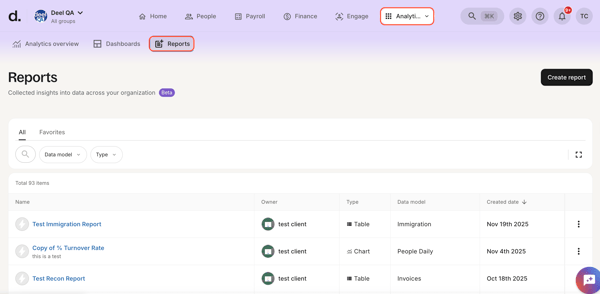
Overview: Deel IT (formerly Hofy) is the hardware management arm of Deel, the global employment and payroll platform. For companies already using Deel for EOR (Employer of Record) contracts, Deel IT provides a native way to manage device procurement and retrieval within the same platform as payroll and HR.
Key strengths vs. Quipteams: Full MDM and device lifecycle management built into the same platform as global payroll and EOR, a single vendor for global employment and IT management that Quipteams, as a pure logistics platform, can’t replicate.
Key features
- Device procurement, deployment, retrieval, and ITAD across 100+ countries
- Built-in MDM powered by JumpCloud supporting Windows, macOS, Linux, iOS, and Android
- Zero-touch enrollment via Apple Business Manager and Windows Autopilot
- Real-time fleet visibility with color-coded compliance status at device and fleet level
- Automated patch management, remote wipe, device lock, and location tracking
- Device Lifecycle Management (DLM) covering pre-configuration, repair, replacement, and secure returns
- Loaner laptop program during hardware repair to maintain employee productivity
- Per-seat pricing co-termed with existing Deel IT platform contract; DLM available as an add-on
- Native integration with Deel’s HR, EOR, and payroll platform for end-to-end employee lifecycle management
Best for
- Companies already using Deel for global employment, EOR contracts, or payroll who want to consolidate IT management in the same platform
- Organizations that want MDM and device lifecycle management handled within the same system as HR and compliance
- Teams managing globally distributed workforces that need a single vendor for employment and IT operations
Not ideal for
- Organizations not using Deel for HR or payroll, the platform’s strongest value comes from the ecosystem integration, not the logistics layer alone
- Teams that need Quipteams-style pay-as-you-go economics with no platform commitment
- Companies where the cumulative cost of Deel’s modular pricing (platform + MDM + DLM + EOR) exceeds the budget for standalone ITAM tooling
Pricing
Provides a two-tier pricing structure with a free entry-level option for existing Deel customers and a paid per-seat plan for advanced device lifecycle management capabilities. Additional services and modules are priced separately based on organizational needs and contract scope.
Quipteams vs. the alternatives: Side-by-side comparison
| Platform | Countries | Pricing model | MDM included | Linux | Best for |
|---|---|---|---|---|---|
| GroWrk | 150+ | Tiered subscription + pay-as-you-go | ✅ | ✅ | Full ITAM + MDM for global teams |
| Quipteams | 133 | Pay-per-use (no platform fee) | ❌ | — | Pay-as-you-go global logistics |
| Workwize | 100+ | Custom quote | ❌ | ❌ | Automated zero-touch workflows |
| Firstbase | 150+ | Per-seat all-inclusive | ❌ | ❌ | Predictable all-inclusive billing |
| ZenAdmin | 150+ | Custom quote | ❌ | ❌ | Device + SaaS management |
| Allwhere | 60+ | Custom quote | ❌ | ❌ | US-enterprise device logistics |
| Unduit | 100+ | Pay-per-use / Custom | ❌ | — | ServiceNow-embedded enterprises |
| Deel IT | 150+ | Per module | ❌ | ❌ | Deel payroll + IT bundled |
Frequently asked questions
What is Quipteams?
Quipteams is a global IT device lifecycle platform that procures, deploys, retrieves, stores, and buys back hardware for distributed teams across 133 countries. Its key differentiator is a pay-per-use pricing model with no platform fees or minimum orders. The platform works through a network of 400+ local vendors for faster, locally-priced deliveries.
Is Quipteams free?
Quipteams charges no platform fee, subscription fee, or minimum order. Customers pay only when they place an order. However, per-action costs (procurement, retrieval, storage, etc.) are not free, they are charged transparently at local market rates. This model is cost-effective for low-volume or irregular orders but can become expensive at scale compared to subscription alternatives like GroWrk.
What is the best Quipteams alternative for a team needing MDM?
If you need both IT logistics and device management in one platform, GroWrk is the strongest alternative to Quipteams. GroWrk includes automated MDM enrolment across Windows, macOS, and Linux, alongside procurement, deployment, retrieval, and ITAD, all from a single ITAM platform operating in 150+ countries.
How does Quipteams compare to GroWrk?
Quipteams is optimized for pay-per-use logistics, ideal for companies with variable hiring. GroWrk is a broader platform that includes endpoint management, AI-powered asset intelligence, and subscription-based pricing suited to teams with consistent device volumes. GroWrk also covers more countries (150+ vs. 133) and supports Linux, which Quipteams does not.
Which Quipteams Alternative Is Right for You?
The best Quipteams alternative depends on what you're trying to solve:
- Full IT asset management + MDM across 150+ countries: GroWrk
- Automated HR-triggered onboarding and offboarding workflows: Workwize
- Predictable, all-inclusive per-seat pricing: Firstbase
- Hardware + SaaS management in one platform: ZenAdmin
- US-enterprise HR integrations: Allwhere
- ServiceNow-embedded enterprise workflows: Unduit
- Teams already on Deel for global payroll: Deel IT