


The first-day problem: what broken onboarding actually costs
 Carlos N. Escutia
· Estimated reading time: 3–5 minutes
I’ve been asking IT and People leaders a simple question lately: what percentage of your new hires start with working equipment on day one? Almost nobody has the number. That gap — between something everyone agrees matters and something nobody measures — is usually where the expensive problems live.
Broken remote employee onboarding costs productivity, momentum, and belief — and it fails structurally, not through carelessness. The path from signed offer to working machine runs through six handoffs and four teams against one date that doesn’t move: recruiting closes the candidate, HR triggers onboarding, IT gets a request with days of notice, procurement sources in-country, logistics delivers to an address entered months earlier, and the machine has to arrive already enrolled. Miss any handoff and the person with the least standing to complain absorbs it. Measure your day-one readiness rate, then trigger global device deployment from the signed offer rather than the start date.
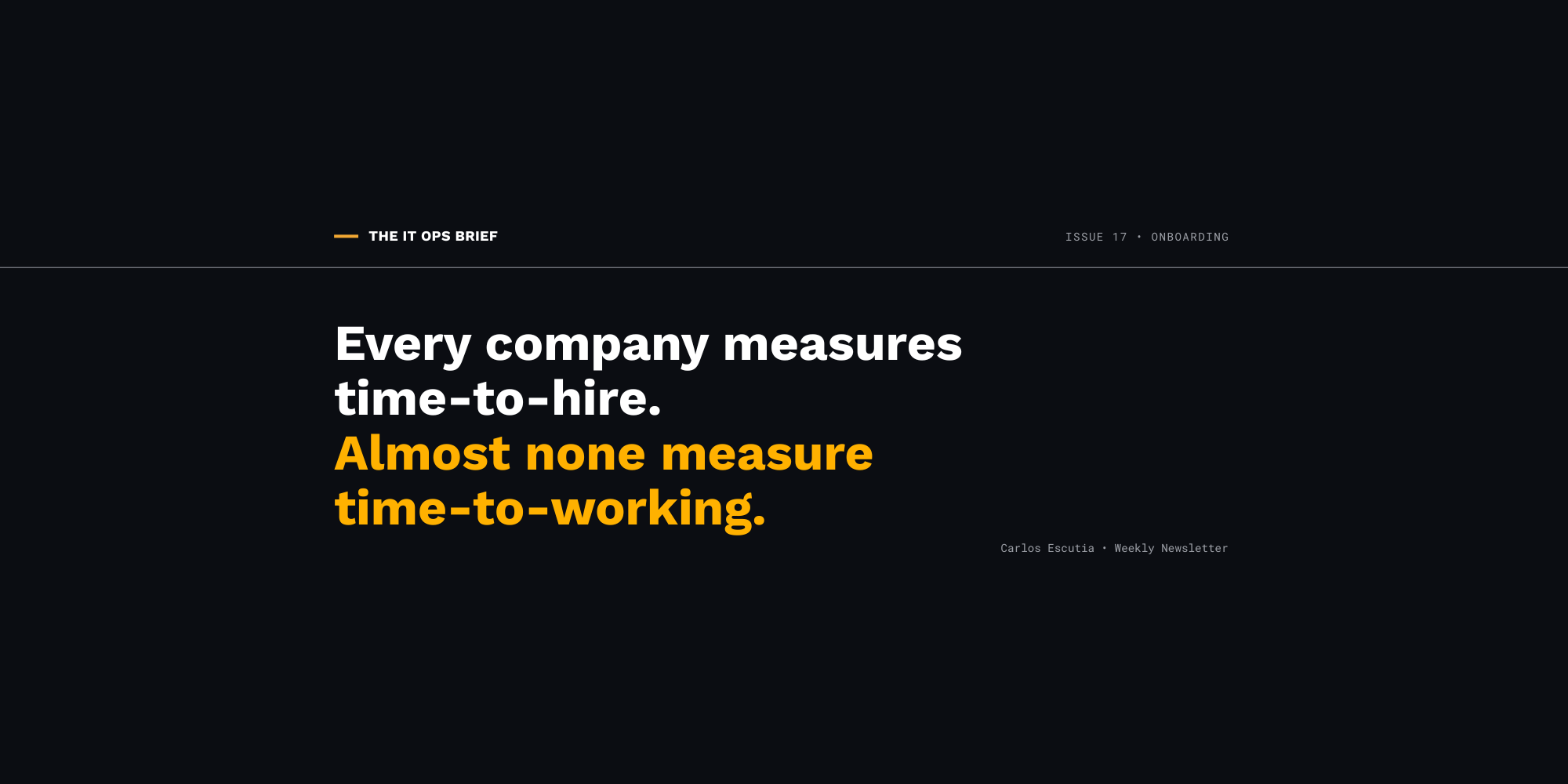
The signal: everyone tracks time-to-hire, nobody tracks time-to-working
Companies obsess over time-to-hire. It’s on dashboards, in board decks, tied to recruiter comp. Meanwhile the metric that describes what happens after someone accepts — how quickly they can actually do the job they were hired for — is almost never tracked.
For distributed teams this gap has widened quietly. Hiring in eight countries is now normal. Equipping people in eight countries is not, and the two decisions get made by different people, months apart, with no shared metric between them.
The problem: six handoffs, four teams, one date that doesn’t move
Day-one readiness fails structurally, not through carelessness. Look at the path from signed offer to working machine.
Recruiting closes the candidate and hands off a start date. HR triggers onboarding. IT gets a request — sometimes with a week’s notice, sometimes with three days’. Laptop procurement for remote teams means sourcing a device in a country with its own vendors, lead times, and stock reality. Logistics delivers to a home address that may have been entered once, months earlier. And the machine has to arrive configured, which means enrollment had to happen before it shipped, which means the purchase had to run through the right channel.
Six handoffs. Four teams. One date that doesn’t move.
Miss any handoff and the new hire waits. And notice who absorbs the failure: the person with the least standing to complain. A brand-new employee will not escalate. They’ll apologize for asking. Then they’ll draw a conclusion.
The costs stack in three layers:
Productivity
The obvious one, and the smallest. A few days of a salaried person unable to work, multiplied by every hire.
Momentum
The 30-day plan slips. The manager’s first impression of the hire is shaped by a delay the hire didn’t cause. Early relationships get built around workarounds.
Belief
The expensive one. A first week is the highest-signal experience an employee will ever have of how a company operates. Nobody quits over a laptop — but “it took nine days to get me a working machine” becomes a permanent part of how they describe working for you, and it’s the first thing they tell a friend considering the same offer.
Here’s the trap for scaling companies specifically: this works fine until it doesn’t. One country, one office, ten hires a year — a person can hold it together with a spreadsheet and effort. At five countries and fifty hires, the same approach produces failures that look random but aren’t. They’re structural, and they arrive right when hiring velocity matters most.
The operator takeaway: measure it, then fix three things
Start by measuring it. Day-one readiness rate: the percentage of new hires who begin with working, correctly configured equipment on their actual start date. Not “within the first week.” The day. Most teams have never calculated it and are surprised by their own number. That surprise is the finding.
Then fix the three things that produce most failures:
- Trigger from the offer, not the start date. Device procurement should begin when the offer is signed, not when onboarding paperwork completes. You’re buying back the lead time that kills you in slow markets.
- Verify the address while someone’s paying attention. A stale or wrong delivery address is one of the most common and most preventable causes of a missed day one. Confirm it at signing, not in transit.
- Ship configured, not just shipped. A laptop that arrives unenrolled means day one is a setup call. MDM enrollment has to be arranged at purchase, through a channel that supports it in that country.
And name an owner. The single best predictor of whether day-one readiness works is whether one person or system owns the whole path from offer to working machine — rather than four teams each owning a segment and nobody owning the outcome.
One GroWrk lens
Vividly’s IT lead described their old state in one sentence: “Laptops were showing up a week after a person started, and it wasn’t the correct laptop.” Late and wrong — the two ordinary failures, in a company running a remote team across six countries with one person managing IT.
After consolidating onto a single lifecycle system: new hires equipped on day one across all six countries, and 35–45% of his operations time returned.
The mechanism is unglamorous. The offer triggers the order, the device is sourced in-country and configured before it ships, and one system owns the path rather than four teams owning pieces of it. Day one stops being something people coordinate toward and starts being a default.
One stat
Day-one readiness rate. The percentage of your new hires who start with working, configured equipment on their actual first day.
Almost no company measures it. Every new employee does.
If you’re hiring across countries and don’t know that number, that’s the first thing worth finding out — before the next fifty hires teach it to you one disappointment at a time.
If you want to see what it looks like when day one is an operational default, we would like to show you.