




Finding a work-from-home job in 2026 isn’t rare anymore; it’s routine. According to the Bureau of Labor Statistics' Current Population Survey, approximately 34.3 million employed people teleworked or worked at home for pay as of April 2025. What hasn’t become standard, however, is how companies handle equipment.
Some employers ship a fully configured laptop, monitor, and peripherals before day one. Others offer a stipend and leave the setup to you. And many provide little clarity. We’ve seen firsthand that the level of preparedness (especially during onboarding) can shape a new hire’s confidence, productivity, and overall success from the very beginning.
Behind the scenes, much of this inconsistency stems from logistics. What sounds simple in theory, “just ship a laptop,” becomes far more complicated once a company hires across multiple countries. Procurement turns into customs paperwork, tax exposure, warranty limitations, and international shipping coordination. Some organizations have invested in systems to manage that complexity. Others are still piecing together processes as they grow, which is why equipment policies can feel inconsistent, vague, or location-dependent.
Remote work may be widespread. Remote infrastructure maturity still varies widely.
This guide covers:
- Remote-friendly job types that typically include equipment packages
- A curated company list of organizations known for strong equipment or stipend programs
- Key questions to ask during the hiring process so you're not surprised after accepting an offer
- A verification checklist used by IT and People Ops teams to evaluate programs
How we built this list
We focused on companies that publicly document their remote equipment programs, either on careers pages, in benefits documentation, or within employee handbooks. We also cross-referenced information from job postings and reputable review platforms to identify patterns. Where programs vary significantly by country or role, we've flagged those distinctions. (That said, always confirm details with your recruiter, as policies evolve.)
Quick answer: What kinds of remote jobs provide equipment most often?
Remote roles in regulated industries, customer-facing teams, and data-sensitive positions are far more likely to provide equipment. The most common categories include:
- Customer support and call center: recorded calls, compliance
- Sales development and inside sales: call quality, customer data
- Software engineering and QA: proprietary systems
- Product and UX design: company tools and security
- IT, helpdesk, and security: sensitive infrastructure
- Finance operations: regulated data handling
- Recruiting and HR operations: employee data access
These roles either require consistent hardware and security controls or depend on reliable performance for client interactions that employers don't want to risk on personal devices.
Equipment policies vary significantly by company, country, and employment classification. Always confirm specific provisions in your offer letter before accepting.
What "provides equipment" actually means (5 common models)
When a job listing says "equipment provided," it doesn't always mean the same thing. Most companies fall into one of these five models:
- Company-owned laptop (shipped to you): You receive a company-managed device configured by IT with security software, mobile device management, and encryption — typically set up as part of a broader IT onboarding checklist. Most common in tech, finance, healthcare, and regulated industries.
- Laptop plus peripherals bundle: In addition to a laptop, the company provides a monitor, keyboard, mouse, headset, and docking station. Common in customer support and sales roles where performance and call quality directly impact client experience.
- One-time home office stipend: Instead of shipping hardware, the company provides a fixed amount, typically $300 to $1,500, for you to purchase approved equipment. You gain flexibility in what you buy, but the stipend may not fully cover a complete setup — a gap that shows up directly in the cost of onboarding a new employee.
- Monthly remote work allowance: A recurring payment, usually $50 to $150 per month, to offset internet, coworking space, or home office expenses. This may supplement rather than replace hardware support.
- BYOD (Bring Your Own Device) plus reimbursement: You use your personal laptop and may receive partial reimbursement. This is more common for contractors and early-stage companies, and it's the least standardized for security and IT support — which is why best MDM platforms for BYOD policies exist in the first place. According to Verizon's 2024 Data Breach Investigations Report, lost and stolen personal devices are behind a growing number of confirmed data breaches — more than 90% of security incidents involving lost or stolen devices resulted in an unauthorized data breach.
Always ask for details in writing, especially if the job posting simply says "equipment provided" without specifics.
The hidden catch: Equipment policies vary by country and worker type
Even within the same company, remote equipment policies vary by country, worker classification, seniority level, and data access requirements.
A full-time employee in the U.S. might have a company laptop delivered to their doorstep before day one. Meanwhile, a contractor in another country could be offered a stipend or told to use their personal device. That gap in expectations is one of the recurring global hiring challenges companies face once they hire across borders, and it's often where frustration starts. On paper, both roles are “remote.” In practice, the experience can look very different, and that’s where candidates can feel caught off guard after signing.
→ See GroWrk's IT equipment country guide for how this plays out region by region.
A job description might say "equipment provided," but the actual policy varies by location and employment classification.
Always confirm in writing before accepting:
What equipment is provided? Is it company-owned or stipend-based? When will it ship or be available? Do policies differ for your country or worker type?
Treat job descriptions as marketing. The offer letter and written confirmation are what count.
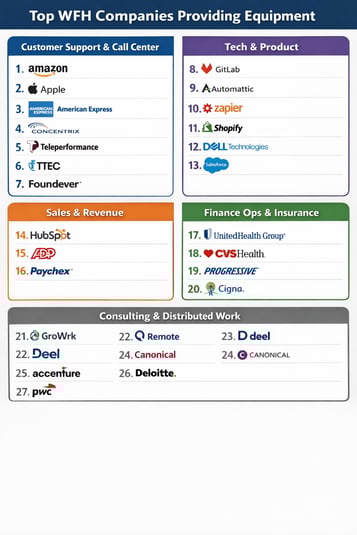
26 Companies With Work-from-Home Jobs That Provide Equipment (or Stipends)
Note: “Provides equipment” may mean a company-issued device and/or stipend. Policies vary by role and country. Always confirm with the recruiter.
Customer Support & Call Center
(Historically, the most consistent category for shipped equipment due to QA recording and system requirements.)
1) Amazon
Typical roles: Virtual Customer Service Associate, Technical Support Associate
Typical equipment provided (varies by program and location):
- Company-issued laptop
- Headset (for customer-facing roles)
- Ethernet adapter or connectivity accessories
- Sometimes an external monitor
Many virtual customer service programs ship standardized equipment before day one. Some roles instead specify minimum system requirements, so confirm in writing.
2) Apple
Typical roles: Apple Support Advisor, AppleCare At-Home Advisor
Typical equipment provided (varies by country and role):
- Company-issued Apple computer (iMac or MacBook)
- Headset for support roles
- Pre-configured, IT-managed system built on Apple Business Manager features like DEP and app distribution
Certain programs have included home office stipends. Equipment packages differ by region.
Typical roles: Customer Care Professional, Travel Consultant
Typical equipment provided (primarily U.S.-based remote roles):
- Company-issued laptop or desktop system
- Headset for customer service roles
- Secure access tools and authentication devices
Because of financial compliance requirements, managed devices are common for remote employees.
4) Concentrix (Webhelp)
Typical roles: Remote Customer Support Representative, Technical Support
Typical equipment provided (varies by client contract):
- Company-issued laptop or desktop
- Headset
- Sometimes monitor or peripherals
As a BPO provider, equipment policies depend on the specific client program and geography.
Typical roles: Remote Customer Service Representative, Tech Support
Typical equipment provided (client-dependent):
- Company-provided laptop or desktop
- Headset
- Required security software pre-installed
Some roles require candidates to meet system specs rather than receive shipped hardware.
6) TTEC
Typical roles: Customer Experience Representative, Healthcare Support Associate
Typical equipment provided (program-dependent):
- Company-issued computer
- Headset
- Secure remote access tools
Certain healthcare and enterprise programs ship full equipment kits prior to onboarding.
7) Foundever (formerly Sitel)
Typical roles: Remote Customer Support, Call Center Agent
Typical equipment provided (varies by account and region):
- Company-issued device
- Headset
- Occasionally monitor or peripherals
Some roles provide equipment; others require specific home system standards.
Tech & Product
(Security, code access, and internal systems make company-issued laptops common in this category.)
8) GitLab
Typical roles: Software Engineer, DevOps Engineer, Product Manager
Typical equipment provided (remote-first company):
- Laptop provided or reimbursed
- Home office equipment allowance
- Standardized security configuration
As a fully distributed company, GitLab supports remote setup, though structure varies by location.
9) Automattic
Typical roles: Software Engineer, Happiness Engineer (Support), Designer
Typical equipment provided:
- Laptop of choice (within budget guidelines)
- Home office stipend
- Tools and software required for role
Automattic supports globally distributed employees with hardware budgets rather than one-size-fits-all kits.
10) Zapier
Typical roles: Engineer, Customer Champion, Product Designer
Typical equipment provided:
- Company-issued laptop
- Home office stipend
- Remote work allowance (in some regions)
Zapier operates as a remote-first company and supports distributed infrastructure.
11) Shopify
Typical roles: Developer, Support Advisor, Product Designer
Typical equipment provided (varies by team and geography):
- Company-issued laptop
- Remote setup support
- Sometimes stipend for home office equipment
Hybrid and fully remote teams may have different equipment structures.
Typical roles: Technical Support, Sales Engineer, Systems Engineer
Typical equipment provided (remote technical roles):
- Company-managed laptop
- Security software and device management
- Role-specific peripherals
As a technology company, standardized hardware is common for remote employees.
13) Salesforce
Typical roles: Account Executive, Developer, Solutions Engineer
Typical equipment provided:
- Company-issued laptop
- Security and access management tools
- Sometimes stipend for home office setup
Due to data security controls, managed devices are typical for remote roles.
Sales & Revenue
(Sales teams typically require standardized laptops and headsets due to CRM systems, dialers, and recorded calls.)
14) HubSpot
Typical roles: Sales Development Representative (SDR), Account Executive, Customer Success Manager
Typical equipment provided:
- Company-issued laptop
- Home office stipend
- Remote onboarding support
Equipment policies vary by country and employment classification.
15) ADP
Typical roles: Inside Sales Representative, Client Support Specialist
Typical equipment provided (regulated payroll roles):
- Company-issued laptop
- Secure login and authentication tools
- Headset for client-facing positions
Compliance requirements typically require managed devices.
16) Paychex
Typical roles: Sales Representative, Payroll Specialist, Client Support
Typical equipment provided:
- Company-issued computer
- Secure system access tools
- Headset for service and payroll roles
Equipment support depends on employment type and region.
Finance Ops & Insurance
(Regulated industries typically require company-managed devices due to data privacy and compliance standards.)
Typical roles: Customer Service Representative, Claims Processor, Care Coordinator
Typical equipment provided (healthcare data roles):
- Company-issued laptop
- Encrypted device configuration
- Secure remote access systems
Because of HIPAA requirements, managed devices are standard for many remote roles.
18) CVS Health
Typical roles: Customer Care Representative, Claims Support, Pharmacy Support
Typical equipment provided:
- Company-provided computer system
- Security and authentication tools
- Headset for service roles
Policies vary across subsidiaries and locations.
19) Progressive
Typical roles: Claims Adjuster, Customer Service Representative
Typical equipment provided:
- Company-issued laptop
- Monitor (for some claims roles)
- Headset
- Security software
Insurance compliance typically requires managed hardware.
20) Cigna
Typical roles: Customer Service Advocate, Claims Representative
Typical equipment provided:
- Company-managed laptop
- Encrypted systems
- Secure authentication tools
Healthcare data access generally requires company-issued hardware.
Hiring, HR & Distributed Ops
(Distributed companies often support remote work through laptop programs or stipends, though policies vary globally.)
21) GroWrk
Typical roles: Operations, Logistics, Customer Success, Account Management, IT Asset Management, Partnerships
Typical equipment provided (as part of IT infrastructure support):
- Laptop management for remote teams, provisioned and IT-managed from day one
- Pre-configured systems with security and device management
- Standardized peripherals (headsets, monitors, docking accessories, as needed)
- Support from IT logistics partner for cross-border shipping and return coordination
GroWrk enables companies to provision, ship, manage, and retrieve remote equipment globally. Instead of relying on stipends or ad-hoc purchasing, employers can centralize procurement and logistics to deliver standardized, IT-managed hardware to distributed teams. Equipment packages vary by employer and country.
22) Remote
Typical roles: Account Executive, Customer Success Manager, Operations Specialist
Typical equipment provided (varies by employment structure):
- Laptop provided or reimbursed
- Home office stipend (in some regions)
- IT-managed configuration support
Policies differ depending on whether employees are hired directly or through EOR arrangements.
23) Deel
Typical roles: Account Executive, Customer Support Manager, Compliance Specialist
Typical equipment provided (varies by role and region):
- Laptop reimbursement or provision
- Remote work stipend
- Equipment support options
Distributed structure means policies vary by employment classification.
24) Canonical
Typical roles: Software Engineer, Support Engineer, Sales Representative
Typical equipment provided:
- Laptop support or reimbursement
- Remote setup assistance
- Role-specific tooling
As a distributed company, equipment models vary by geography.
Consulting & Knowledge Work
(Large consulting firms and professional services organizations typically use company-managed devices due to client data and security standards. Policies vary by practice and geography.)
25) Accenture
Typical roles: Technology Consultant, Analyst, Customer Operations Support
Typical equipment provided:
- Company-issued laptop
- Security and VPN tools
- Role-specific peripherals
Device provisioning is typically centralized through IT.
26) Deloitte
Typical roles: Consultant, Audit Associate, Tax Analyst
Typical equipment provided:
- Company-managed laptop
- Secure access systems
- Authentication devices
Equipment policies align with firm-wide security standards.
27) PwC
Typical roles: Advisory Associate, Tax Specialist, Risk Consultant
Typical equipment provided:
- Company-issued laptop
- Encrypted device configuration
- Secure authentication tools
Remote flexibility varies by practice and geography.
.jpg?width=600&height=338&name=cost%20of%20onboarding%20a%20new%20employee%20(4).jpg)
Equipment benefits comparison table
|
Equipment model |
Best for |
Watch-outs |
What to ask |
|
Company laptop shipped |
Security, compliance-heavy roles |
Shipping delays, customs issues |
“Is the laptop company-owned and IT-managed?” |
|
Laptop + peripherals bundle |
Customer support, sales, high call volume roles |
Monitor size, ergonomic quality |
“Are monitor and headset included?” |
|
One-time home office stipend |
Flexible remote setups |
May not cover full setup costs |
“What’s the stipend amount and what qualifies?” |
|
Monthly remote allowance |
Internet, coworking, recurring expenses |
Can be changed or removed |
“Is this contractual or policy-based?” |
|
BYOD + reimbursement |
Contractors, early-stage companies |
Limited IT support, security risks |
“Is BYOD mandatory? How is security handled?” |
What this means for remote job seekers
If your goal is stability, the safest bet is a company-owned, IT-managed laptop. Remote work isn't going anywhere. WFH Research finds that about 29% of all paid workdays across U.S. firms are now done from home — which means the question isn't whether to work remotely, but whether the company you're joining has actually built the infrastructure to support it.
In industries like tech, healthcare, finance, consulting, and enterprise sales, this is often the norm rather than a perk. These roles tend to require tighter security and standardized systems, so employers typically ship a configured device before you start.
Stipends sound flexible, and sometimes they are. But the reality varies. A $500 allowance might help offset costs, yet it rarely covers a full setup once you factor in a reliable laptop, monitor, ergonomic chair, headset, and docking station. What looks generous in a job listing can shrink quickly in practice.
Bring Your Own Device (BYOD) models shift even more responsibility onto you. That means relying on your own hardware, managing wear and tear, and in some cases, navigating security requirements on a personal machine. For some people, that tradeoff is fine. For others, it’s an unexpected expense and risk.
The key isn’t whether a role is “remote.” It’s how the company actually supports remote work once you’re hired.
What to ask the recruiter (so you don't get burned)
Even when a listing says "equipment provided," details vary by role, location, and employment type. Before you accept an offer, get clarity in writing.
Key questions to ask:
- “Will I receive a company-owned laptop? Is it IT-managed (MDM)?”
Clarifies security expectations and whether you’ll use a personal device. - “Are peripherals included (monitor, headset, keyboard), or is there a stipend?”
“Equipment” sometimes means laptop only. - “If there’s a stipend, how much is it and what qualifies?”
Ask whether it covers just hardware, or also internet, chair, desk, etc. - “When will the equipment ship relative to my start date?”
Delays can impact onboarding or force temporary BYOD use. - “Are there differences based on my country or worker classification?”
Policies often differ for contractors vs full-time employees. - “What happens if equipment is delayed, damaged, or needs replacement?”
This reveals how mature the company’s remote operations are. - “If I leave, who covers return shipping, and what’s the timeline?”
Especially important for cross-border roles.
Why this matters
Too many remote employees only learn the fine print about equipment after they’ve already signed the offer. That’s when “remote-friendly” turns into “please use your personal laptop for now.” Asking clear questions early isn’t being difficult; it’s being smart. It helps you avoid surprise expenses, smooths out your first week, and shows the employer you think ahead. Most importantly, it protects you from vague promises that sound good in a job post but don’t hold up in practice.
Email template: Confirm equipment in writing
If the recruiter answers verbally, follow up with a written confirmation. This protects you from miscommunication and ensures expectations are aligned before day one.
You can copy and paste this:
Subject: Quick confirmation on remote equipment support
Hi [Recruiter Name],
Before I finalize my decision, could you please confirm the remote equipment policy for this role in [Country/City]?
Specifically:
- Whether the company provides a company-owned, IT-managed laptop
- Whether peripherals are included (monitor, headset, keyboard) or if a stipend is offered
- The expected shipping timeline relative to my start date
- Whether there are any role- or location-specific exceptions
I appreciate the clarification, just want to ensure everything is aligned before I sign.
Thank you,
[Your Name]
How IT teams evaluate "remote-ready" companies
Not every company that calls itself “remote-friendly” is actually built to operate remotely at scale. Behind the scenes, IT and People Ops teams usually pressure-test three areas before approving distributed setups: security, support, and logistics.
Security readiness
At a minimum, remote roles that touch internal systems or customer data should include:
- Company-managed laptops enrolled in MDM
- Disk encryption and single sign-on with multi-factor authentication
- Endpoint protection software
- Controlled access to internal tools
In regulated industries, these controls are standard. When companies rely heavily on bring-your-own-device without strong safeguards, it can introduce security risks and limit how much real support IT can provide.
→ See the full MDM benefits for distributed teams
Support readiness
Even strong security policies fall apart without operational support. Mature remote teams typically have:
- Helpdesk coverage across time zones
- Clear replacement policies if equipment is lost or stolen
- Loaner devices during repairs
- Standardized hardware catalogs
Without these processes, small issues turn into onboarding delays, shipping confusion, or long stretches of working on personal devices.
Logistics readiness
This is where many companies struggle, especially internationally. Scaling remote work requires:
- Cross-border shipping capability
- Customs and import tax handling
- Local retrieval when employees leave
- Asset tracking and lifecycle management
If these systems aren’t in place, employees may face delayed start dates, reimbursement confusion, or complicated return shipping processes.
→ Companies that don't plan for this often run into the same bottlenecks, which is why it helps to know how to avoid delays in IT procurement.
Why this matters for job seekers
You don’t need to audit a company’s infrastructure, but you should listen for clarity. If a recruiter can confidently explain how devices are secured, supported, and shipped, that’s usually a strong sign the company has invested in real remote infrastructure.
If the answers feel vague, policies are inconsistent, or responsibilities are unclear, that’s often a signal that the operation is still improvised.
Asking structured equipment questions isn’t just about hardware. It’s one of the fastest ways to gauge how mature a company’s remote operations really are.
How Growrk helps companies provide remote equipment globally
Most equipment confusion isn't a hiring issue; it’s an infrastructure problem. Companies that scale remote teams successfully treat device provisioning as part of IT onboarding, not an afterthought.
Take Illumio, a global cybersecurity company hiring across Japan, Brazil, the EU, and the U.S. As the team expanded internationally, sourcing laptops from countries without local entities became slow and unpredictable. IT teams were juggling vendors, navigating customs delays, and troubleshooting last-minute onboarding gaps, none of which were core to their role.
By centralizing procurement, shipping, and asset management through Growrk, Illumio delivered pre-configured devices to employees across multiple countries without relying on ad hoc local workarounds. Instead of scrambling to get hardware in place, onboarding became consistent and repeatable.
Once procurement, logistics, compliance, and retrieval are systematized, equipment stops being a recurring fire drill and becomes a predictable part of the company's operations.
See how modern global IT onboarding is structured.
FAQ
Do remote jobs usually provide equipment?
Many do, but not all. Remote jobs in tech, healthcare, finance, consulting, and customer support are more likely to provide company-issued laptops to meet security and compliance requirements. However, policies vary by company, country, and worker type. Always confirm before accepting an offer.
What equipment do work-from-home jobs typically provide?
Most commonly:
- Company-owned laptop
- Headset (especially for support or sales roles)
- Sometimes monitor, keyboard, and mouse
Some companies offer a one-time stipend or a monthly allowance instead of shipping hardware. If that's the case, check our picks for the best laptops for remote work.
Do remote jobs pay for internet?
Some companies offer a monthly remote-work allowance that can cover internet costs. Others consider internet a personal expense. It’s not universal; ask directly during the hiring process.
What does “equipment provided” actually mean?
It can mean one of several things:
- A company-managed laptop shipped to you
- A laptop plus peripherals
- A one-time home office stipend
- A monthly remote allowance
- BYOD (bring your own device) with partial reimbursement
The phrase alone isn’t specific enough; ask for details in writing.
Are equipment policies different for contractors?
Often, yes. Contractors are more likely to receive stipends or use their own devices, while full-time employees are more commonly provided with company-owned hardware. Policies vary by organization and region.
How can I verify that a company actually provides equipment?
- Review the job description carefully
- Check the company’s careers or benefits page
- Ask the recruiter specific equipment questions
- Get confirmation in writing before signing