



Remote maintenance software allows IT teams and managed service providers to monitor, patch, and manage endpoint devices remotely from a centralized platform. Their importance has grown as organizations manage increasingly complex device fleets across offices, remote employees, and client environments.
In the United States alone, more than 40,000 managed service providers oversee nearly 70 million endpoints using RMM platforms, highlighting how widely these tools are used to maintain and secure modern IT infrastructure.
Without centralized monitoring and automation, routine tasks such as patching systems, detecting device failures, or responding to security alerts require constant manual work from IT staff. RMM software solves this problem by providing a single interface where teams can monitor device health, deploy updates, run scripts, and remotely access endpoints when issues occur.
This guide evaluates the ten leading RMM software and RMM software tools for U.S. buyers in 2026: IT managers running internal teams, managed service providers scaling client accounts, mid-market companies standardizing their IT stack, and CTOs making a platform decision that will stick for years. Each tool review is based on publicly documented capabilities, verified pricing data, and third-party review scores from G2 and Capterra.
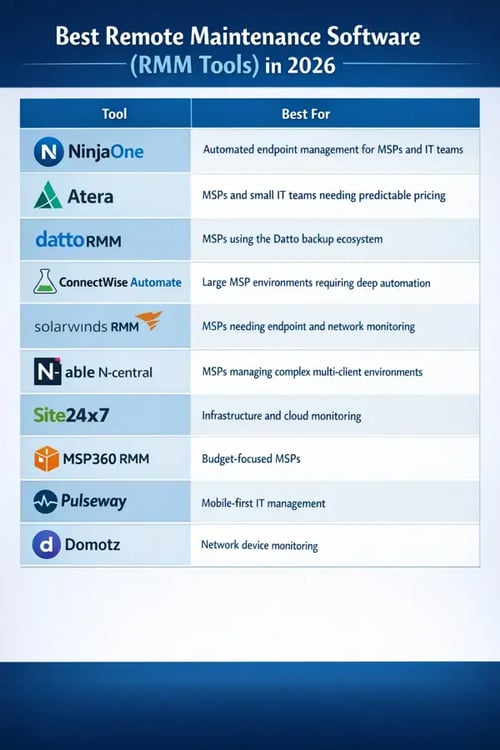
What is remote maintenance software?
Remote maintenance software allows IT teams and managed service providers to monitor, maintain, and control endpoint devices remotely from a centralized platform. In the IT industry, these platforms are commonly known as RMM tools (Remote Monitoring and Management tools).
Remote maintenance software works by installing a lightweight agent on each managed device, such as laptops, servers, or workstations. This agent continuously reports system health, performance metrics, and software status back to the management console, giving technicians visibility into the condition of every endpoint.
Instead of troubleshooting problems only after they disrupt operations, IT teams can detect issues early and automate routine maintenance across hundreds or thousands of devices.
Core features of remote maintenance software typically include:
- Real-time endpoint monitoring for CPU, memory, disk usage, uptime, and system services
- Automated patch management for operating systems and third-party applications
- Secure remote access for troubleshooting and device control
- Scripting and automation tools for running maintenance tasks at scale
- Alerting and notifications when system thresholds are exceeded
- Asset inventory and device tracking across managed devices
- Integrations with PSA, security, and backup platforms
How remote maintenance software works
Every RMM platform follows the same fundamental architecture for background management, even if the execution varies significantly between vendors. Understanding the flow helps you evaluate whether a platform's approach fits your environment and client networks.
The process works like this for remote monitoring:
- An agent application is silently deployed to each managed endpoint, Windows, macOS, Linux, or mobile devices, depending on the platform for mobile device management.
- The agent continuously sends telemetry data back to a cloud (or on-premises) dashboard: device health, event logs, installed software, patch status, and active services on client endpoints and client devices.
- When a metric crosses a configured threshold, disk space below 10%, a service failing, a patch going undeployed for more than seven days, an alert fires and routes to the responsible technician for proactive issue detection.
- Automation workflows can respond to those alerts without human intervention: restart a service, run a remediation script, quarantine a device if a threat is detected, and automate routine tasks.
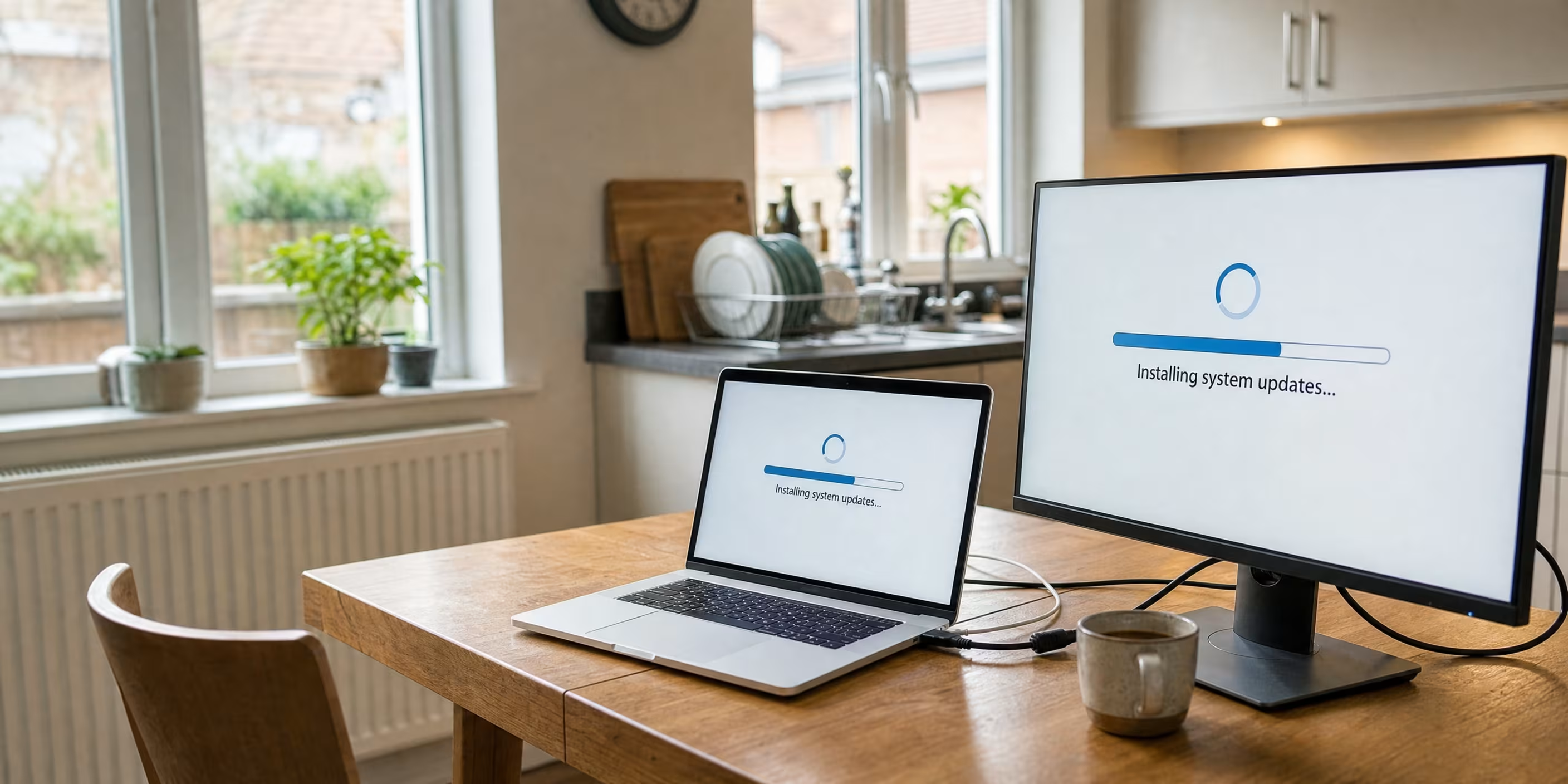
- Patch policies run on a defined schedule, staging updates for testing before pushing to production endpoints, maintaining compliance without manual effort for operational efficiency.
Modern cloud-based RMM solutions layer security features and integrations on top of this foundation. EDR, backup, and SIEM tools connect through native integrations or open APIs, creating a unified view of endpoint health, vulnerability posture, and incident response in a single centralized management dashboard rather than across five separate consoles for IT asset management and tools for IT professionals.
How we chose the best remote maintenance softwares
Not every RMM platform weighs its key features equally. When we evaluated tools like top RMM tools, we found that the capabilities that most directly affect operational efficiency and business operations are:
- Patch management depth: Does the platform handle patch management only for the OS, or does it manage third-party applications too for comprehensive protection? How granular is the approval workflow?
- Automation engine: Can you build conditional logic without writing scripts for automation capabilities? The quality of automation capabilities distinguishes entry-level tools from platforms that actually reduce technicians' workload to improve service delivery.
- Remote access quality: Unattended access, file transfer, and command-line access are table stakes, including web-based remote access. Latency and session reliability matter when you are troubleshooting a server under load with remote access tools. You might also what to look at remote device management options.
- Alerting configurability: Generic alerts generate noise. The best platforms let you set per-device or per-client thresholds and suppress known-good conditions.
- PSA integration with leading psa tools: If your team uses ConnectWise Manage, Autotask, or HaloPSA for ticketing as professional services automation, check whether the RMM software creates tickets automatically and bi-directionally syncs status.
- Security features integrations: Native hooks into EDR tools (SentinelOne, Bitdefender, Malwarebytes) and backup platforms reduce the number of consoles your team has to manage for secure systems and data protection.
Pricing models
The RMM software market uses two dominant pricing models, and the one that suits you depends entirely on how your team is structured relative to your endpoint count for transparent pricing.
Per-device pricing is the most common model in pricing. You pay a set rate per monitored endpoint, typically between $1.50 and $8 per device per month, depending on the vendor and volume. Costs scale directly with your device count, which works well for managed service providers that bill clients per device. NinjaOne, Datto, N-able, SolarWinds, and Domotz all use this model.
Per-technician pricing flips the equation. You pay a fixed monthly rate per staff member regardless of how many devices they manage. Atera and MSP360 use this model. For an MSP with three technicians managing 800 endpoints, per-technician pricing is dramatically cheaper for service delivery. For a team of ten technicians managing 200 devices, it is not.
Watch for add-ons that inflate the base price. Some platforms advertise a low per-device rate but charge separately for network device monitoring, backup integration, advanced reporting, or additional remote access sessions. Always request a fully loaded quote.
Best fit by organization type
- Small IT teams (1–5 technicians): Atera or MSP360 for IT teams. Transparent per-technician pricing, fast deployment, built-in professional services automation functionality.
- Growing MSPs (50–500 endpoints per client): NinjaOne as one of the best RMM tools. Scales well, strong automation capabilities, widely supported by PSA integrations to manage devices.
- MSPs with existing Datto stack: Datto RMM. The backup ecosystem integration is genuinely differentiated; switching costs to rebuild that integration elsewhere are high for Datto RMM.
- Large MSPs or enterprise IT: ConnectWise Automate or N-able N-central for top RMM solutions. Deep scripting, NOC services support, and complex multi-tenant environments.
- Cloud-heavy or DevOps-adjacent teams: Site24x7 for network management and cloud based RMM solutions. Infrastructure monitoring depth for hybrid and multi-cloud environments exceeds what traditional RMM tools offer.
- Network-first monitoring: Domotz. Network management device visibility and SNMP monitoring are its core features, not just endpoint agent management for remote devices.
- Distributed or remote-first teams: GroWrk. While RMM platforms monitor endpoint software and health, GroWrk manages the physical lifecycle of those devices: procurement, deployment, tracking, and retrieval across global teams.
Top 10 remote maintenance software tools in 2026
The tools below represent the strongest options across different buyer profiles as top RMM software. We have not ranked them in a single descending order of quality. The right pick depends on your team size, pricing models preference, and existing toolstack. Each entry is evaluated on its own terms for endpoint management.
|
Tool |
Best For |
Pricing Model |
Patch Mgmt |
Automation |
Free Trial |
G2 Rating |
|---|---|---|---|---|---|---|
|
NinjaOne |
Automated endpoint management for MSPs and IT teams |
Per Device (Custom Quote) |
Yes |
Advanced |
Yes |
4.8 / 5 |
|
Atera |
MSPs and small IT teams needing predictable pricing |
Per Technician |
Yes |
Good |
Yes |
4.6 / 5 |
|
Datto RMM |
MSPs using the Datto backup ecosystem |
Per Device (Custom Quote) |
Yes |
Good |
No |
4.3 / 5 |
|
ConnectWise Automate |
Large MSP environments requiring deep automation |
Per Device (Custom Quote) |
Yes |
Advanced |
No |
4.1 / 5 |
|
SolarWinds RMM |
MSPs needing endpoint and network monitoring |
Per Device (Custom Quote) |
Yes |
Good |
Yes |
4.2 / 5 |
|
N-able N-central |
MSPs managing complex multi-client environments |
Per Device (Custom Quote) |
Yes |
Advanced |
Yes |
4.3 / 5 |
|
Site24x7 |
Infrastructure and cloud monitoring |
Tiered Subscription |
Limited |
Good |
Yes |
4.4 / 5 |
|
MSP360 RMM |
Budget-focused MSPs |
Per Technician |
Yes |
Basic |
Yes |
4.0 / 5 |
|
Pulseway |
Mobile-first IT management |
Per Device |
Yes |
Good |
Yes |
4.5 / 5 |
|
Domotz |
Network device monitoring |
Per Network |
No |
Basic |
Yes |
4.6 / 5 |
1. NinjaOne: Best for Automated Endpoint Management at Scale
NinjaOne is widely used by MSPs and mid-size IT departments because its automation tools can handle many of the repetitive maintenance tasks that normally consume technician time. For example, administrators can create policies that automatically restart failed services or deploy patches across hundreds of devices at once. In practice, this level of automation is one of the reasons NinjaOne consistently ranks highly in technician satisfaction surveys.
Key services
• Real-time endpoint monitoring for Windows, macOS, and Linux devices
• Automated patch management for operating systems and third-party applications
• Secure remote access for troubleshooting and device control
• Automation and scripting tools for routine maintenance tasks
• Asset inventory and device health reporting
Pros
• Strong automation tools that reduce manual maintenance work
• Clean interface that technicians can learn quickly
• Reliable patch management across large endpoint environments
Cons / Limitations
• Pricing is not publicly listed and requires contacting sales
• Smaller IT teams managing fewer devices may find per-device pricing expensive
Best for
Mid-size IT teams and MSPs managing hundreds or thousands of endpoints that need strong automation and centralized monitoring.
NOT recommended for
Small IT teams with limited device counts that prefer predictable per-technician pricing.
Pricing
NinjaOne uses a per-device pricing model, with custom quotes based on the number of managed endpoints.
2. Atera: Best for Per-Technician Pricing
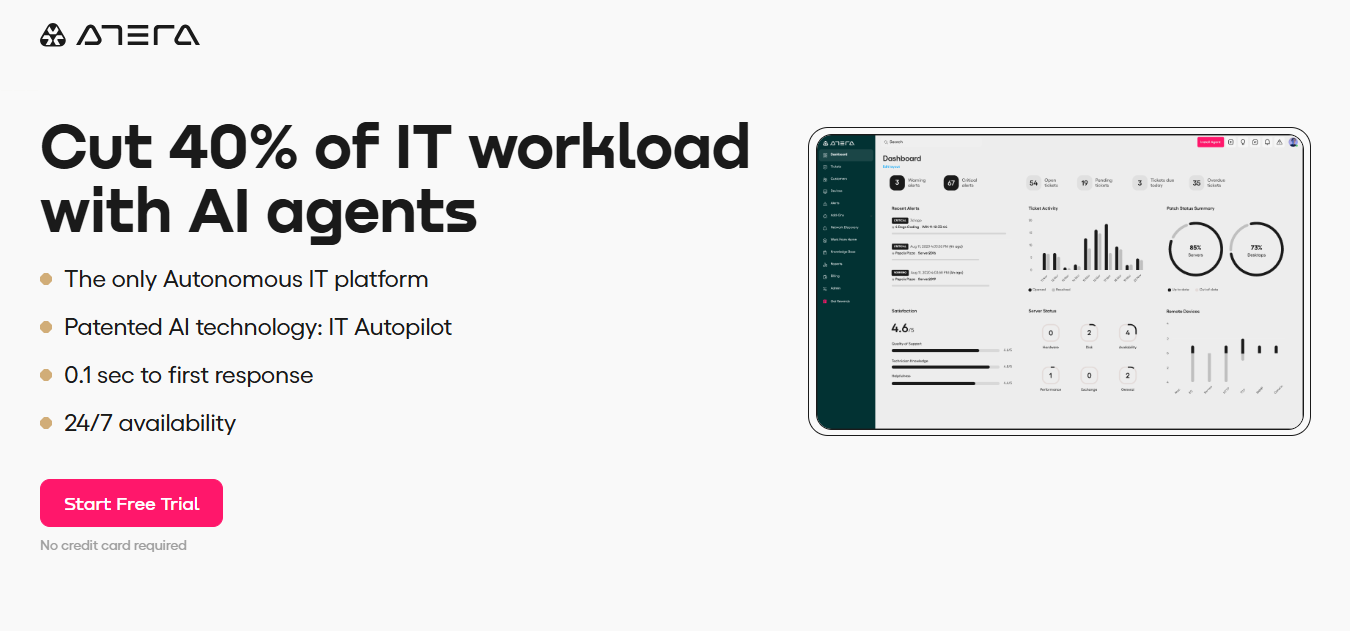
Atera stands out primarily because of its pricing model. Instead of charging per device, the platform charges per technician, which means a single admin can manage hundreds of endpoints without increasing software costs. For MSPs with fast-growing client environments, that pricing structure can make a noticeable difference in margins compared with traditional per-device RMM platforms.
Key services
• Endpoint monitoring and device health alerts across Windows, macOS, and Linux
• Automated patch management for operating systems and common third-party software
• Secure remote access for troubleshooting and device control
• Built-in PSA features including ticketing, helpdesk management, and billing
• Automation and scripting tools for maintenance tasks
Pros
• Per-technician pricing allows teams to manage unlimited devices without increasing software costs
• Built-in PSA tools reduce the need for separate ticketing and billing software
• Fast deployment and relatively simple setup compared with enterprise RMM platforms
Cons / Limitations
• Automation and scripting capabilities are less advanced than platforms like NinjaOne or ConnectWise Automate
• Some reporting features are limited compared with larger enterprise RMM tools
Best for
Small MSPs or internal IT teams that want predictable pricing and an all-in-one RMM and helpdesk platform.
NOT recommended for
Large MSPs that require deep automation workflows, extensive integrations, or complex multi-tenant management.
Pricing
Atera uses per-technician pricing, typically starting around $129–$219 per technician per month, with unlimited managed devices included.
3. Datto RMM: Best for MSPs Using the Datto Backup Stack
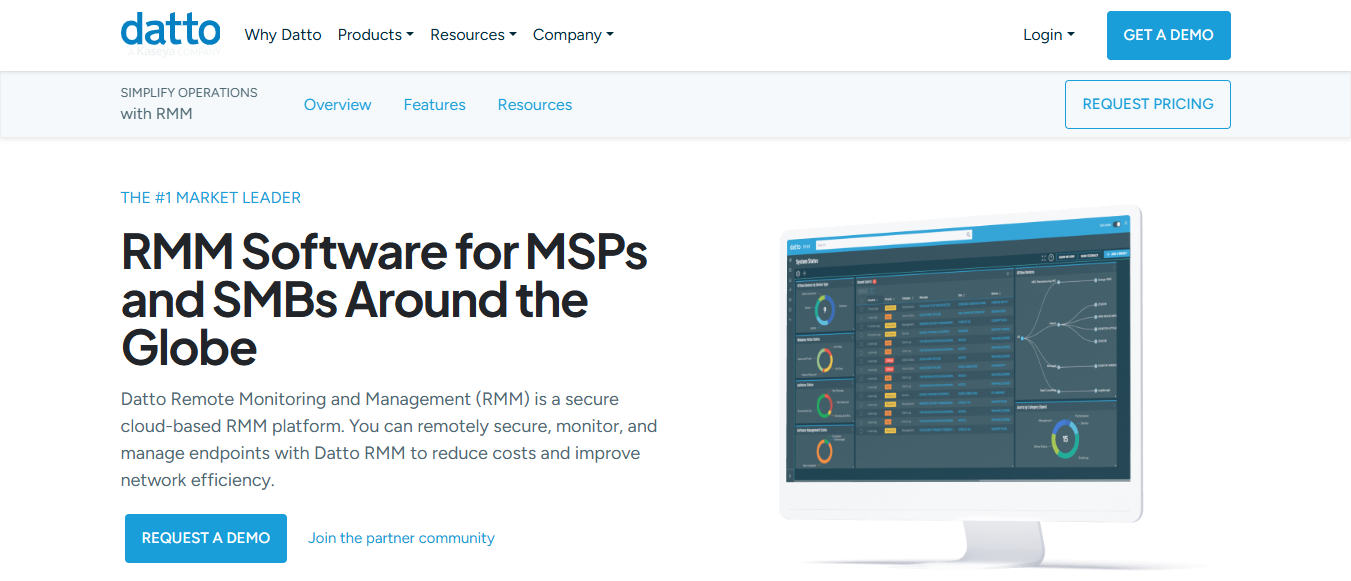
Datto RMM is particularly attractive to service providers already using Datto backup infrastructure. Within the platform, technicians can monitor endpoint health and confirm backup status without switching dashboards. That tight integration is the main reason many MSPs remain in the Datto ecosystem once they adopt it, even though other RMM tools offer similar monitoring capabilities.
Key services
• Endpoint monitoring and alerting for Windows, macOS, and Linux devices
• Automated patch management for operating systems and third-party applications
• Remote access tools for troubleshooting and device control
• Automation policies and scripting for routine maintenance tasks
• Integration with Datto backup and disaster recovery systems
Pros
• Tight integration with Datto backup products simplifies monitoring for MSPs already using the Datto ecosystem
• Strong automation features for patching and routine device maintenance
• Designed specifically for multi-client MSP environments
Cons / Limitations
• Pricing is not publicly listed and typically requires a sales consultation
• The platform is most valuable within the Datto ecosystem, which may limit flexibility for teams using other backup systems
Best for
Managed service providers already using Datto backup or disaster recovery products that want centralized monitoring and maintenance across client environments.
NOT recommended for
Internal IT departments or MSPs that prefer open integrations with a wider range of third-party infrastructure tools.
Pricing
Datto RMM uses a per-device pricing model, with pricing available through vendor quotes depending on the number of managed endpoints.
4. ConnectWise Automate: Best for Advanced Automation and Large MSP Environments
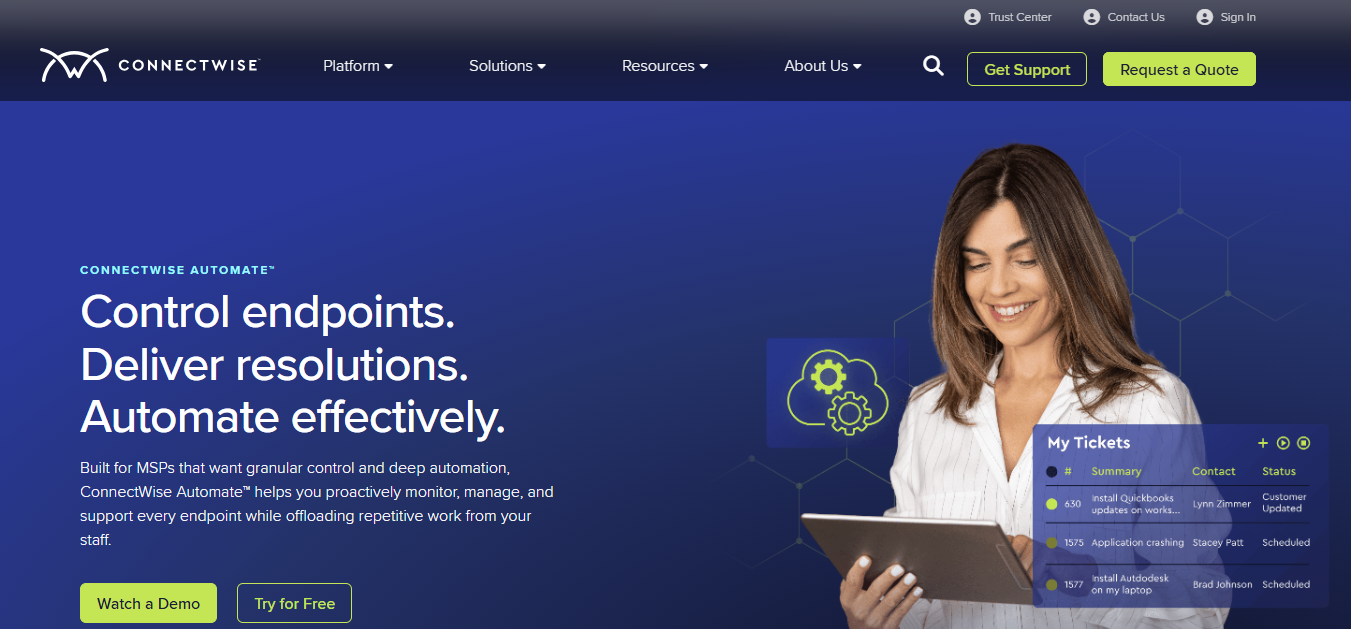
ConnectWise Automate is known for its scripting engine, which allows technicians to build detailed automation workflows. In practice, many MSPs use these scripts to automatically remediate issues like disk space shortages or failed services across thousands of endpoints. The trade-off is complexity—Automate can be extremely powerful, but it usually requires more setup time than newer RMM platforms.
Key services
• Endpoint monitoring and alerting for servers, workstations, and network devices
• Automated patch management for operating systems and third-party applications
• Advanced scripting engine for automation and remediation workflows
• Secure remote access and device troubleshooting tools
• Integration with ConnectWise Manage for ticketing and service management
Pros
• One of the most powerful automation and scripting environments in the RMM category
• Strong integration with the broader ConnectWise MSP tool ecosystem
• Built to handle complex, multi-client environments
Cons / Limitations
• Steep learning curve compared with more modern RMM platforms
• Setup and configuration often require significant time and training
Best for
Established MSPs managing large numbers of endpoints that need advanced automation and deep customization.
NOT recommended for
Small IT teams or MSP startups that want a simple platform with minimal setup and training.
Pricing
ConnectWise Automate typically uses per-device pricing, with costs provided through custom vendor quotes depending on the size of the deployment.
5. SolarWinds RMM: Best for Integrated Network and Endpoint Monitoring
SolarWinds RMM combines endpoint monitoring with broader infrastructure visibility. IT teams can track server health, deploy patches, and monitor network performance from a single console. In environments where the same team is responsible for both endpoints and network infrastructure, having those monitoring layers together can simplify day-to-day operations.
Key services
• Real-time monitoring of servers, workstations, and network devices
• Automated patch management for operating systems and common third-party software
• Remote access tools for troubleshooting and device control
• Automation and scripting for routine maintenance tasks
• Alerts and reporting for system health and performance monitoring
Pros
• Combines endpoint monitoring and network visibility in one platform
• Automation features help reduce manual maintenance work
• Designed for MSP environments managing multiple client networks
Cons / Limitations
• Pricing is not publicly transparent and usually requires contacting sales
• Interface and configuration can take time for new technicians to learn
Best for
Managed service providers or mid-size IT teams that want monitoring across both endpoints and network infrastructure.
NOT recommended for
Small IT teams looking for simple deployment or highly simplified monitoring tools.
Pricing
SolarWinds RMM typically uses per-device or custom subscription pricing, with quotes based on the number of endpoints and monitoring features required.
6. N-able N-central: Best for MSPs Managing Large, Complex Client Environments
N-central is built for service providers managing large client environments where consistency matters. Administrators can create monitoring policies and deploy them across multiple organizations, ensuring every endpoint follows the same configuration standards. That policy-driven approach is one reason many larger MSPs prefer N-central for managing complex multi-tenant environments.
Key services
• Endpoint monitoring and alerting for Windows, macOS, and Linux systems
• Automated patch management for operating systems and third-party applications
• Automation manager with scripting and policy-based workflows
• Network discovery and monitoring for routers, switches, and other devices
• Built-in integrations for security tools such as EDR and backup platforms
Pros
• Deep automation and policy-based monitoring capabilities
• Flexible deployment options (cloud or on-premises)
• Strong scalability for MSPs managing large multi-client environments
Cons / Limitations
• Setup and configuration can be complex for smaller teams
• Interface and workflows may feel heavy compared with newer RMM platforms
Best for
Established MSPs managing large client environments that need advanced automation and policy-based monitoring.
NOT recommended for
Small IT teams or MSP startups looking for a lightweight remote maintenance software platform with minimal setup.
Pricing
N-able N-central typically uses per-device pricing, with quotes provided by the vendor based on the number of endpoints and modules deployed.
7. Site24x7: Best for Cloud and Infrastructure Monitoring
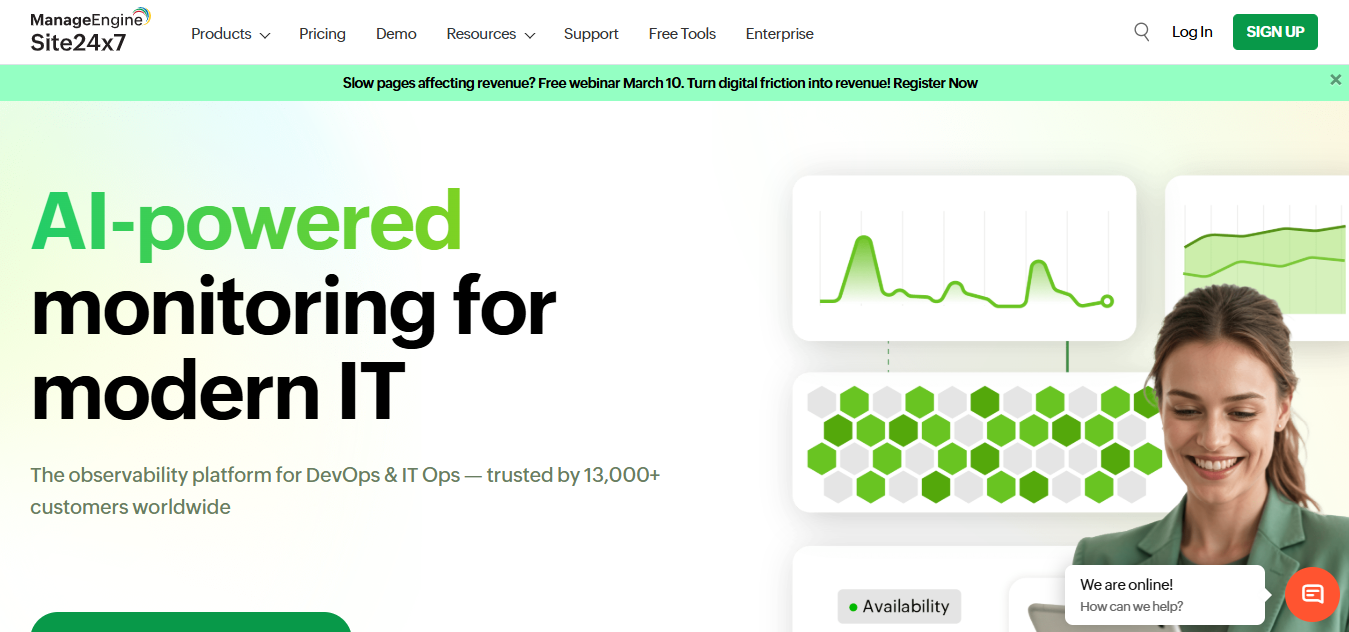
Site24x7 takes a broader monitoring approach than most RMM platforms. In addition to endpoints, the platform can track application performance, server health, and cloud infrastructure across providers like AWS and Azure. For teams running hybrid environments, this wider view of infrastructure can be more useful than tools that focus exclusively on endpoint monitoring.
Key services
• Monitoring for servers, applications, networks, and cloud infrastructure
• Synthetic website monitoring and uptime tracking from global locations
• Application performance monitoring for technologies such as Java, .NET, and Node.js
• Cloud monitoring integrations for AWS, Azure, and Google Cloud
• Centralized alerting, dashboards, and reporting across infrastructure components
Pros
• Broad monitoring coverage across infrastructure, cloud services, and applications
• Useful for organizations managing hybrid or multi-cloud environments
• Flexible monitoring modules that can scale with infrastructure needs
Cons / Limitations
• Less focused on endpoint management compared with traditional RMM tools
• Interface can feel crowded when monitoring large numbers of resources
Best for
IT teams and MSPs that need infrastructure and cloud monitoring alongside endpoint visibility.
NOT recommended for
Organizations that primarily want a dedicated endpoint-focused remote maintenance software platform.
Pricing
Site24x7 offers tiered subscription pricing, with infrastructure monitoring plans starting around $9 per month and additional modules available depending on the monitoring features required.
8. MSP360 RMM: Best for Cost-Conscious MSPs
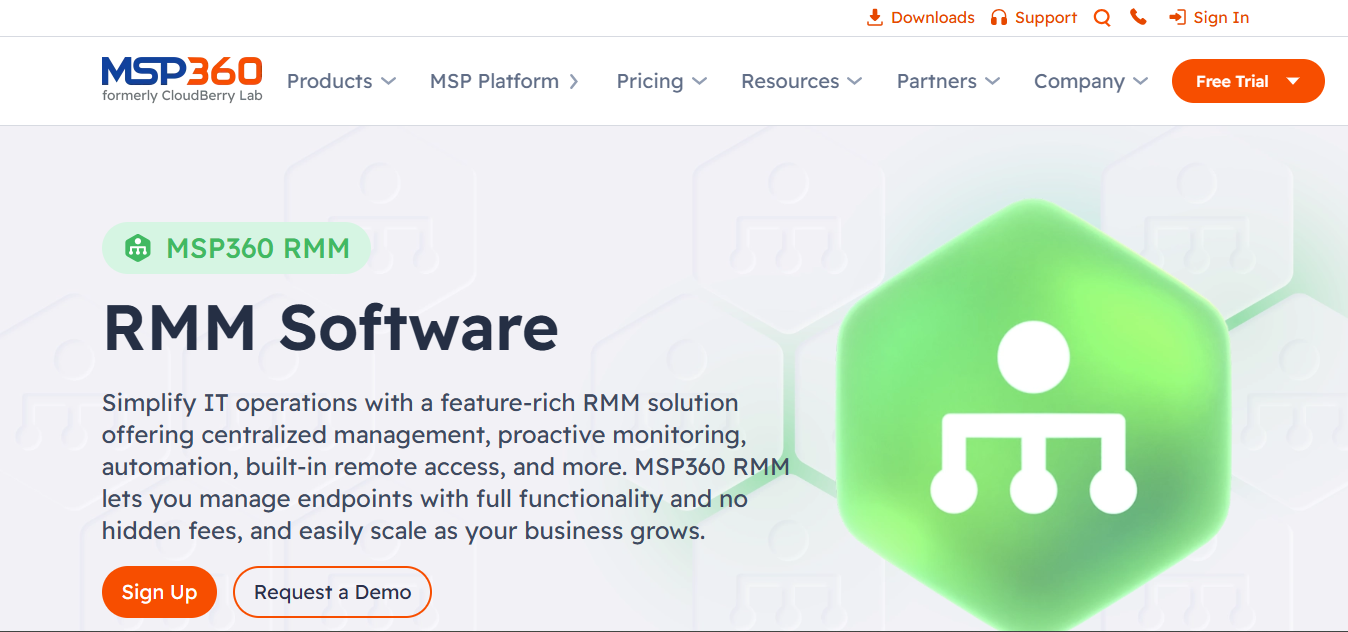
MSP360 RMM focuses on delivering the core monitoring features many smaller MSPs actually need without the overhead of larger platforms. Administrators can monitor device health, deploy patches, and remotely access endpoints from a relatively simple interface. While it lacks some advanced automation capabilities, its pricing and straightforward setup make it appealing to budget-conscious service providers.
Key services
• Endpoint monitoring for system health, disk usage, CPU, and memory
• Patch management for Windows systems and software updates
• Remote desktop access for troubleshooting devices
• Software deployment and script execution across endpoints
• Alerting and reporting on device status and performance
Pros
• Lower cost compared with many enterprise RMM platforms
• Simpler setup and deployment for smaller IT teams
• Integration with MSP360 Backup for combined monitoring and backup management
Cons / Limitations
• Automation and scripting capabilities are more limited than tools like ConnectWise Automate or NinjaOne
• Reporting and analytics are less advanced than larger RMM platforms
Best for
Small to mid-size managed service providers that want basic remote maintenance software with predictable pricing.
NOT recommended for
Large MSPs that require deep automation workflows or highly customizable monitoring policies.
Pricing
MSP360 RMM typically starts around $59.99 per administrator per month, with each license supporting unlimited endpoints.
9. Pulseway: Best for Mobile-First IT Management
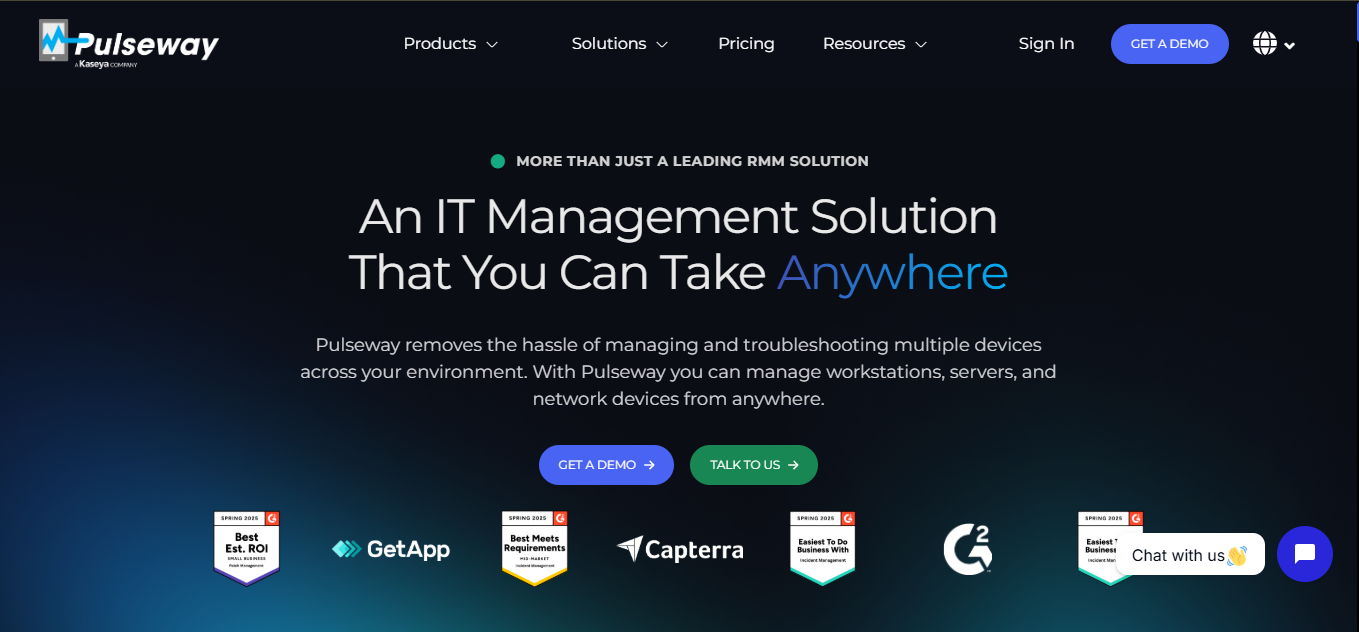
Pulseway’s main differentiator is its mobile management experience. Technicians can receive alerts, run scripts, and remotely access devices directly from a smartphone. For smaller IT teams that are frequently away from their desks, that ability to manage infrastructure from a mobile device can be surprisingly practical.
Key services
• Real-time endpoint monitoring for servers and workstations
• Automated patch management for operating systems and common applications
• Secure remote access and remote desktop troubleshooting
• Mobile app for monitoring alerts, executing commands, and managing devices
• Automation workflows for routine maintenance and remediation
Pros
• Mobile app allows technicians to monitor and manage systems from anywhere
• Simple deployment and relatively fast setup
• Real-time alerting that can trigger actions directly from mobile devices
Cons / Limitations
• Automation and scripting capabilities are less advanced than larger RMM platforms
• Linux and macOS support is more limited than Windows environments
Best for
Small IT teams or MSPs that want remote maintenance software with strong mobile management capabilities.
NOT recommended for
Large MSPs that require deep automation workflows or complex multi-tenant infrastructure management.
Pricing
Pulseway uses per-device pricing, with plans typically starting around $44 per device per month, depending on the number of endpoints and selected modules.
10. Domotz: Best for Network Device Monitoring
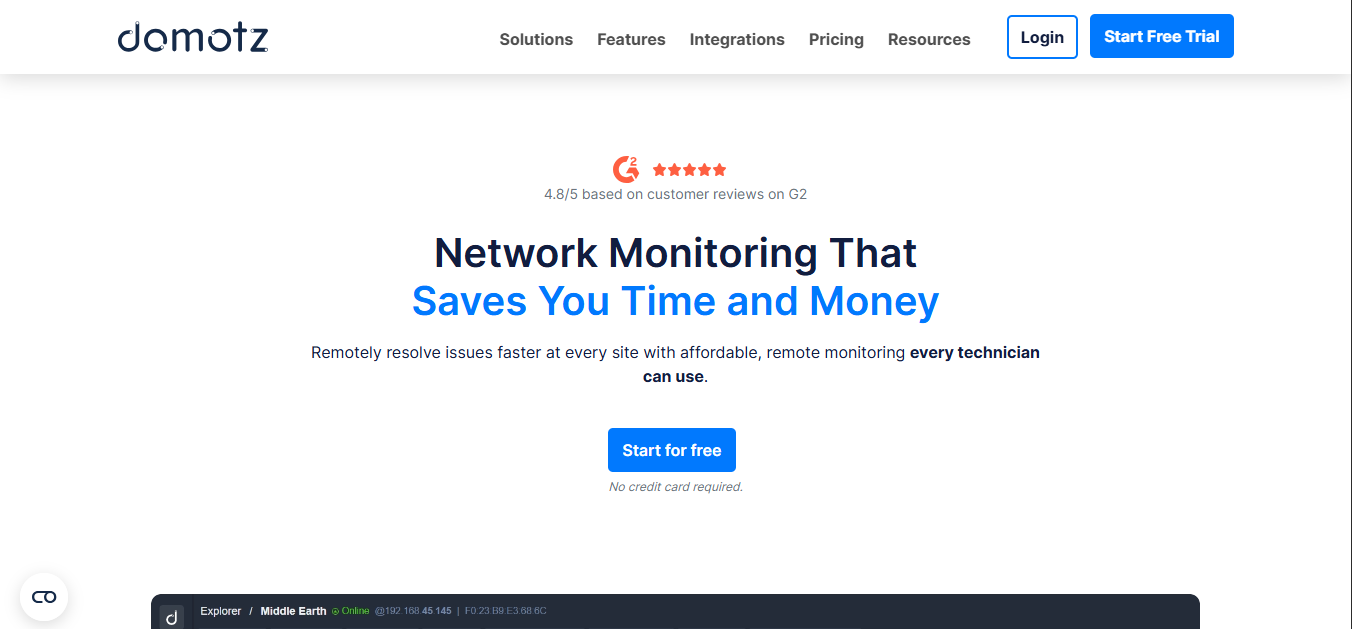
Domotz focuses on network visibility rather than endpoint maintenance. The platform automatically discovers devices on a network and builds a topology map showing how those devices connect. For MSPs troubleshooting network performance issues, having that visual overview can make it much easier to identify bottlenecks or misconfigured hardware.
Key services
• Automatic network discovery and device mapping
• Monitoring for routers, switches, firewalls, and other network hardware
• Secure remote access through RDP, SSH, and web connections
• Network performance monitoring using SNMP and TCP service checks
• Integrations with PSA tools such as ConnectWise, Autotask, and Zendesk
Pros
• Strong visibility into network infrastructure and device relationships
• Automatic network discovery simplifies onboarding new client environments
• Works well alongside other IT management platforms
Cons / Limitations
• Limited endpoint patch management compared with traditional RMM platforms
• Not designed as a full endpoint management solution
Best for
MSPs and IT teams that need detailed monitoring of network infrastructure and connected devices.
NOT recommended for
Organizations looking for remote maintenance software focused primarily on endpoint patch management and device automation.
Pricing
Domotz typically uses per-network pricing, starting at approximately $35 per network per month, depending on the deployment and monitoring requirements.
.png?width=600&height=300&name=remote%20maintenance%20software%20(1).png)
Which remote maintenance tool is right for you?
For MSPs
The most important variable for managed service providers is pricing models relative to growth trajectory. If you are adding clients and endpoints faster than technicians, Atera's per-technician model saves real money at scale for service delivery. If you are already mid-size with 500+ endpoints across clients and need automation capabilities, depth, and PSA integration breadth, NinjaOne is the safer long-term investment as one of the best RMM software. MSPs deeply embedded in the Datto backup ecosystem should evaluate Datto RMM seriously before switching to anything else; the integrated visibility is hard to replicate externally.
For internal IT teams
Internal IT teams typically care more about reporting quality, compliance audit support, and integration with ITSM tools than about multi-tenant client management. NinjaOne and SolarWinds RMM both serve this profile well for remote devices. For smaller in-house teams where the budget matters as much as the feature set, Atera's per-technician pricing is worth modeling out against your actual endpoint count before defaulting to per-device alternatives.
For mid-sized companies
Mid-sized companies often fall between the MSP tools (which assume a multi-client model) and enterprise platforms (which assume a large IT team and big training budget). NinjaOne performs well here because its intuitive interface does not require deep RMM expertise to operate effectively. Site24x7 is worth evaluating if cloud infrastructure is a significant part of your environment.
For enterprise environments
At enterprise scale, the evaluation criteria shift toward the depth of automation capabilities, compliance logging, multi-site support, and integration with existing ITSM and security toolchains. ConnectWise Automate and N-able N-central are the strongest contenders as top RMM solutions. Both require meaningful onboarding investment, budget for this explicitly in the project plan, and include a 90-day post-deployment evaluation milestone to ensure the platform is configured to its potential.
For distributed or remote-first teams
RMM platforms help monitor and maintain the software running on company devices, but they do not solve the logistics of deploying, retrieving, and tracking those devices across a distributed workforce. For organizations hiring globally or managing remote employees across multiple regions, GroWrk fills that operational gap. The platform helps IT teams procure equipment, ship devices to employees worldwide, track assets centrally, and recover hardware when employees leave, complementing remote maintenance software rather than replacing it.
Understanding key certifications for RMM companies
When you choose a company to manage your computers, you must know they are safe. RMM tools have special badges called certifications. These badges prove that a company follows strict rules to protect your data. Here are the most important ones you should look for.
SOC 2 Type II: The gold standard for trust
A SOC 2 Type II report proves that the company keeps your data safe from hackers. It also shows that their systems are always ready when you need them. This badge is all about trust and making sure the company does what they promise to do.
ISO 27001: The global security framework
This badge is recognized all over the world, including The US. It shows that an RMM platform has a solid plan for managing security risks. To get this badge, a company must find every possible way a problem could happen and create a fix for it.
GDPR: protecting your privacy in Europe
The GDPR is a set of rules from Europe that protects your privacy. Even if an IT team is not in Europe, they must follow these rules if they have customers there. This badge means the company lets you control your own data.
HIPAA: safety for healthcare data
If you work in a doctor's office or a hospital, this badge is a must. HIPAA is a law in the United States. It sets rules for how medical records are kept safe.
Close the gap between endpoint monitoring and device lifecycle management with GroWrk
Remote maintenance software keeps devices running smoothly, but it doesn’t address what happens before a device reaches an employee or after it leaves their hands. Procurement, global shipping, storage, redeployment, and retrieval often remain manual processes handled through spreadsheets, vendors, and ad-hoc logistics.
For distributed teams, this gap becomes obvious quickly. Devices must be shipped across countries, recovered from departing employees, and redeployed to new hires without creating inventory blind spots or compliance risks. Without a structured lifecycle process, IT teams end up managing hardware logistics alongside endpoint monitoring.
GroWrk helps organizations manage the physical lifecycle of company devices so IT teams can focus on maintaining the systems that run on them. The platform supports teams by helping them:
• Procure and deploy devices to employees in more than 150 countries
• Track hardware inventory through a centralized asset management platform
• Retrieve equipment from remote employees during offboarding
• Store, redeploy, or recycle devices as part of structured lifecycle management
• Maintain clear asset records for audits, compliance, and internal reporting
The result is a more complete IT device strategy: remote maintenance software keeps endpoints secure and operational, while GroWrk manages how those devices are deployed, tracked, and recovered across the organization.
Request a demo to learn more about GroWrk IT asset lifecycle management.
Frequently asked questions
Is remote maintenance software the same as RMM?
Yes, in practice. "Remote maintenance software" and "RMM software" describe the same category of tools.
What features are essential in an RMM platform?
The non-negotiables for most IT teams are: real-time endpoint monitoring with configurable alerting for proactive monitoring, automated patch management for OS and applications, unattended remote access, and an audit log for compliance purposes.
How much does RMM software cost?
Pricing varies significantly by pricing models and vendor. Per-device platforms like NinjaOne range from approximately $1.50 to $8 per endpoint per month depending on scale. Per-technician platforms like Atera start at $129/technician/month for MSPs and $149/technician/month for IT departments, with unlimited endpoints included. Domotz is transparently priced at $1.50/device/month. Many enterprise vendors (Datto, ConnectWise, N-able) require custom quotes.
Can RMM tools automate patch management?
Yes, automated patch management is a core features of every platform on this list.
Are RMM tools secure?
A well-configured RMM platform is an important part of an organization's security features posture, not a risk to it. That said, RMM agents running with system-level privileges on every managed device are a meaningful attack surface, there are documented cases of threat actors abusing legitimate rmm tools in attacks. Evaluate platforms for MFA enforcement, role-based access control, audit logging, and SOC 2 or ISO 27001 certification.
What is the difference between RMM and remote desktop software?
Remote desktop software (TeamViewer, AnyDesk, Windows RDP) gives you visual access to a single device when you initiate a session as remote access. An RMM platform continuously monitors all managed devices in the background, sends proactive alerts, deploys patches automatically with automated maintenance tasks, and enables unattended access across your entire fleet from a single dashboard. RMM is proactive and fleet-wide; remote desktop is reactive and one-at-a-time.
Do RMM tools support Mac and Linux endpoints?
Most modern platforms support Windows, macOS, and Linux, but the depth of support varies.