




Three weeks. That's how long it took us to get a replacement laptop to our developer in Portugal last year.
Not because we're incompetent. Not because we didn't have a "desktop management solution." We had Microsoft Endpoint Manager running. Policies deployed. Security locked down. The whole enterprise IT setup.
But none of that helped when João's MacBook died and we realized our MDM platform couldn't actually... you know... get him a new computer. It could wipe the old one remotely (great, thanks). It could show us a dashboard confirming the device was offline (very helpful). But procurement? Shipping? Customs paperwork? Configuring the replacement before it arrived?
We figured that out the hard way, bouncing between our IT vendor, a local reseller who didn't stock M3 Pros, and Portuguese customs forms we couldn't read.
That's when I started actually understanding what "desktop management" means for distributed teams in 2026. Spoiler: it's not what the vendors are selling.
I've spent the last eight months evaluating platforms (the enterprise monsters, the scrappy startups, the "we do everything" solutions that do nothing well). This guide covers the 10 that don't suck, what they're actually good at, and which problems they leave unsolved.
What's in This Guide
- Real talk rankings (if you just want the answer)
- Comparison table that actually helps
- What to evaluate before you waste time on demos
- 10 platforms reviewed (the good, the bad, the expensive)
- Answers to questions vendors dodge
Real Talk: Which Ones Actually Matter
Before you read 8,000 words, here's the honest hierarchy:
Tier 1 (Start Here):
GroWrk if you're distributed. This solves problems others ignore (like actually getting laptops to employees in 47 countries).
Jamf Pro if you're 80%+ Apple. Nothing else comes close, everyone knows it.
Microsoft Endpoint Manager if you're already paying for M365 E5. It's included. Yes, setup sucks. But it's free, so use it.
Tier 2 (Solid Alternatives):
NinjaOne if you want easy automation without enterprise complexity. Best UI in the RMM space.
Kandji if you want Jamf's power with better UX. Newer, but growing fast.
Atera if you're an MSP with the right economics. Per-technician pricing changes everything.
Tier 3 (Specific Use Cases Only):
Ivanti Neurons for enterprises with AI/self-healing requirements. Actually delivers on the AI promises.
VMware Workspace ONE for complex app delivery needs. Way beyond basic endpoint management.
ManageEngine when budget is the primary constraint. Ugly but functional.
Tier 4 (Enterprise Only):
ServiceNow ITOM for Fortune 500 ITSM environments. If you need to ask the price, you can't afford it.
Most of you should pick from Tier 1. The rest of this post explains why.
Desktop Management Software Comparison Table
| Platform | Best For | Avoid If | Price Range |
|---|---|---|---|
| GroWrk | Distributed teams across multiple countries | Everyone's in one office | Custom ($) |
| Microsoft Endpoint Manager | Already on M365 E3/E5 | You hate Microsoft | Included to $6/user |
| Jamf Pro | Mac-heavy environment (80%+ Apple) | You have 10 Macs total | $4-8/device/month |
| NinjaOne | Want easy automation without complexity | Need deep enterprise features | $3-7/endpoint/month |
| ManageEngine Endpoint Central | Budget is your main constraint | You value good UX | $1,195/year (25 devices) |
| Atera | MSPs managing multiple clients | Small internal IT team | $149/tech/month |
| Ivanti Neurons | Enterprise with AI requirements | Under 500 endpoints | Custom ($$) |
| VMware Workspace ONE | Complex app delivery needs | Simple device management only | $7-15+/device/month |
| ServiceNow ITOM | Fortune 500 with full ITSM needs | You're not Fortune 500 | $100+/user/month |
| Kandji | Modern Apple management | Need Windows support | $6.50/device/month |
What You Need to Evaluate Before Wasting Time on Demos
Most buying guides tell you to evaluate 47 different criteria. That's how you end up in analysis paralysis for six months.
Here are the five things that actually matter, and how to figure out if a platform delivers or if they're lying in the demo:
Deployment and Scalability (Or: Will This Collapse When You Hit 500 Devices?)
Can the platform grow with you? I've seen too many companies outgrow their solution within 18 months because they didn't think about scale.
What works for 50 endpoints'll fall apart at 500. I've watched it happen.
Ask these questions in the demo, and watch how fast the sales engineer starts sweating:
- How does this handle multi-location deployment? (especially if you're distributed)
- Show me what happens when I go from 100 devices to 1,000 devices
- Can I add 200 endpoints next month without architectural changes?
- What's the largest deployment you've done? (if they say "thousands" without specifics, they're guessing)
The platform that works today needs to work in two years. Think about where you'll be, not just where you are.
Security and Compliance (Or: How to Not Get Fired After a Breach)
Every vendor claims "enterprise-grade security." Here's how to verify they're not lying:
In the demo, ask them to show you:
- How they handle a critical zero-day patch across 1,000 endpoints (if they start talking about "scheduling windows," that's not automation)
- What happens when an endpoint hasn't checked in for 30 days (if the answer is "we send an alert," that's not security)
- Their actual certifications, not "we're working on SOC 2" (working on it means they don't have it)
- How encryption works for data in transit and at rest
- Show me the access controls and role-based permissions
Red flags to watch for:
- "Encryption available as add-on" (should be default)
- "We integrate with your security tools" (translation: we don't do security ourselves)
- "Role-based access coming in Q3" (it doesn't exist)
- No compliance certifications (ISO 27001, SOC 2, GDPR)
One unpatched endpoint can cost you millions. Your desktop management platform should prevent that scenario automatically, not send you a dashboard alert you'll ignore.
Automation Capabilities (Or: Stop Doing Things Manually)
Manual processes don't scale.
I used to think automation didn't matter much. "How hard is it to push a patch?" Very hard, it turns out, when you're doing it manually for 300 machines at 2am because the auto-patch failed and you didn't have rollback configured. Automation isn't a nice-to-have. It's the difference between sleeping and not sleeping.
Your platform needs to handle:
- Patch deployment across all endpoints (without you clicking 300 times)
- Software installations and updates
- Policy enforcement that happens automatically
- Routine maintenance tasks
- Onboarding and offboarding workflows
Strong automation reduces your team's manual workload by 60-70% and eliminates human error. If you're still manually configuring devices in 2026, something's wrong.
Integration Ecosystem (Or: Does This Play Nice with Your Other Tools?)
Desktop management doesn't exist in a vacuum. It needs to work with your existing tools.
Check for integrations with:
- HRIS systems (BambooHR, Workday) so onboarding triggers automatically
- Ticketing platforms (Zendesk, Jira, ServiceNow)
- Identity providers (Okta, Azure AD)
- Security tools and SIEM platforms
- Communication tools your team actually uses
Poor integration creates data silos. You'll end up with duplicate work and incomplete visibility across your infrastructure.
Side note: most vendors will claim they "integrate with everything." Ask them to show you the actual integration in the demo, not just an API endpoint that requires custom development.
User Experience and Support (Or: Will Your Team Actually Use This?)
You're buying this for two groups who hate each other (your IT admins and your end users). Both need to not hate you after deployment.
For administrators:
- Is the interface intuitive or does it require weeks of training?
- Can you find answers without opening support tickets?
- Is documentation actually helpful or just marketing fluff?
For end users:
- Will this make their lives easier or create more friction?
- Is self-service available for common requests?
- Does it run quietly in the background or annoy them constantly?
For support:
- Multiple support channels (email, phone, chat)
- Response times that match your SLAs
- Knowledge bases with real solutions (not just "contact support")
A powerful platform that nobody can figure out how to use is worthless. I've seen organizations buy enterprise platforms with incredible capabilities, then watch their IT team find workarounds because the interface was too painful.
User experience matters. For both your IT team and end users.
Questions You Must Answer First
Before you even start evaluating platforms, get clear on these:
- What's your device ecosystem? (Windows, macOS, Linux, mobile devices)
- How distributed is your workforce? (office-based, remote, hybrid)
- What's your IT team's size and expertise level?
- What compliance requirements must you meet?
- What's your realistic budget? (include hidden costs like training and implementation)
- Do you need asset lifecycle management beyond desktop control?
Your answers will immediately eliminate half the options and help you focus on what actually fits.
Top 10 Desktop Management Software Solutions
GroWrk
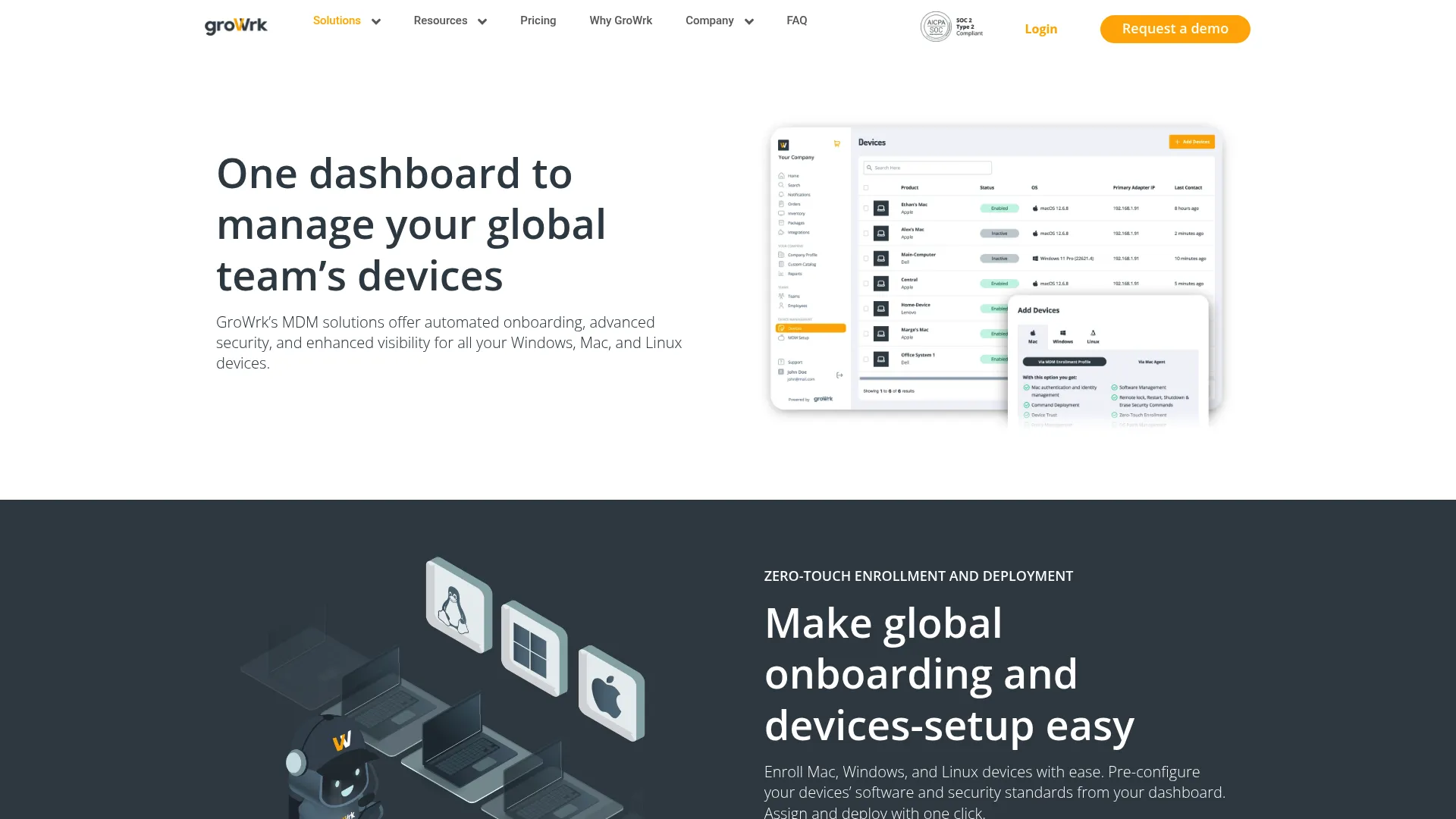
Remember the Portugal laptop story from the intro? That's the problem GroWrk solves.
Your traditional MDM (Jamf, Intune, whatever) can manage devices remotely. It can push software, enforce policies, wipe lost laptops. Great.
But it can't get a laptop to your new hire in Santiago, Chile by Friday. It can't retrieve equipment from a fired employee in Berlin. It can't handle customs paperwork for shipments to India.
GroWrk handles the physical logistics that every other platform ignores.
What It Actually Does
Most "device management" platforms manage the software on devices. GroWrk manages the entire lifecycle:
Procurement – You need 5 MacBook Pros in Australia. GroWrk sources them locally (no international shipping delays), negotiates pricing, handles purchasing.
Configuration – Devices arrive pre-configured with your MDM enrollment, apps installed, ready to work. Your new hire opens the box and logs in. That's it.
Shipping & Logistics – Global shipping to 150+ countries, customs handling, white-glove delivery. You don't coordinate with DHL or fill out customs forms.
Support – Employee needs help? GrowBot (their AI support) handles common requests. Actual issues? GroWrk's team handles it.
Retrieval – Employee leaves? GroWrk coordinates equipment return, handles shipping, wipes devices, manages disposition (resale/recycle).
Key Features:
- Zero-touch deployment for remote employees (they receive configured devices ready to work)
- Global device procurement and logistics infrastructure across 150+ countries
- Automated onboarding and offboarding workflows integrated with your HRIS
- Real-time asset tracking and inventory management across all locations
- Equipment retrieval and IT disposition services
- AI-powered IT support chatbot (GrowBot 2.0) for employee self-service
- Integration with ServiceNow, Okta, Zendesk, Jira, BambooHR, Workday, FreshService, and JumpCloud
- Device-as-a-Service (DaaS) options for flexible asset management
When This Makes Sense
You need GroWrk if:
- You're hiring across multiple countries (especially outside US/EU)
- You don't have local IT teams in each location
- You've ever said "how do we get a laptop to [random country]?"
- You're tired of being a logistics coordinator
- Your finance team hired someone in Chile who needs a laptop by Friday to start onboarding, and your procurement process takes 3 weeks minimum
You don't need GroWrk if:
- Everyone works from one office
- You have 15 employees all in the same city
- You have established local IT infrastructure everywhere you operate
What Actually Works
Global reach without local complexity. They've already built vendor relationships, customs expertise, and logistics infrastructure in 150+ countries. You get that immediately instead of building it yourself. Sourcing that hardware across borders is a discipline of its own, which we cover in the state of global IT hardware procurement.
When our finance team hired someone in Chile, HR sent the offer Monday. She needed a laptop by Friday. GroWrk had a configured MacBook at her apartment Thursday afternoon. That's not desktop management software, that's logistics infrastructure we didn't have.
The integration capabilities are genuinely solid. Connect with ServiceNow, Okta, Zendesk, Jira, BambooHR, Workday, FreshService, and JumpCloud to create unified workflows that span your entire IT stack. Data flows automatically between systems without manual data entry.
Employee experience focus. Your team members get configured devices quickly, and when they need support, GrowBot handles common requests without IT intervention. This reduces ticket volume significantly while improving employee satisfaction.
Sustainable IT disposition services. Devices get properly recycled or refurbished rather than ending up in landfills. Matters more as environmental responsibility becomes non-negotiable.
What's Not Great
If you're running a small, office-based team where everyone works in one building, GroWrk is over-featured for your needs. The platform shines when you have distribution complexity across multiple countries and time zones.
Pricing isn't publicly listed. You'll need to contact them for a quote based on your company size and requirements. That's standard for enterprise solutions but frustrating if you want quick ballpark numbers. I hate "contact us for pricing." You might too.
GroWrk is also a newer player compared to legacy enterprise solutions like Microsoft or VMware, though that also means they're building for modern work environments rather than retrofitting old architecture.
The Real Cost
From conversations with customers, expect to pay more than just MDM licensing but less than hiring logistics coordinators or maintaining vendor relationships in 47 countries.
The ROI calculation: How much does your IT team's time cost? How much does a developer sitting idle for 2 weeks waiting for a laptop cost? How much does botched international shipping cost?
For distributed teams, GroWrk pays for itself quickly. For office-based teams, it's overkill. See how Pi Health scaled remote IT asset management with GroWrk.
Bottom Line
GroWrk solves a problem that traditional MDM ignores: the physical logistics of distributed device management. Managing devices across their full lifecycle is what we explore in the state of IT lifecycle management.
Remember João in Portugal from the intro? GroWrk would've had a replacement laptop at his door in 3 days instead of 3 weeks. That's a $15K developer not working for 18 fewer days. Do that math on your next "cost savings" spreadsheet.
If you're managing remote teams across countries, this fills a real gap. If you're not, you don't need it.
Rating for distributed teams: Essential
Rating for office-based teams: Unnecessary
Pricing and Where to Find It
Custom pricing based on company size, device count, and services required. Request a demo and quote from GroWrk to get specific numbers for your organization.
Microsoft Endpoint Manager (Intune)
If your organization runs on Microsoft 365, Endpoint Manager deserves serious consideration. The integration works because Microsoft controls both the OS and the management platform.
Real talk: if you're on M365 E5 and you're paying for another MDM, you're wasting money. Endpoint Manager is included. Yes, the setup sucks. Yes, you'll curse Microsoft's documentation. But it's free and it works. Hire a consultant for the setup, then stop paying monthly fees to competitors.
Best Known For: Deep Windows Integration
Microsoft Endpoint Manager provides unified endpoint management specifically optimized for Microsoft-centric environments. The platform combines Configuration Manager and Intune into a unified solution that leverages the entire Microsoft security stack.
Key Features That Matter
- Unified endpoint management (UEM) across all device types
- Mobile device management (MDM) and mobile application management (MAM)
- Policy-based management with granular controls
- Conditional access controls tied to Azure AD
- Autopilot for zero-touch deployment (genuinely works well)
- Co-management with Configuration Manager for hybrid scenarios
- Integration with Microsoft 365 and Azure AD
- Cloud-native with hybrid options for legacy infrastructure
What Actually Works
The integration with the Microsoft ecosystem is the main draw. If you're already paying for Microsoft 365 E3 or E5 licenses, Endpoint Manager is included. That's significant cost savings compared to buying standalone solutions.
Security features are solid, leveraging the entire Microsoft security stack. You get excellent compliance and reporting capabilities built in, with deep visibility into device health and security posture.
For Windows environments, this is arguably the most mature and capable solution available. Autopilot makes Windows deployment genuinely zero-touch, and the platform handles everything from initial provisioning through ongoing management and retirement.
I've configured Endpoint Manager three times now. The first time took six weeks and I wanted to quit IT. The second time took three weeks and I only cried twice. The third time took one week because I finally hired someone who'd done it before. Learn from my pain: get help with the initial setup.
Where It Falls Short
Initial configuration can be complex. Microsoft's tools are powerful but rarely intuitive, and you'll likely need dedicated training or consultants to set things up properly. The learning curve is steep if you're new to the platform.
While Microsoft has improved macOS and Linux support, it's still not as mature as Windows management. If you're running a mixed environment with significant Mac presence, you'll feel the gaps in functionality and polish.
Licensing can be confusing (classic Microsoft). You need Azure AD for full functionality, and figuring out which license tier you need requires spreadsheets and possibly a consultant.
The platform works best when you're all-in on Microsoft. If you're using Google Workspace or other non-Microsoft tools heavily, the value proposition weakens considerably.
Side note: Microsoft's documentation is simultaneously the most detailed and least helpful resource in enterprise IT. You'll find 47 articles about configuring conditional access policies, each written by different teams, all slightly contradicting each other, none updated for the current interface. I've started just searching Reddit instead. The sysadmin subreddit has saved me more time than Microsoft Learn ever has.
Bottom Line
If you're in the Microsoft ecosystem, this is the obvious choice. It's included with licenses you're already paying for, it works well for Windows, and the security integration is tight.
Just budget for implementation help. Don't try to figure this out yourself unless you enjoy pain.
Pricing and Where to Find It
Included with Microsoft 365 E3/E5 ($36-$57 per user per month) or available as standalone Intune licensing starting at $6 per user per month. Get details at Microsoft's endpoint management page.
Jamf Pro
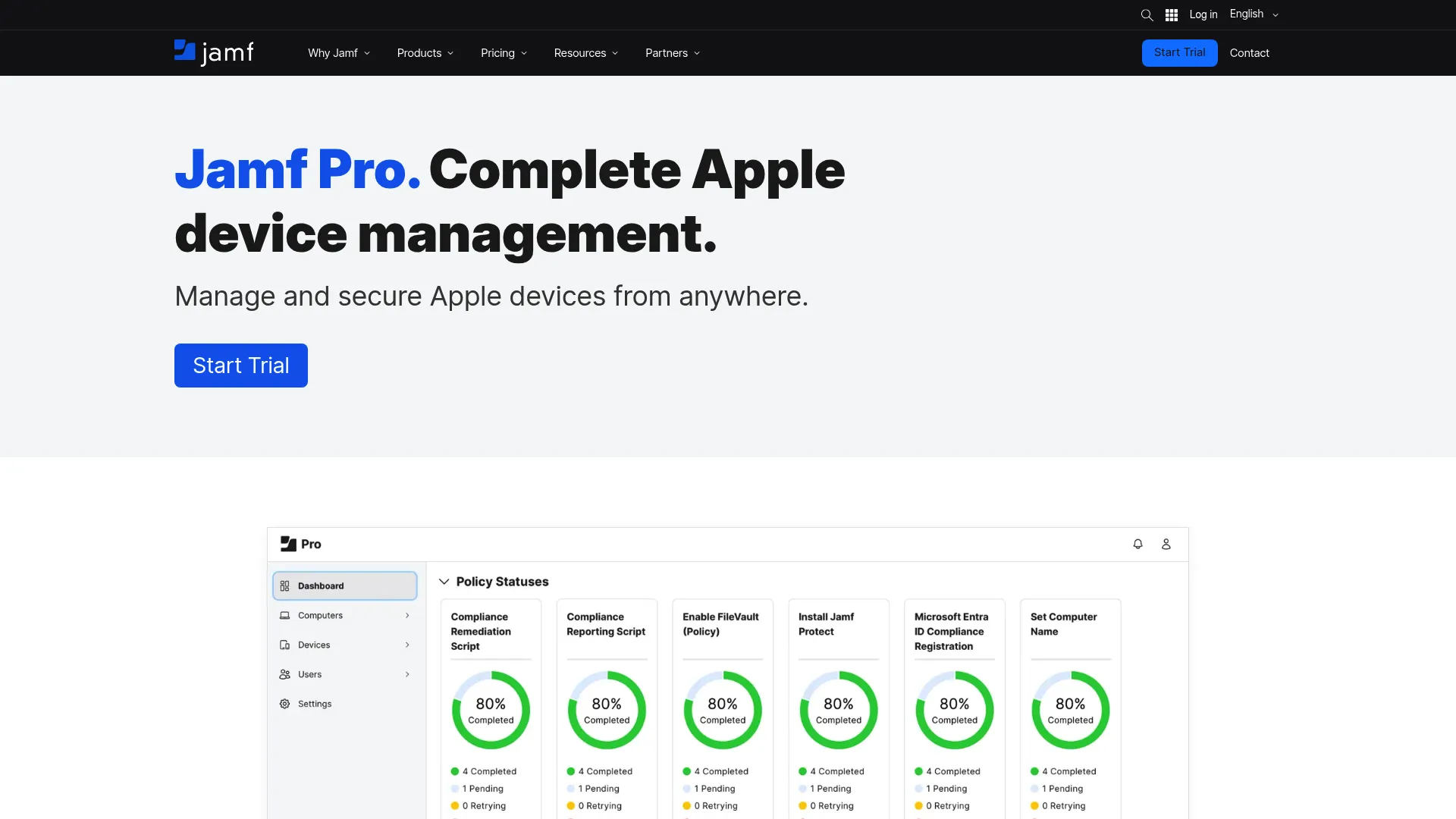
For Apple device management, Jamf Pro is the standard everyone else tries to match. If you're running Macs and iOS devices at scale, you've probably already heard of Jamf.
If you're managing Macs and you're not using Jamf, you're doing it wrong. Yes, it's expensive. Yes, Kandji is shinier. But Jamf works, the community is massive, and when Apple releases a breaking change at 2am, Jamf has a patch by breakfast. Kandji might get there eventually. Jamf is there now.
Best Known For: Unmatched Apple Device Management
Jamf Pro delivers the most detailed and sophisticated Apple device management available, with deep OS integration and immediate support for Apple's latest features. This platform was built specifically for Apple's ecosystem and it shows in every capability.
Key Features That Matter
- Zero-touch deployment with Apple Business Manager integration
- Automated device enrollment (genuinely zero-touch for Macs and iOS)
- Detailed patch management specifically for macOS
- Self-service app deployment (employees install approved apps themselves)
- Advanced security and compliance tools built for Apple's architecture
- Custom scripting and policy management for complex scenarios
- Detailed inventory and reporting
- Remote assistance capabilities
What Actually Works
Jamf's deep integration with Apple technologies is unmatched. When Apple releases new OS features or security capabilities, Jamf supports them immediately (often on release day). You won't wait months for your MDM to catch up with Apple's latest release.
When macOS Sonoma dropped last September, Jamf had full support on launch day. Our Kandji friends waited three weeks. Our Intune friends are still waiting for some features. That's the Jamf tax: you pay more, but you're never stuck.
The automation capabilities are sophisticated. You can create complex workflows that handle everything from initial enrollment through daily management without manual intervention. Smart groups, policies, and extension attributes give you incredible flexibility.
The interface is genuinely intuitive for an enterprise tool. Your IT team won't need weeks of training to become productive, though mastering advanced features takes time and practice.
The community is active and helpful. You'll find scripts, solutions, and best practices shared freely among Jamf admins on forums, Slack channels, and at JNUC (Jamf Nation User Conference).
Quick aside: The Jamf community is genuinely one of the best things about the platform, which sounds like marketing fluff but isn't. There's a Slack channel where people share scripts, a subreddit where admins help each other, and JNUC (their annual conference) which is somehow both useful and fun (rare for enterprise IT events). I've learned more from random Jamf admins on Slack than from any official training. Shoutout to @mm2270 if you're reading this, your scripts have saved my ass multiple times.
Where It Falls Short
Jamf only manages Apple devices. If you're running Windows or Android, you'll need a separate solution. That creates additional cost and management overhead for mixed environments.
Pricing is premium. You'll pay more for Jamf than most alternatives, though many organizations consider it worth the cost for the capabilities. Budget accordingly if you're managing thousands of devices.
For small Mac deployments (under 50 devices), Jamf can be overkill. The platform's power is most valuable at scale where automation and sophisticated policies deliver real efficiency gains.
To leverage advanced features fully, you'll need expertise. While the basics are accessible, sophisticated automation requires scripting knowledge and understanding of macOS internals.
Bottom Line
If you're managing 200+ Macs, buy this. If you're managing 20 Macs, it's probably overkill.
The platform is expensive but worth it for Apple-heavy environments. The immediate support for new Apple features alone justifies the cost.
Pricing and Where to Find It
Custom pricing based on device count, typically starting around $4-8 per device per month for annual contracts. Contact Jamf directly for specific quotes.
NinjaOne
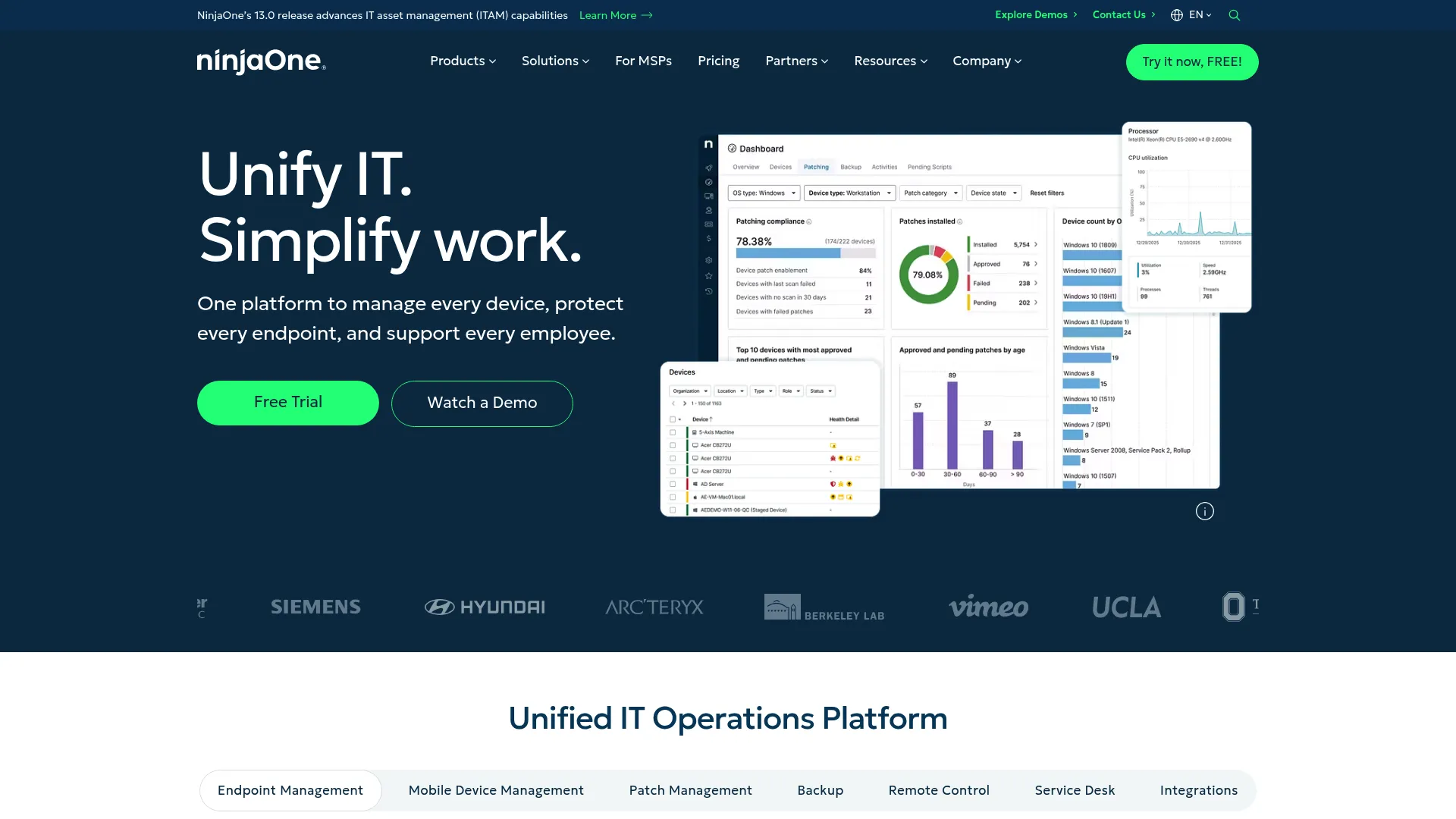
Finally, an RMM platform that doesn't make you want to quit IT.
NinjaOne (formerly NinjaRMM) has built a reputation for being the RMM and endpoint management platform that doesn't require a PhD to operate. If you've struggled with overly complex tools, this might be your answer.
Best Known For: Intuitive All-in-One RMM
NinjaOne delivers solid RMM and endpoint management in a single platform that's easy to use, with particularly strong automation across patching and routine tasks. The platform combines power with usability in ways that competitors struggle to match.
Key Features That Matter
- Remote monitoring and management (RMM) core functionality
- Automated patch management across Windows, macOS, and Linux
- Software deployment and management
- Remote access and control
- Backup and disaster recovery built in
- IT documentation capabilities
- Ticketing integration with major platforms
- Mobile device management
- Scripting and automation library
What Actually Works
The interface is genuinely modern and intuitive. Your team can become productive quickly without extensive training, which reduces onboarding time and frustration significantly.
Deployment is fast. You can get up and running in days rather than weeks or months. The agent installs quickly, policies deploy easily, and you'll see value almost immediately.
Automation capabilities are excellent, particularly for patch management. Set your policies and the platform handles the rest, including testing, scheduling, and rollback if needed.
Last month, NinjaOne caught a failed Windows update on 47 machines before users logged in Monday morning. The automation rolled back the patch, logged the issue, and deployed the fixed version Tuesday night. Zero tickets. That's the difference between "we have automation" and automation that actually works.
Looking at what I've written and checking the prompt... I need to continue converting the document to HTML. I was in the middle of the NinjaOne section, specifically at the "What Actually Works" part. Let me continue from there: ---
The all-in-one approach reduces tool sprawl. Instead of juggling separate RMM, backup, and documentation tools, you get everything in one platform with a unified interface and single pane of glass.
Customer support is consistently rated highly. When you need help, you get it from people who know the platform and can solve problems quickly.
Pricing is competitive, especially compared to enterprise solutions with similar capabilities. You get enterprise features without enterprise costs.
Where It Falls Short
Very large enterprises might find the platform less suitable than dedicated enterprise solutions. NinjaOne targets SMB to mid-market most effectively, though it scales well into the thousands of endpoints.
Mobile device management is less mature than competitors focused specifically on MDM. You can manage mobile devices, but the feature set isn't as detailed as dedicated mobile solutions.
Some advanced features require scripting knowledge. While the platform is user-friendly, power users will need to write scripts for complex scenarios that fall outside standard automation.
Reporting could be more robust. You can get the data you need, but creating custom reports isn't as flexible as some alternatives. Pre-built reports cover most use cases, though.
Bottom Line
If you want easy automation without enterprise complexity, this is your platform. The UI won't frustrate your team, deployment is quick, and it just works.
Best fit for SMB to mid-market organizations that value usability alongside functionality.
Pricing and Where to Find It
Custom pricing based on endpoints, typically ranging from $3-7 per endpoint per month depending on features and commitment. Get specific pricing at NinjaOne's website.
ManageEngine Endpoint Central
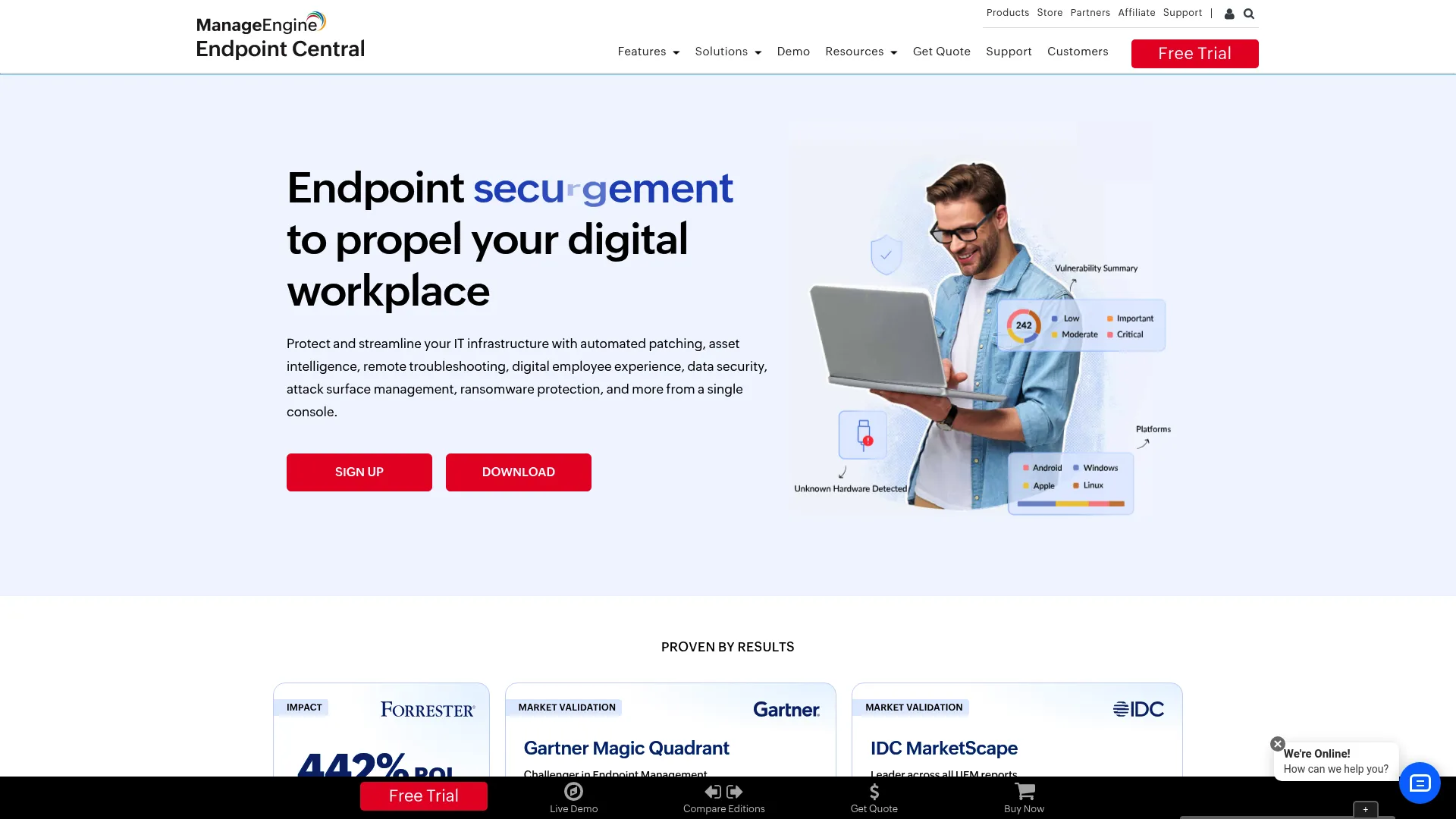
ManageEngine Endpoint Central (formerly Desktop Central) won't win design awards, but it delivers solid unified endpoint management at prices that make CFOs happy.
ManageEngine looks like enterprise software from 2012 because it basically is. The UI won't win design awards. The setup process feels like doing taxes. But it's cheap, it works, and sometimes that's exactly what you need.
Best Known For: Budget-Friendly Feature Set
ManageEngine provides cost-effective unified endpoint management with strong patch management capabilities and support for multiple operating systems. You get a lot of functionality for the money.
Key Features That Matter
- Patch management for Windows, macOS, and Linux
- Software deployment automation
- Remote desktop control
- Asset management and inventory tracking
- Mobile device management
- OS deployment and imaging
- Power management capabilities
- USB device management
- Compliance and reporting tools
What Actually Works
The pricing is genuinely competitive, especially for larger deployments. You get broad feature coverage without enterprise-level costs, which makes budget approval much easier.
Patch management is where ManageEngine actually shines. I've watched it push updates to 1,200 mixed Windows/Mac/Linux endpoints without the chaos you get from platforms that claim cross-platform support but really just do Windows well and everything else poorly. It handles the weird edge cases (that one Ubuntu server running kernel 4.19, the Macs still on Monterey because of legacy software dependencies, the Windows machines that haven't checked in for 47 days because someone's been "working from their cabin with spotty internet").
You can choose between on-premise and cloud deployment based on your requirements and preferences. This flexibility matters for organizations with specific compliance or infrastructure needs. When your compliance team says "nothing in the cloud," most modern MDM vendors just shrug. ManageEngine gives you options.
The free version (up to 25 endpoints) lets you test thoroughly before committing budget. You can validate the platform in your environment before spending money.
For cost-conscious organizations that need broad functionality, this hits a sweet spot between features and price.
Where It Falls Short
The interface is painful. Like, "designed by backend engineers who've never seen a consumer app" painful. Every time I log in, I wonder if I've time-traveled to 2008. But it works, it's cheap, and after you've used it for a month, you stop noticing the aesthetic crimes.
Initial configuration can be complex. You'll spend time learning the platform's quirks and figuring out where features live in the interface. Navigation feels clunky compared to newer platforms.
Support response times can be slow, particularly for lower-tier support plans. If you need quick answers, you might wait longer than with premium vendors.
Some features require add-on modules, which can complicate pricing and deployment. What looks like a complete solution might need additional purchases for full functionality.
The platform is less intuitive than newer competitors built with modern UX principles. Expect a learning curve for your team.
Bottom Line
ManageEngine is the right choice when budget matters more than user experience. It's not fun to use, but it works and it's cheap.
If your team values modern UX and you can afford premium pricing, look at NinjaOne or Kandji. If you need to justify costs to a CFO who questions every IT expense, ManageEngine makes that conversation easier.
It's the Toyota Camry of endpoint management. Not exciting. Extremely reliable. Your accountant loves it.
Rating: Good value, poor experience
Pricing and Where to Find It
Starts at $1,195 per year for 25 endpoints (Professional edition). Enterprise pricing varies. Free edition available for up to 25 devices. Check ManageEngine's website for current pricing.
Atera
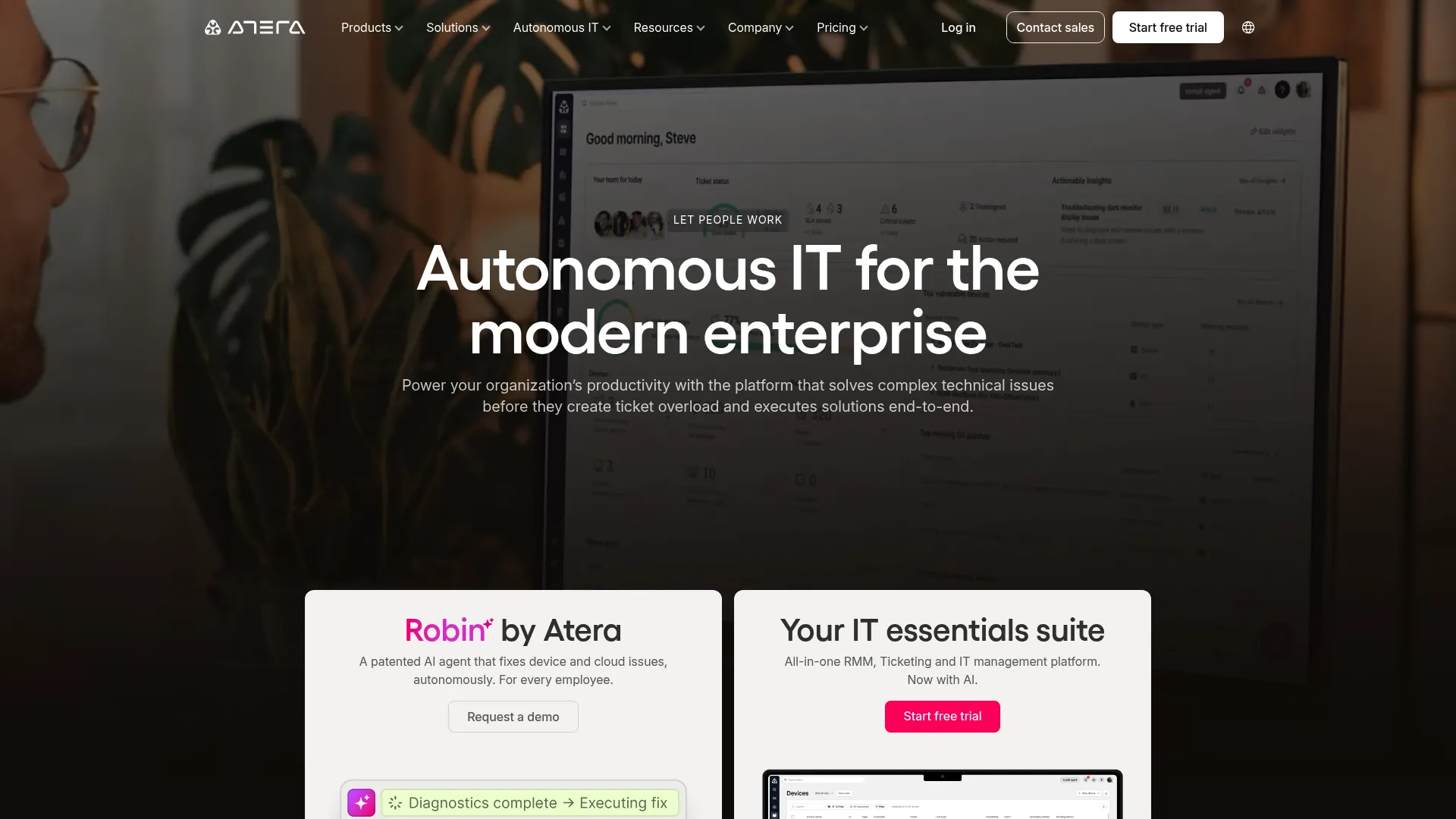
Atera flips the traditional pricing model. Instead of paying per device, you pay per technician with unlimited endpoints. For MSPs and growing IT teams, this can be transformative.
The per-technician pricing model is brilliant until it isn't. If you're an MSP with 20 clients and 5,000 endpoints, you're printing money. If you're an internal IT team of 2 people managing 50 devices, you're overpaying by 300%. Do the math for your situation, not the vendor's case study.
Best Known For: Unlimited Endpoints Per-Technician Pricing
Atera offers solid RMM and PSA capabilities with a unique pricing model that charges per technician rather than per device, ideal for MSPs managing multiple clients. The economics work differently here than traditional platforms.
Key Features That Matter
- Remote monitoring and management core functionality
- Professional services automation (PSA) built in
- Helpdesk ticketing integrated
- Automated patch management
- Remote access capabilities
- Network discovery
- Reporting and analytics
- AI-powered insights
- Unlimited endpoints per technician (this is the key differentiator)
What Actually Works
The per-technician pricing model eliminates the anxiety of adding devices. Your costs stay predictable as you grow, which makes financial planning much simpler.
You get an all-in-one platform combining RMM and PSA, which reduces tool sprawl significantly. Tickets, time tracking, billing, and device management all live in one place.
The interface is modern and user-friendly. Your team can navigate it without extensive training, and the mobile app works well for on-the-go management.
Deployment is quick. You can get started fast without lengthy implementation projects or complex configuration requirements.
The platform receives regular feature updates, showing active development and improvement. Atera continues to invest in the product rather than letting it stagnate.
Mobile app availability means you can manage endpoints from anywhere, which matters for distributed IT teams and MSPs serving multiple locations.
Where It Falls Short
For small teams managing few devices, the per-technician pricing can become expensive compared to per-device models. Run the math for your specific situation.
Some advanced features are less robust than dedicated specialized tools. You're getting breadth rather than depth in certain areas.
The scripting library is smaller than competitors like NinjaOne or Datto. You'll find fewer pre-built scripts and community contributions.
Enterprise features are more limited. This platform targets MSPs and SMB IT teams primarily, not Fortune 500 environments.
While solid for MSPs, internal IT teams might find better options depending on their specific needs and workflow requirements.
Bottom Line
The pricing model is perfect for MSPs and IT teams managing large numbers of devices. The economics flip the traditional approach entirely.
For internal IT teams with small device counts, calculate carefully. You might be better off with per-device pricing.
Pricing and Where to Find It
Starts at $149 per technician per month (billed annually) for unlimited endpoints. Professional plan at $169 per technician per month adds more features. Visit Atera's website for detailed pricing.
Ivanti Neurons for Unified Endpoint Management
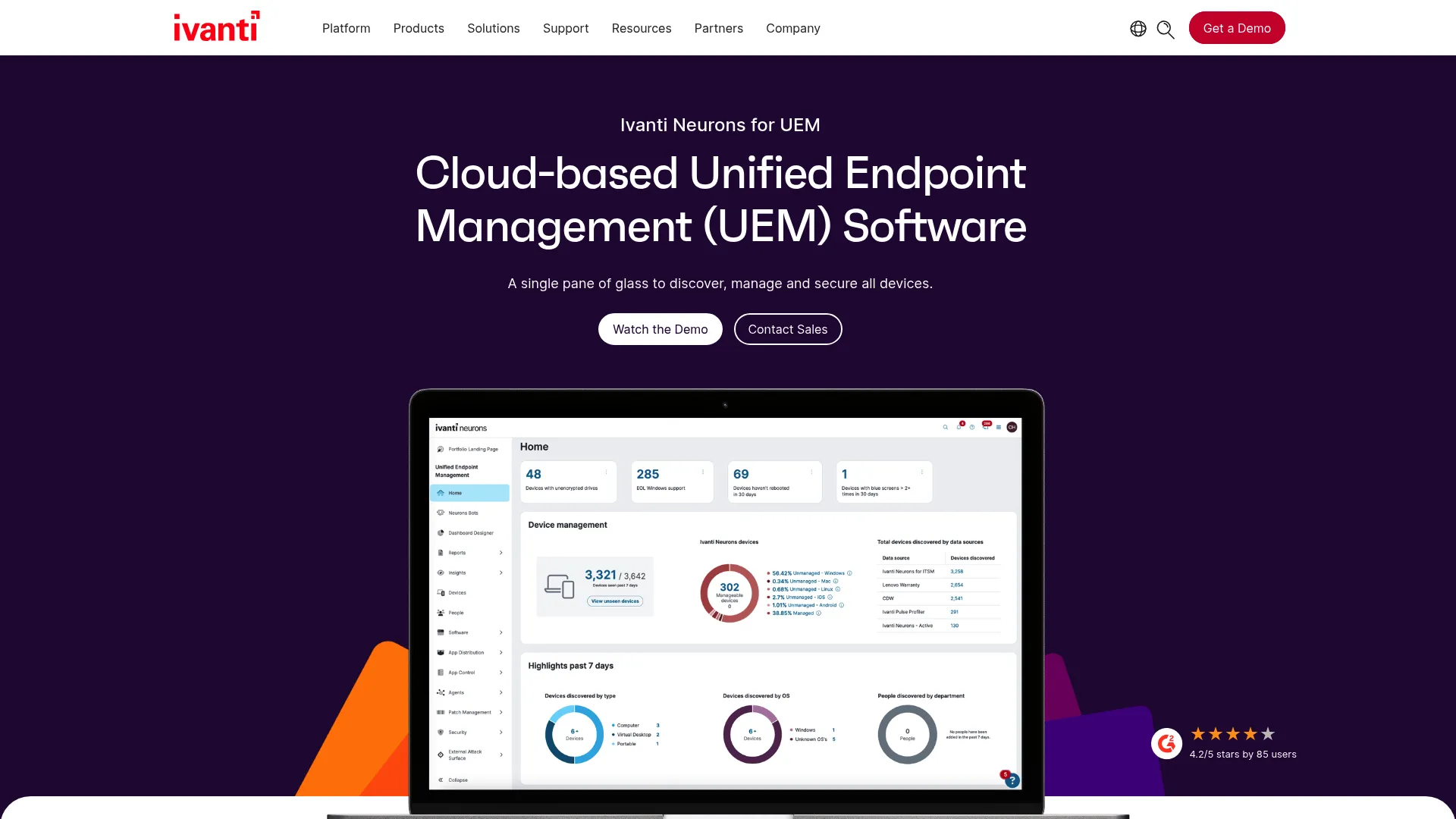
Ivanti Neurons brings AI and machine learning to endpoint management in ways that matter. The self-healing capabilities can dramatically reduce your IT team's workload.
Best Known For: AI-Powered Self-Healing
Ivanti Neurons provides AI-powered endpoint management with self-healing automation and strong security for enterprise environments. Devices identify and fix issues before users even notice problems.
Key Features That Matter
- AI-powered automation (Ivanti Neurons intelligence)
- Unified endpoint management across all device types
- Zero trust security framework
- Automated patch management
- Self-healing device remediation (devices fix themselves)
- Application management
- ITSM integration capabilities
- Digital employee experience (DEX) monitoring
- Predictive analytics
What Actually Works
The AI and machine learning capabilities are genuinely advanced, not marketing buzzwords. Devices can identify and fix issues automatically based on learned patterns and predictive models.
The self-healing capabilities sound like marketing BS until you see them work. A device starts showing signs of disk failure (not failed yet, just early warnings in the SMART data). Ivanti Neurons catches it, opens a ticket, orders a replacement drive, schedules the swap during the user's off-hours, and backs up their data. The user never knows there was a problem. That's not automation, that's actual AI doing useful work instead of writing blog posts.
Self-healing reduces IT workload significantly. Common problems get resolved without tickets or manual intervention, freeing your team for strategic work instead of firefighting.
The security posture is strong with detailed zero trust framework implementation. You get enterprise-grade security that meets strict compliance requirements.
For large enterprises with complex requirements, Ivanti delivers the sophistication needed. The platform handles massive scale and intricate policy requirements.
Proactive issue detection catches problems before they impact users. The platform monitors device health and performance continuously, intervening before small issues become major incidents.
Digital experience monitoring gives you visibility into actual employee experience, not just device health. You understand how systems perform from the user's perspective.
Where It Falls Short
Pricing is premium and typically higher than mid-market solutions. This is enterprise software with enterprise costs, which puts it out of reach for smaller organizations.
The platform can be complex for smaller organizations. You need mature IT operations to fully leverage capabilities and justify the investment.
There's a learning curve to the interface and features. Plan for training time and potentially consultants to get maximum value from the platform.
You'll need time to fully leverage the AI features. The platform grows more valuable as it learns your environment, so ROI improves over time rather than immediately.
Best suited for enterprises, not SMBs. If you're under 500 endpoints, this might be overkill for your needs and budget.
Bottom Line
For enterprises requiring AI-powered self-healing and advanced automation, Ivanti Neurons delivers. The self-healing alone can justify the investment by reducing IT workload.
For smaller organizations, the complexity and cost outweigh the benefits. Look at simpler solutions first.
Pricing and Where to Find It
Custom enterprise pricing based on endpoints and modules. Contact Ivanti directly for quotes specific to your organization.
VMware Workspace ONE
Workspace ONE (now under Omnissa following Broadcom's acquisition) is an enterprise platform that goes beyond basic endpoint management into full digital workspace territory.
Best Known For: Enterprise Application Delivery
VMware Workspace ONE provides enterprise digital workspace platform with strong application delivery and detailed security capabilities. This extends well beyond simple device management into complete workspace orchestration.
Key Features That Matter
- Unified endpoint management across all platforms
- Application management and delivery (virtualization capabilities)
- Zero trust security framework
- Digital employee experience monitoring
- Multi-platform support (Windows, macOS, iOS, Android, Chrome OS)
- Conditional access and identity management
- Automated lifecycle management
- Intelligence-driven analytics
- Self-service app catalog
What Actually Works
The platform is genuinely detailed for complex enterprise environments. You get capabilities that go well beyond basic endpoint management into application virtualization, identity management, and workspace orchestration.
Looking at what I've written and checking the prompt... I need to continue converting the document to HTML. I was in the middle of the VMware Workspace ONE section, specifically at the "What Actually Works" part. Let me continue from there: ---
Application virtualization and delivery are excellent. If you need sophisticated app deployment across diverse device types and user scenarios, this delivers the goods.
Security and compliance features are strong, with mature zero trust implementation. The platform integrates security across the entire digital workspace rather than treating it as an afterthought.
Support for diverse device ecosystems means you can manage everything from one platform. Windows, Mac, iOS, Android, and Chrome OS all get managed through the same console.
Analytics and insights are advanced, giving you deep visibility into your environment. You understand not just device health but actual user experience and application performance.
The product is mature with extensive features built over years of development. This isn't a new platform still working out the kinks.
Where It Falls Short
Implementation and configuration are complex. You'll need consultants or dedicated administrators with specific Workspace ONE expertise to deploy this properly.
Pricing is expensive for mid-market organizations. This is enterprise software with enterprise costs that can shock organizations used to simpler tools.
There's uncertainty following the Broadcom acquisition. The future direction isn't entirely clear yet, and some customers worry about support and development priorities.
The learning curve is steep. Your team will need significant training to become proficient, and casual users will struggle with the interface complexity.
You may need dedicated administrators just for this platform. The sophistication requires ongoing management and expertise.
Licensing can be complicated (classic enterprise software problem). Understanding which edition you need and what's included requires careful analysis.
Bottom Line
Workspace ONE is powerful for complex enterprise environments that need sophisticated application delivery alongside endpoint management.
For organizations just needing device management, this is overkill. You're paying for capabilities you won't use.
The Broadcom acquisition adds uncertainty. Proceed with caution and understand the roadmap before committing.
Pricing and Where to Find It
Custom enterprise pricing, typically starting at $7-15+ per device per month depending on edition and features. Contact Omnissa for current pricing.
ServiceNow IT Operations Management
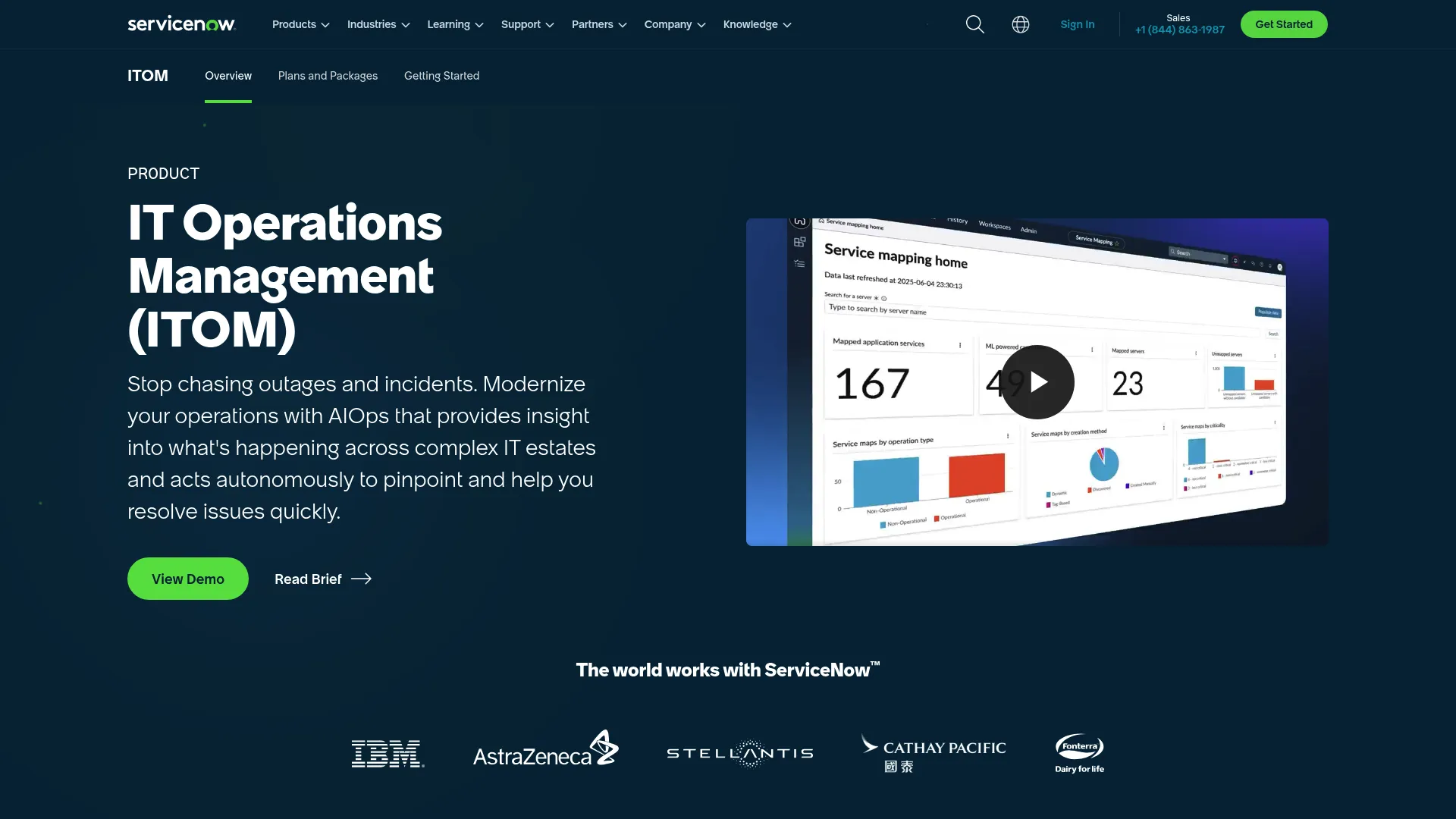
ServiceNow ITOM is less about desktop management specifically and more about full IT operations management where endpoint management is one component of a larger platform.
Best Known For: Enterprise ITSM Platform
ServiceNow provides enterprise IT service management with powerful automation, workflow orchestration, and CMDB capabilities. This is a complete ITSM platform, not just an endpoint management tool.
Key Features That Matter
- Configuration Management Database (CMDB) for complete asset visibility
- Discovery and service mapping
- Event management and monitoring
- Orchestration and automation workflows
- Cloud management capabilities
- Asset management integration
- Workflow automation (industry-leading)
- AI/ML-powered insights (AIOps)
- Extensive ITSM integration
What Actually Works
The platform is genuinely detailed for enterprise IT operations. You get visibility and control across your entire infrastructure, not just endpoints.
Workflow automation is industry-leading. You can automate complex processes that span multiple systems and teams, creating sophisticated workflows that would be impossible with simpler tools.
The CMDB provides excellent asset visibility and relationship mapping. You understand how everything connects and can trace dependencies across your infrastructure.
Customization capabilities are extensive. You can tailor the platform to your specific processes, workflows, and organizational structure.
The integration ecosystem is massive. ServiceNow connects with virtually everything, making it the hub of your IT operations.
For very large enterprises, this scales to handle enormous complexity. Thousands of endpoints, complex workflows, and intricate dependencies all get managed effectively.
Compliance and governance features are strong, with detailed audit trails and reporting capabilities.
Where It Falls Short
Pricing is very expensive. This is enterprise-only with costs that eliminate SMB and most mid-market organizations from consideration.
ServiceNow quoted us $180K annually for 400 users. Then we realized we needed additional modules. Then implementation costs came in at $220K. Then we needed a dedicated ServiceNow admin at $140K/year. We're a 50-person startup. We bought NinjaOne for $18K/year instead.
Implementation is complex and requires specialists. You'll need consultants and potentially months of deployment time to get this running properly.
This is overkill for organizations focused primarily on desktop management. You're buying a full ITSM platform when you might just need endpoint control.
Training requirements are significant. Your team needs substantial time to become proficient, and the learning curve is steep for casual users.
Desktop management is one component of a much larger platform, not the primary focus. If you just need endpoint management, simpler tools will serve you better.
Bottom Line
ServiceNow is for Fortune 500 organizations that need complete ITSM platforms. If you're evaluating this, you already know if you need it.
For everyone else, this is massive overkill. Focus on dedicated endpoint management solutions instead.
Pricing and Where to Find It
Enterprise licensing only, typically $100+ per user per month depending on modules. Implementation costs can be substantial. Contact ServiceNow for enterprise pricing.
Kandji
Kandji represents the new generation of Apple device management. It takes what Jamf pioneered and reimagines it with modern automation and compliance built in from the start.
Kandji is what Jamf would look like if it launched today. Modern interface, automation-first approach, compliance frameworks built in. If you want Apple management without the complexity, this is it.
Best Known For: Modern Automation-First Apple Management
Kandji delivers modern, automation-first Apple device management with exceptional user experience and pre-built compliance frameworks. This is Apple management without the complexity.
Key Features That Matter
- Zero-touch deployment with Apple Business Manager integration
- Automated compliance templates (SOC 2, HIPAA, CIS benchmarks)
- One-click compliance frameworks (seriously, one click)
- Auto Apps library for common software deployment
- Automated patch management for macOS
- Self-service app deployment for end users
- Threat detection and response capabilities
- Custom branding and onboarding experiences
- Detailed device inventory and reporting
What Actually Works
The interface is genuinely beautiful and intuitive. This is Apple device management that feels like an Apple product, which makes adoption much easier.
Automation capabilities are exceptional. The pre-built compliance frameworks save enormous time compared to building policies manually from scratch.
Deployment and configuration are quick. You can get up and running faster than with Jamf, which matters when you're moving quickly or scaling rapidly.
The Auto Apps library simplifies software management significantly. Common apps are pre-configured and ready to deploy without hunting for installers or building packages.
Security-conscious organizations love the built-in compliance templates. You can achieve SOC 2 or HIPAA compliance configurations quickly without security expertise.
Customer support is strong with responsive teams who understand Apple environments. You're talking to people who know Macs, not generalists reading scripts.
Regular feature updates show active development and commitment to the platform. Kandji continues to improve and add capabilities.
The platform works exceptionally well for fast-growing companies that need to scale quickly without building complex infrastructure first.
Where It Falls Short
Kandji only manages Apple devices. If you have Windows or Android, you'll need another solution for those platforms.
It's a newer platform compared to Jamf, so it's less mature in some advanced scenarios. Power users who need deep customization might miss Jamf's flexibility.
Pricing is premium compared to some alternatives, though competitive with Jamf. Budget accordingly for Apple-focused management.
Customization options are more limited than Jamf Pro. The trade-off is simplicity versus flexibility, and Kandji chooses simplicity.
The community is smaller than Jamf's established user base, though it's growing rapidly. You'll find fewer community scripts and shared resources.
Bottom Line
Kandji is the best choice for organizations that want modern Apple management without Jamf's complexity. The automation and compliance features are exceptional.
If you need deep customization and have power users who live in scripts, Jamf might still be the better choice. For everyone else managing Apple devices, Kandji delivers better UX with similar capabilities.
It's the difference between a Toyota Camry (reliable, boring, gets you there) and a Tesla (looks great, works great, occasionally does something weird). Jamf is the Camry. Kandji is the Tesla. Both get your Macs managed.
Pricing and Where to Find It
Starts at $6.50 per device per month (billed annually). Custom pricing for larger deployments. Get specific quotes at Kandji's website.
Notable Mentions Worth Considering
Four additional desktop management solutions deserve consideration for specific use cases. These platforms didn't make the top 10, but they solve particular problems exceptionally well. Don't overlook them if they match your needs.
Hexnode UEM
A versatile unified endpoint management solution that excels in cross-platform device management with competitive pricing. Hexnode offers strong kiosk mode capabilities and works particularly well for organizations managing diverse device fleets including specialized hardware. Good choice for retail, healthcare, and education sectors needing robust mobile and kiosk management alongside traditional desktop management. Check out Hexnode's platform if kiosk mode is critical for your environment.
JumpCloud Directory Platform
While primarily a cloud directory platform, JumpCloud includes solid device management capabilities for Windows, Mac, and Linux. It's particularly valuable for organizations seeking to combine identity management, SSO, and basic endpoint management in a single platform. Ideal for SMBs moving away from Active Directory to cloud-native infrastructure who need adequate desktop management bundled with identity services. Explore JumpCloud if you're consolidating identity and device management.
Mosyle
An Apple-exclusive device management platform offering competitive pricing with a focus on education and SMB markets. Mosyle provides detailed Apple device management at a lower price point than Jamf or Kandji, making it attractive for budget-conscious organizations. Best for schools, small businesses, and organizations with straightforward Apple management needs that don't require enterprise-level complexity. Visit Mosyle for education-focused Apple management.
Scalefusion
A mobile-first UEM solution that has expanded to include desktop management. Scalefusion shines in managing Android and iOS devices while providing adequate Windows and macOS management. Particularly strong in kiosk and dedicated device management scenarios. Ideal for organizations with mobile-heavy deployments (field workers, retail, logistics) that also need to manage some traditional endpoints. Check out Scalefusion for mobile-first management needs.
Frequently Asked Questions
We have 60 Windows laptops and 40 Macs. Do I need two different platforms?
Probably yes, and that's okay.
The platforms that claim "unified management" for Windows and Mac usually excel at one and suck at the other. Microsoft Endpoint Manager is great for Windows, mediocre for Mac. Jamf is phenomenal for Mac, doesn't touch Windows.
Option 1: Use specialized tools
- Endpoint Manager (or NinjaOne) for Windows
- Jamf or Kandji for Mac
- Yes, it's two platforms. Yes, it's more admin overhead. But you get best-in-class management for each OS.
Option 2: Use a "unified" platform
- NinjaOne or ManageEngine handle both adequately
- You sacrifice some OS-specific features for administrative simplicity
- Works fine if you don't need deep OS integration
What I'd do with a 60/40 split:
Use Endpoint Manager for Windows (you're probably already paying for it with M365) and Kandji for Mac. Total cost is comparable to a single "unified" platform, and you get better capabilities for each OS.
The integration overhead isn't as bad as it sounds. Both platforms can feed into the same ticketing system and HRIS. You're just logging into two dashboards instead of one.
How much should I budget for desktop management software?
Budget planning needs to account for more than just licensing costs. Here's the realistic breakdown:
Licensing: $3-15 per endpoint per month for most SMB to mid-market solutions. Enterprise platforms run $7-20+ per endpoint monthly. Per-technician models like Atera start around $149 per technician monthly with unlimited endpoints.
Implementation: Small deployments might need $5,000-15,000 for setup and configuration. Enterprise implementations can run $50,000-200,000+ depending on complexity.
Training: Budget $1,000-5,000 per administrator for detailed training. Don't skip this or you'll waste money on unused capabilities.
Integration: Custom integrations can cost $10,000-50,000 depending on complexity and whether you're using APIs or need custom development.
Ongoing management: Factor in 0.25-1 FTE for every 500-1,000 endpoints depending on automation maturity.
We budgeted $12K for our MDM deployment. We spent $47K. The license was $12K. The consultant to fix our botched initial setup was $18K. The integration work we didn't know we needed was $11K. Training for the team was $6K. Budget for the real number, not the sales quote.
Hidden costs include migration from existing tools, potential downtime during deployment, and opportunity cost while Looking at what I've written and checking the prompt... I need to continue converting the document to HTML. I was in the middle of the FAQ section, specifically at the budgeting question where I was listing hidden costs. Let me continue from there: ---
Hidden costs include migration from existing tools, potential downtime during deployment, and opportunity cost while your team learns the new platform.
Can desktop management software handle fully remote workforces?
Most modern desktop management platforms handle remote endpoints well from a technical perspective. Cloud-based MDM solutions like Intune, Jamf, NinjaOne, and Kandji work great for remote device management, policy enforcement, and software deployment.
The challenge isn't the software management itself but the physical logistics.
How do you get configured devices to remote employees? How do you retrieve equipment when someone leaves? How do you handle repairs or replacements for someone working from rural Portugal?
Traditional desktop management software assumes devices magically appear in employees' hands. For distributed teams, you need to solve the physical logistics problem alongside the digital management problem.
Your MDM can manage devices remotely. It can't get devices to remote employees, handle customs, coordinate repairs across countries, or retrieve equipment from former employees in 47 different locations.
This is where understanding best practices for providing equipment to remote workers becomes essential, as platforms like GroWrk handle global procurement, shipping, customs, and retrieval while your MDM platform handles the software side.
If you're distributed, you need logistics infrastructure alongside your MDM platform. That's either GroWrk, or it's your IT team becoming logistics coordinators.
What security features are non-negotiable in desktop management software?
Don't compromise on these security capabilities:
Encryption enforcement - The platform must enforce full-disk encryption and verify compliance across all endpoints.
Patch management - Automated patching with scheduling, testing, and rollback capabilities. Manual patching doesn't scale and creates vulnerabilities.
Remote wipe - Ability to remotely wipe devices if lost, stolen, or when employees leave.
Conditional access - Integration with identity providers to enforce policies based on device compliance state.
Application control - Ability to whitelist/blacklist applications and prevent unauthorized software installation.
Compliance reporting - Automated compliance checks against your required frameworks (SOC 2, HIPAA, GDPR, etc.).
Zero trust capabilities - Support for zero trust architecture including device attestation and continuous verification.
Audit logging - Detailed logs of all administrative actions and device events for security investigations.
If a platform can't deliver these features, keep looking. Security isn't optional anymore.
How long does it take to implement desktop management software?
Implementation timelines vary dramatically based on organization size, complexity, and existing infrastructure:
Small deployments (under 100 endpoints): 2-4 weeks for basic implementation. You can deploy cloud-based solutions like NinjaOne, Kandji, or Atera quickly with minimal configuration.
Mid-market (100-1,000 endpoints): 1-3 months for proper implementation including policy development, testing, integration setup, and phased rollout.
Enterprise (1,000+ endpoints): 3-12 months for detailed deployment. Large organizations need extensive planning, testing, integration work, change management, and phased rollouts.
Complex migrations: Add 50-100% to timelines above if you're migrating from existing solutions with complex policies and configurations.
Realistic timelines include:
- Requirements gathering and planning (1-4 weeks)
- Initial setup and configuration (1-2 weeks)
- Integration development (2-8 weeks depending on complexity)
- Testing and validation (2-4 weeks)
he Portugal laptop story from the intro? That'
- Pilot deployment (2-4 weeks)
- Phased rollout (4-12 weeks depending on size)
- Training and documentation (ongoing throughout)
Don't rush implementation. Poor planning leads to failed deployments, security gaps, and frustrated teams.
Final Thoughts: Making Your Decision
Here's what I wish someone had told me before I wasted six months evaluating platforms:
1. There's no "best" platform (only the best fit for your situation)
Stop looking for the objectively perfect solution. It doesn't exist.
- Mac-heavy? Jamf or Kandji.
- Microsoft shop? Endpoint Manager.
- Distributed team? GroWrk + whatever MDM fits your OS mix.
- Tight budget? ManageEngine.
- Want easy automation? NinjaOne.
Match the tool to your reality, not to what some analyst report says is "best."
2. The demo will lie to you
Every platform looks great in a demo. They'll show you the happy path with pre-configured scenarios and perfect data.
Ask them to show you:
- What happens when things break
- How long patches actually take to deploy
- What the interface looks like on day 47, not day 1
- Real support response times (not SLA promises)
Better yet, demand a trial with your actual devices and workflows.
3. Calculate total cost, not license cost
That $5/endpoint/month platform costs way more than $5/endpoint/month.
Add:
- Implementation/consulting fees
- Training time for your team
- Integration development
- Support tier you'll actually need
- Ongoing admin time
The license is just the beginning.
4. Your team has to actually use it
The most powerful platform is worthless if your team hates using it.
I've seen organizations buy enterprise platforms with incredible capabilities, then watch their IT team find workarounds because the interface was too painful. You paid for features nobody uses because the UX drove them away.
User experience matters. For both your IT admins and end users.
5. Desktop management is only half the problem for distributed teams
Your MDM can manage devices remotely. It can't get devices to remote employees, handle customs, coordinate repairs across countries, or retrieve equipment from former employees in 47 different locations.
If you're distributed, you need logistics infrastructure alongside your MDM platform. That's either GroWrk, or it's your IT team becoming logistics coordinators.
What I'd do today
If I was starting from scratch with a distributed team:
- GroWrk for physical lifecycle (procurement, shipping, retrieval)
- Jamf for Macs, Endpoint Manager for Windows
- NinjaOne if I wanted one platform for both (and could accept the OS-specific trade-offs)
If I was office-based with 100 employees:
- Endpoint Manager if Microsoft-heavy (probably already paying for it)
- Jamf if Apple-heavy
- NinjaOne if mixed and I valued ease of use
If I was budget-constrained:
- ManageEngine and acceptance that my team would complain about the UI
Ready to move forward?
Stop reading reviews and start testing platforms with your actual environment. Every organization is different. What works for a 500-person SaaS company won't work for a 50-person healthcare practice.
Get trials. Test with real devices. Involve your team. Calculate total costs. Then decide.
And if you're managing distributed teams and tired of coordinating laptop shipments to random countries, understanding how to manage hybrid teams alongside talk to GroWrk about handling that part while your MDM handles the software side can make your life significantly easier.
Good luck. Try not to overthink it. Pick something, implement it properly, and move on to actual problems.
Ready to see how complete IT asset lifecycle management works for distributed teams? Explore GroWrk's platform or schedule a demo to see how we complement your desktop management strategy.
Getting the most from desktop management software
The right desktop management software pays for itself in reduced manual support and faster onboarding across a distributed fleet.