



You're tracking SLAs. Negotiating contracts. Optimizing spend. And you're still hemorrhaging money.
The problem isn't in your spreadsheets. I've looked at hundreds of procurement budgets, and the biggest cost never shows up in any of them. It's your vendor relationships. Not the contracts themselves: the way you've structured them. And it's costing you way more than you think.
I've worked with 60+ companies on IT procurement. Want to know what they all have in common? They're obsessed with vendor management frameworks. They've got scorecards, KPIs, quarterly business reviews, the whole nine yards.
And they're all missing the same thing: the frameworks themselves are the problem.
The traditional vendor relationship model was designed for a different era of IT procurement. Clinging to it is actively working against your team's efficiency. And the symptoms show up everywhere except your vendor scorecards.
TL;DR
- Vendor fragmentation creates invisible operational costs that exceed the savings from competitive pricing
- Multi-vendor strategies introduce coordination failures that single-vendor risks don't account for
- Procurement velocity matters more than control in distributed work environments
- Vendor-neutral policies often protect outdated processes rather than business outcomes
- Strategic consolidation differs fundamentally from vendor lock-in when structured correctly
- Standardization can reduce flexibility faster than it reduces costs
- Distributed teams expose the weaknesses in centralized procurement models
The Hidden Tax of Vendor Fragmentation
Vendor fragmentation screws up more than your tech stack. It creates work. Tons of it. And most procurement teams don't even realize where all that work is coming from.
The math seems simple: more vendors equal more competitive options and better pricing leverage. But this calculation ignores the resource costs of managing those relationships, the time lost to vendor-specific processes, and the opportunities missed because your team is buried in administrative work.
We're not talking about consolidating just to consolidate. We're talking about recognizing that your vendor architecture has become your bottleneck, and the symptoms are showing up everywhere except your vendor scorecards.
This is the same blind spot that shows up in category management procurement for hardware specifically, where unit-price wins get celebrated while deployment, support, and disposal costs pile up somewhere nobody's tracking.
Why Your Vendor Count Keeps Growing (And Why That's a Red Flag)
Every new vendor makes sense at the time. That's the trap.
You need faster delivery in Europe? Add a regional vendor. Engineering needs specialized workstations? Bring on a specialist. Security wants specific hardware tokens? Get another vendor.
Each decision is rational. Each one solves a real problem. And each one makes your life 15% more complicated.
Do that enough times and you're drowning.
The pattern repeats across organizations: you start with three core IT vendors, add two more for specialized needs, bring on regional partners for global expansion, and suddenly you're managing twelve vendor relationships for hardware alone. Each relationship seemed justified at the time. Each one solved a real problem.
But here's what the business case for each new vendor never captures: the cumulative cost of context switching, the multiplication of invoice reconciliation tasks, the expansion of your compliance surface area, and the dilution of your team's vendor expertise.
Take one company I worked with: 200 people, fully remote, growing fast. Let's call them TechCo because I can't use their real name.
In 2020, they had one hardware vendor. Simple. By 2022? Seven vendors. And their IT manager, Jessica, was spending 15 hours a week just coordinating between them. Not managing IT. Not solving problems. Just coordinating.
When I asked her why they kept adding vendors, she pulled up the business cases. Every single one made perfect sense in isolation. "We needed faster delivery in Europe." "Engineering needed specialized workstations." "Security required specific hardware tokens."
All logical. All approved. All collectively killing their productivity.
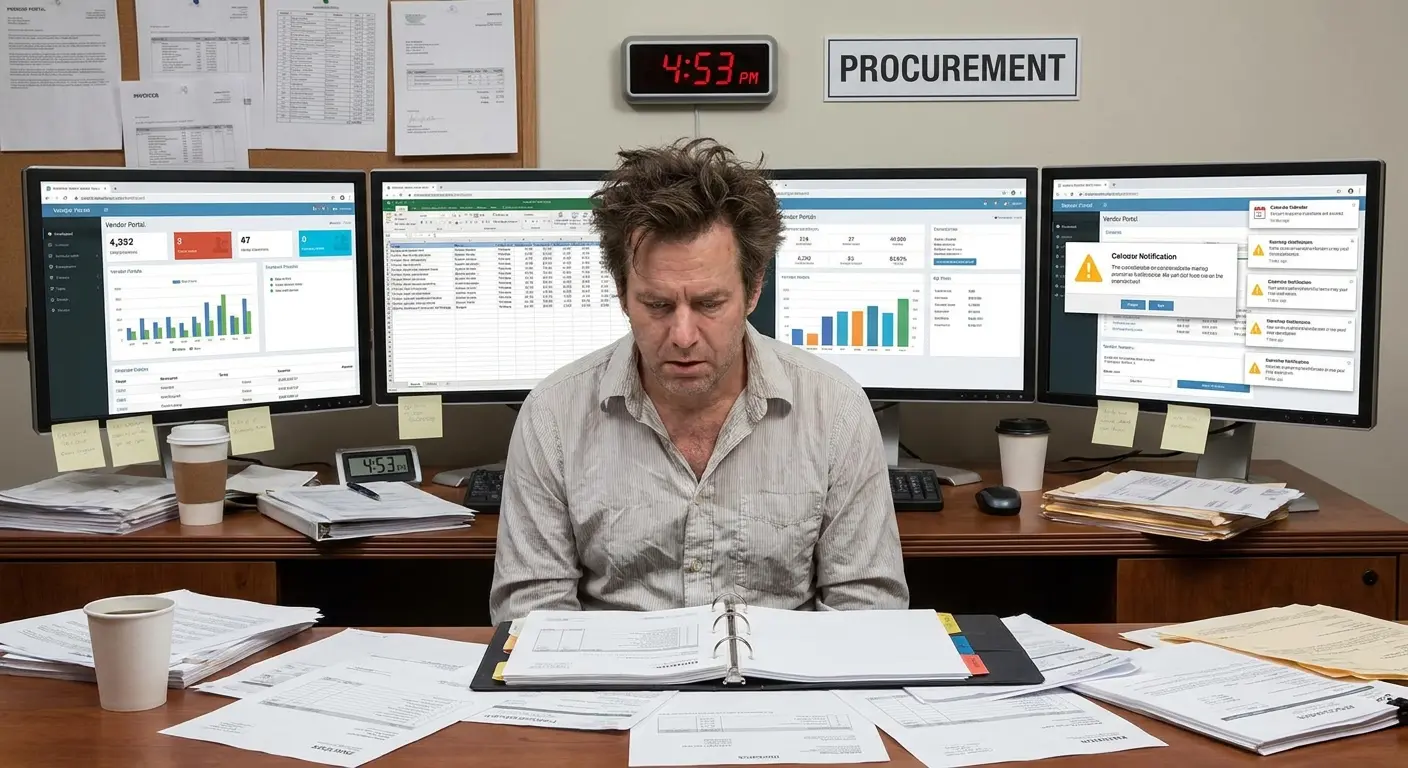
Within 18 months of that first expansion, their IT procurement manager was coordinating with seven different vendors, each with unique portals, payment terms, and support processes. The procurement team spent 15 hours per week on vendor coordination tasks that didn't exist when they had a single vendor relationship. The cost savings from competitive pricing were completely offset by the additional headcount they needed to manage the complexity.
The Coordination Costs No One Measures
Last year, I asked a procurement director to track every minute spent on vendor coordination. Just coordination, not the actual procurement work.
She thought it'd be maybe 10 hours a week. Want to guess what it actually was?
Your procurement team spends hours each week on vendor coordination tasks that don't appear in any cost analysis. Different vendors have different portals, different ordering processes, different support channels, and different SLA structures.
You're running multiple procurement operations in parallel, each with its own learning curve and operational overhead.
This fragmentation cascades through your organization. IT teams need to know which vendor to contact for which issue. Finance teams reconcile invoices from different systems with different formats. Compliance teams track certifications across multiple vendor security frameworks.
When developing your IT procurement process, consider how vendor management best practices can help reduce coordination overhead while maintaining operational efficiency.
| Vendor Management Activity | Single Vendor (hours/month) | Three Vendors (hours/month) | Seven Vendors (hours/month) |
|---|---|---|---|
| Invoice reconciliation | 4 | 12 | 28 |
| Portal management & logins | 2 | 6 | 14 |
| Support ticket coordination | 3 | 9 | 21 |
| Contract review & renewals | 2 | 6 | 14 |
| Compliance documentation | 3 | 9 | 21 |
| Vendor relationship meetings | 4 | 12 | 28 |
| Total coordination time | 18 | 54 | 126 |
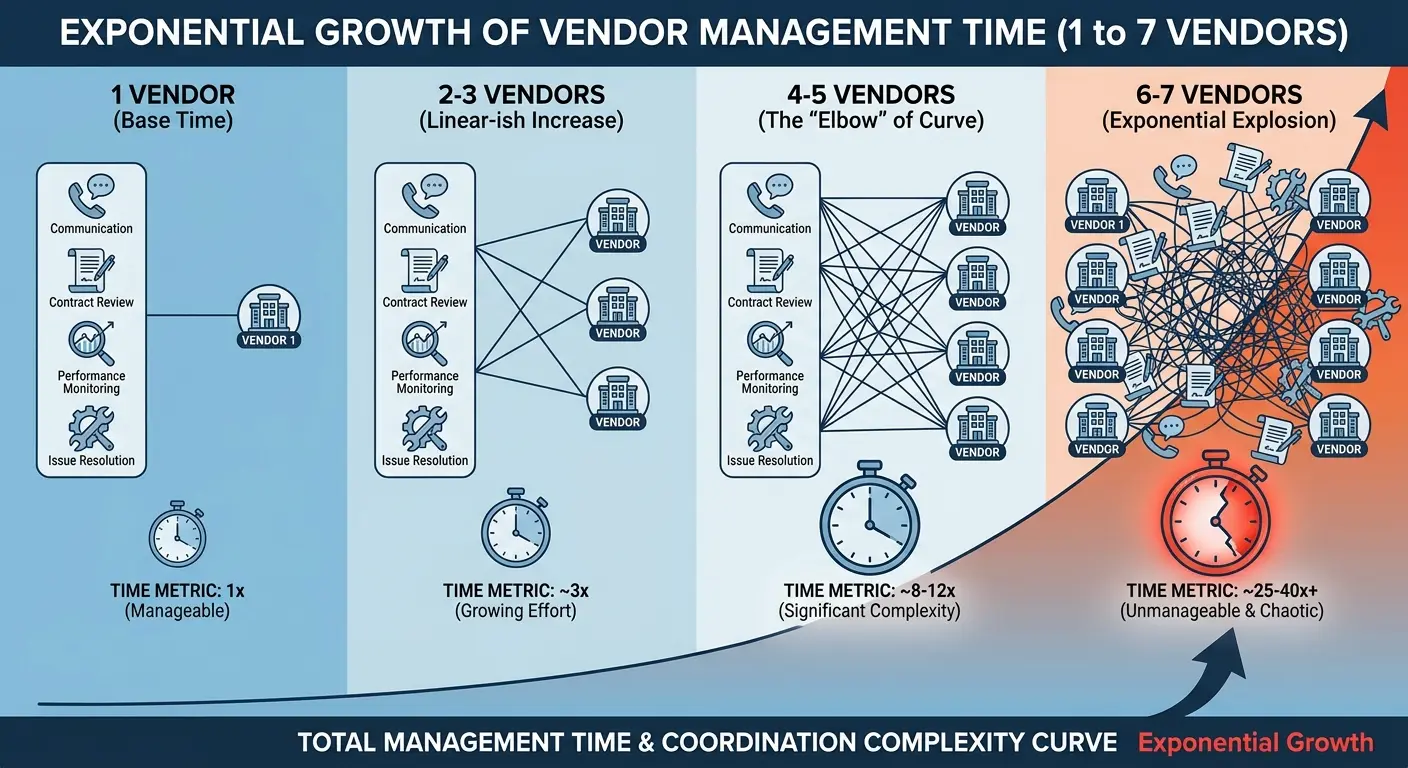
Yeah. 126 hours a month with seven vendors. She nearly fell out of her chair when we added it up.
The real cost isn't the vendor management itself. It's what your team isn't doing because they're managing vendors. Strategic initiatives get delayed. Process improvements get postponed. Your procurement function becomes reactive because proactive work requires bandwidth your team doesn't have.
When Vendor Diversity Becomes Vendor Chaos
We conflate vendor diversity with risk mitigation, but there's a threshold where diversity becomes chaos. You cross that threshold when your team can't maintain deep knowledge of any single vendor relationship because they're spread too thin across too many.
Shallow vendor relationships produce shallow outcomes. You can't negotiate well when you don't understand a vendor's business model. You can't optimize processes when you're still learning their basic workflows. You can't identify value-add opportunities when you're focused on keeping the basics running.
The fragmentation also creates gaps in accountability. When something goes wrong and three vendors are involved, you spend more time determining responsibility than solving the problem. Vendor finger-pointing becomes a feature of your operations rather than an exception.
Building a coherent IT procurement strategy means recognizing when vendor diversity stops being an asset and starts being a liability.
Why Multi-Vendor Strategies Create Single Points of Failure
Here's what nobody wants to hear: multi-vendor strategies are often just risk theater.
You tell yourself you're reducing dependency. What you're actually doing is creating a different kind of dependency on your own ability to coordinate between vendors. And when that coordination breaks down (and it will), you've got nobody to call.
At least with one vendor, you know whose door to knock on when things go sideways.
Multi-vendor strategies promise redundancy and reduce dependency risk, but they introduce their own failure modes that centralized approaches don't face. The coordination layer between vendors becomes a single point of failure that's harder to manage than any individual vendor relationship.
When vendors need to work together to deliver outcomes, you've created integration dependencies that are more fragile than the vendor dependencies you were trying to avoid. The failure isn't dramatic. It's gradual and systemic.
Projects slow down because vendor coordination adds weeks to timelines. Issues take longer to resolve because troubleshooting spans multiple support organizations. Your procurement operation becomes the integration layer that holds everything together, which means your team is now the single point of failure. See how Illumio simplified global IT procurement using GroWrk.
The Integration Burden You Didn't Plan For
You chose multiple vendors to avoid putting all your eggs in one basket. But those vendors need to work together, and making that happen is your problem, not theirs.
Vendor A provides the hardware. Vendor B handles deployment. Vendor C manages support. Each vendor optimizes for their piece of the process, and nobody optimizes for the handoffs between them.
Those handoffs are where your operations break down. Hardware arrives but deployment is delayed because Vendor B's process requires information in a format Vendor A doesn't provide. Support tickets bounce between vendors because the issue spans their respective domains. You become the translator, the coordinator, and the integration point.
This coordination burden scales exponentially, not linearly. Two vendors require one integration point. Three vendors require three integration points. Four vendors require six. Your procurement team becomes a full-time integration service.
A financial services firm used one vendor for laptops, another for mobile devices, and a third for deployment services. When a new hire needed both a laptop and a phone configured for their role, the process required the deployment vendor to receive equipment from two different suppliers, each shipping on different schedules.
The laptop arrived on Monday, but the phone didn't ship until Wednesday because that vendor processed orders on a different cycle. The deployment vendor couldn't complete the configuration package until both devices arrived, delaying onboarding by a full week. The procurement team spent hours coordinating delivery schedules across vendors for what should have been a routine new hire setup.

How Vendor Redundancy Creates Process Fragility
Redundancy should make systems more resilient. In vendor relationships, it often makes them more fragile because redundancy requires coordination, and coordination introduces new failure modes.
You maintain relationships with two hardware vendors for redundancy. When your primary vendor has a supply chain issue, you shift orders to your secondary vendor. Sounds resilient.
But your secondary vendor has different lead times, different configuration options, and different support processes. Your IT team needs to know both systems. Your procurement team maintains two sets of vendor relationships. Your finance team reconciles two invoice formats.
The redundancy you built for resilience becomes a source of operational complexity that creates its own risks. You're not just managing vendor risk anymore. You're managing the risk of your own multi-vendor coordination failing.
When Competition Between Vendors Hurts You
Vendor competition should work in your favor. Sometimes it works against you.
You split your hardware procurement between two vendors to keep them competitive. Each vendor knows they don't have your full business, so neither invests in deep partnership. You get standard pricing and standard service because you're not a strategic account for either vendor.
The vendors compete on price but not on value-add services, process optimization, or strategic support. You've created a race to the bottom that optimizes for transaction cost but ignores relationship value.
This dynamic is damaging for complex procurement needs where vendor expertise and partnership matter more than unit cost. You need vendors who understand your business, anticipate your needs, and invest in making your operations smoother. That level of partnership requires commitment on both sides, and multi-vendor strategies often prevent it from developing.
Following IT procurement best practices means understanding when competitive tension helps and when it hinders your operations.
Procurement Velocity vs. Procurement Control (And Why You're Choosing Wrong)
I'm going to say something that'll make procurement professionals mad: most approval processes exist to cover someone's ass, not to prevent actual problems.
There. I said it.
Look at your approval chain. How many of those approvers have ever actually rejected a request? How many times has that approval step caught a real error versus just adding two days to your timeline?
I've reviewed approval processes at 40+ companies. You want to know the average rejection rate at the approval stage? Less than 3%.
You're adding a week to every order to catch 3% of requests. And half of those "catches" are just missing information that could've been automated.
Procurement teams optimize for control when they should optimize for velocity, and this misalignment creates friction throughout the organization. Control-oriented procurement processes were designed for centralized operations where speed mattered less than compliance and cost management.
Those priorities don't match the reality of distributed teams that need equipment fast and can't wait for approval cycles designed for a different era. The tension between procurement and the rest of the organization isn't about procurement being difficult. It's about procurement optimizing for the wrong metric.
Velocity doesn't mean abandoning controls. It means designing controls that work at the speed your business operates, not the speed your processes were designed for.
Understanding what is IT procurement in modern organizations means recognizing that speed and control aren't opposites. They're both essential, and the challenge is building systems that deliver both.
The Approval Processes That Slow Everything Down
Your procurement process has checks and balances designed to prevent mistakes. Those same checks and balances prevent speed.
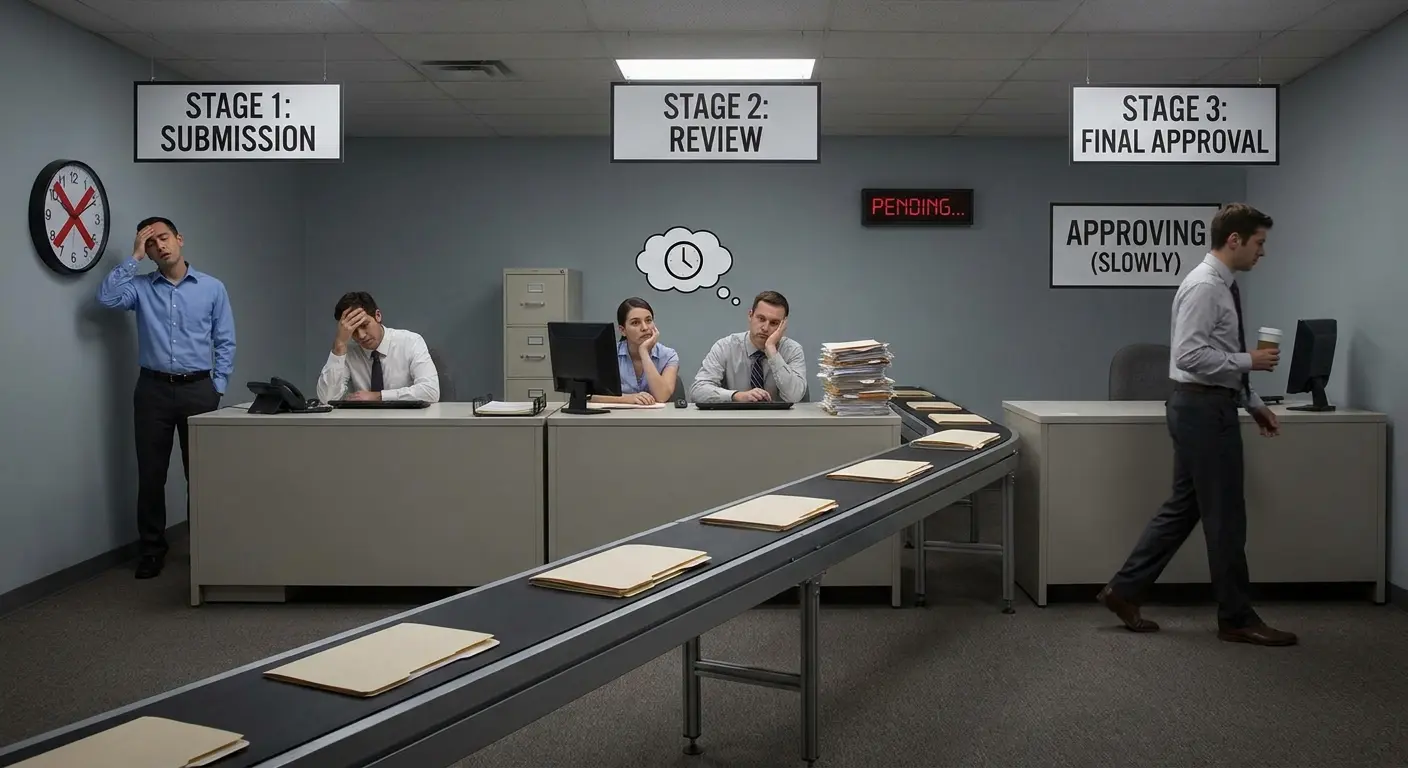
A manager needs to approve a laptop order. Then finance needs to verify budget. Then IT needs to confirm specifications. Then procurement needs to validate the vendor. By the time the order is placed, the new employee's start date is next week and you're paying for expedited shipping to make up for process delays.
Each approval step made sense when it was added. Collectively, they create a sequential process where delays compound. One approver takes two days, the next takes three, and suddenly a simple hardware order takes two weeks.
Understanding what is IT procurement means recognizing how to avoid delays in IT procurement through streamlined approval workflows that balance control with operational speed.
Procurement Velocity Audit Checklist
Use this checklist to identify bottlenecks in your current approval process:
- Map every approval step from request to order placement
- Document average response time for each approver
- Calculate total elapsed time for standard orders vs. employee start dates
- Identify which approval steps catch actual errors vs. rubber-stamp approvals
- Determine which approvals could be automated based on predefined criteria
- Assess whether approval authority could be pushed to lower levels for routine orders
- Review expedited shipping costs as a percentage of total procurement spend
- Survey hiring managers on procurement-related onboarding delays
- Compare your approval timeline to competitor time-to-productivity metrics
The process was designed for control, not velocity. And in distributed work environments where hiring happens quickly and teams span time zones, control without velocity means your procurement function becomes a bottleneck rather than an enabler.
Why Distributed Teams Break Centralized Procurement
Centralized procurement worked when everyone was in the same office and IT needs were predictable. Distributed teams operate differently.
You're hiring someone in Singapore who starts in two weeks. Your centralized procurement process is designed for North American timelines and vendors. The equipment needs to be configured for local power standards, shipped internationally, and delivered to a home office.
Your process wasn't built for this. It assumes local delivery, standard configurations, and predictable timelines. Adapting it for each new market adds complexity that slows everything down.
Distributed teams need procurement systems that are fast by default, not systems that can be expedited as an exception. The exception is becoming the norm, and your processes haven't caught up.
The Real Cost of Procurement Friction
Procurement friction doesn't just delay orders. It creates workarounds that undermine your entire IT procurement process.
Teams get tired of waiting for procurement approval, so they buy equipment on corporate cards and expense it later. You lose visibility, lose volume discounts, and lose control over standardization. The workarounds proliferate because your process is too slow for operational reality.
This shadow IT procurement is a symptom, not a cause. The cause is procurement processes that prioritize control over velocity to the point where the organization routes around them.
You can crack down on workarounds, but that doesn't solve the underlying problem. Your procurement function needs to be fast enough that workarounds aren't necessary. Otherwise, you're fighting your own organization instead of enabling it.
The Real Cost of Vendor-Neutral Policies
Vendor-neutral policies drive me insane.
Not because they're wrong in theory. In theory, they make perfect sense. Stay flexible, maintain options, never get locked in.
But in practice? They're an excuse to never commit to anything. Never build a real partnership. Never get past surface-level vendor relationships.
I watched a company rotate through three hardware vendors in four years because of their vendor-neutral policy. Each time, they spent six months getting the new vendor up to speed. Each time, they lost the institutional knowledge they'd built. Each time, they congratulated themselves on maintaining flexibility.
They were so flexible they couldn't move.
Vendor-neutral policies sound like best practices, but they often protect outdated processes rather than business outcomes. The goal of vendor neutrality is to avoid lock-in and maintain competitive options. The reality is that vendor-neutral policies prevent the deep partnerships that drive real value in IT procurement.
You end up with transactional relationships across the board because your policies prevent anything deeper. This approach made sense when vendors were interchangeable and switching costs were low.
Modern IT procurement involves complex integrations, ongoing support relationships, and vendor-specific expertise that takes time to develop. Vendor neutrality in this context means staying perpetually at the surface level with every vendor, never developing the depth of relationship that unlocks value beyond pricing. Those deeper relationships pay off across the full device lifecycle, which we examine in the state of IT lifecycle management.
How Neutrality Prevents Partnership
Vendor-neutral policies treat all vendors as interchangeable, which means you never develop strategic relationships with any of them.
You rotate hardware vendors every contract cycle to maintain neutrality. Each new vendor needs to learn your requirements, your processes, and your team's preferences. By the time they understand your business, the contract is up for renewal and you might switch again.
This approach optimizes for theoretical flexibility at the cost of practical partnership. Vendors invest in customers who commit to them. They provide better service, more flexible terms, and proactive support to accounts they view as strategic. Vendor-neutral policies prevent you from becoming a strategic account for anyone.
The Switching Costs You're Not Accounting For
Vendor neutrality assumes switching costs are minimal. For modern IT procurement, that assumption is wrong.
Switching hardware vendors means retraining your IT team on new support processes, updating your asset management systems with new vendor integrations, renegotiating terms with new account teams, and rebuilding institutional knowledge about vendor capabilities and limitations.
These costs don't appear in procurement scorecards, but they're real. Your team spends weeks getting up to speed with a new vendor, during which productivity drops and mistakes increase. The learning curve has a cost that your vendor-neutral policy doesn't measure.
| Switching Cost Category | Visible in Procurement Reports | Actual Business Impact |
|---|---|---|
| New contract negotiation time | Yes | 40-60 hours of senior staff time |
| IT team retraining | No | 2-3 weeks reduced productivity |
| Asset management system integration | Partially | 80-120 hours implementation + ongoing maintenance |
| Lost institutional knowledge | No | 6-12 months to rebuild vendor expertise |
| Support process learning curve | No | 25-40% longer resolution times for 3-6 months |
| Relationship development | No | 12-18 months to achieve strategic account status |
| Process documentation updates | Partially | 20-30 hours across multiple teams |
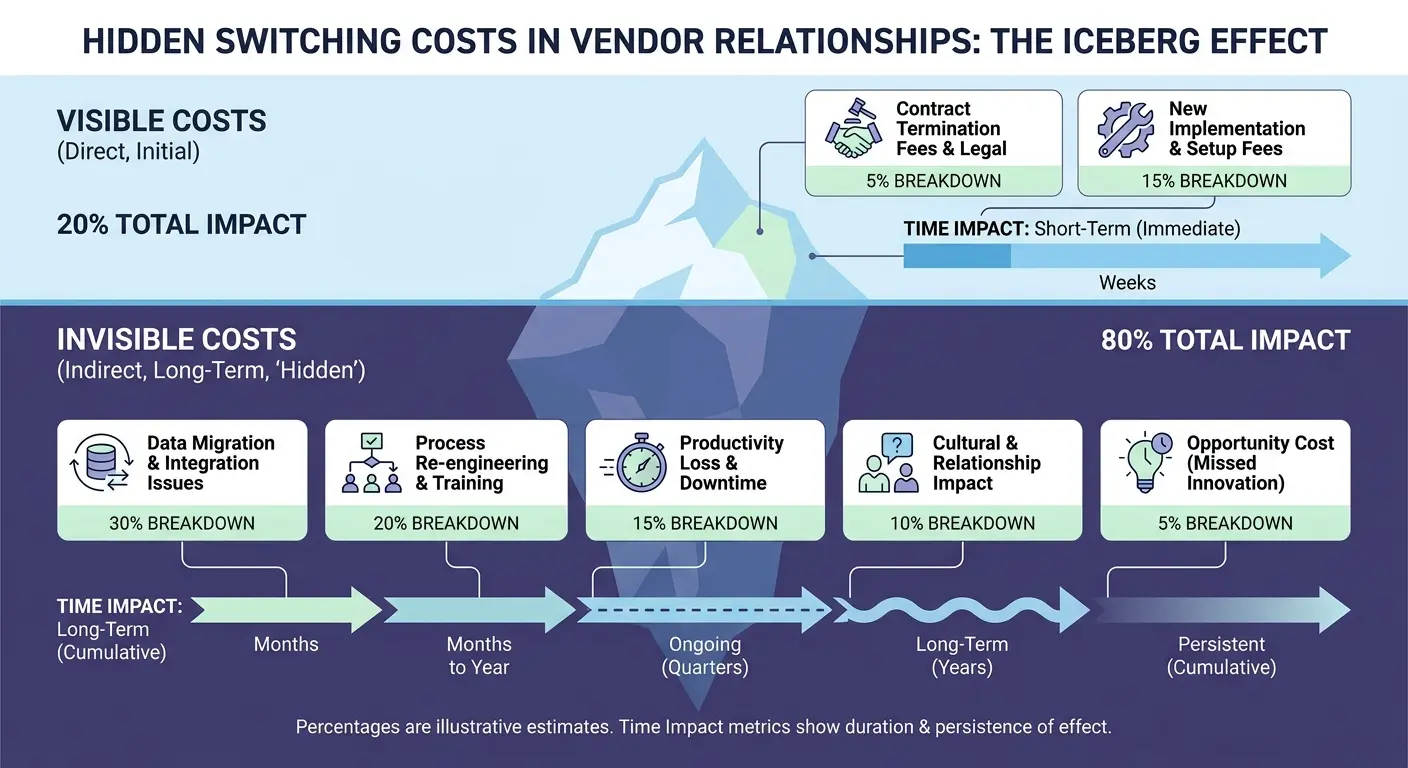
You're also losing the institutional knowledge your team built with the previous vendor. That knowledge had value. You knew who to call for urgent issues, how to escalate effectively, and which vendor capabilities were reliable versus aspirational. Starting over with a new vendor means rebuilding that knowledge from scratch.
When Competitive Tension Undermines Collaboration
Vendor-neutral policies maintain competitive tension to keep pricing sharp. That tension also prevents the collaboration needed for complex procurement operations.
You need your hardware vendor to coordinate with your deployment partner to streamline new hire onboarding. But your hardware vendor knows they might lose the contract next cycle, so they're not invested in making someone else's process work better.
The competitive tension you've created prevents the cross-vendor collaboration you need. Vendors optimize for their own metrics because they're not confident in the relationship's longevity. You get transactional service because you've created transactional relationships.
This dynamic is problematic for global operations where vendor coordination is essential. You need vendors who will invest time in understanding your global requirements and adapting their processes accordingly. That investment requires relationship stability that vendor-neutral policies actively prevent.
Effective IT procurement best practices recognize that neutrality and partnership serve different purposes, and you need to choose which matters more for your specific context.
Rethinking Vendor Consolidation Without Losing Leverage
Now, before you run off and consolidate everything with one vendor, hold on.
I'm not saying consolidation is always right. I've seen it go wrong. Spectacularly wrong.
One company I worked with consolidated everything with a single vendor in 2019. That vendor got acquired in 2020. The new parent company changed all the terms. Prices went up 40%. And the company had no alternatives ready because they'd let all their other vendor relationships die.
That's not strategic consolidation. That's just putting all your eggs in one basket and hoping nothing happens to the basket.
The difference is in how you structure it.
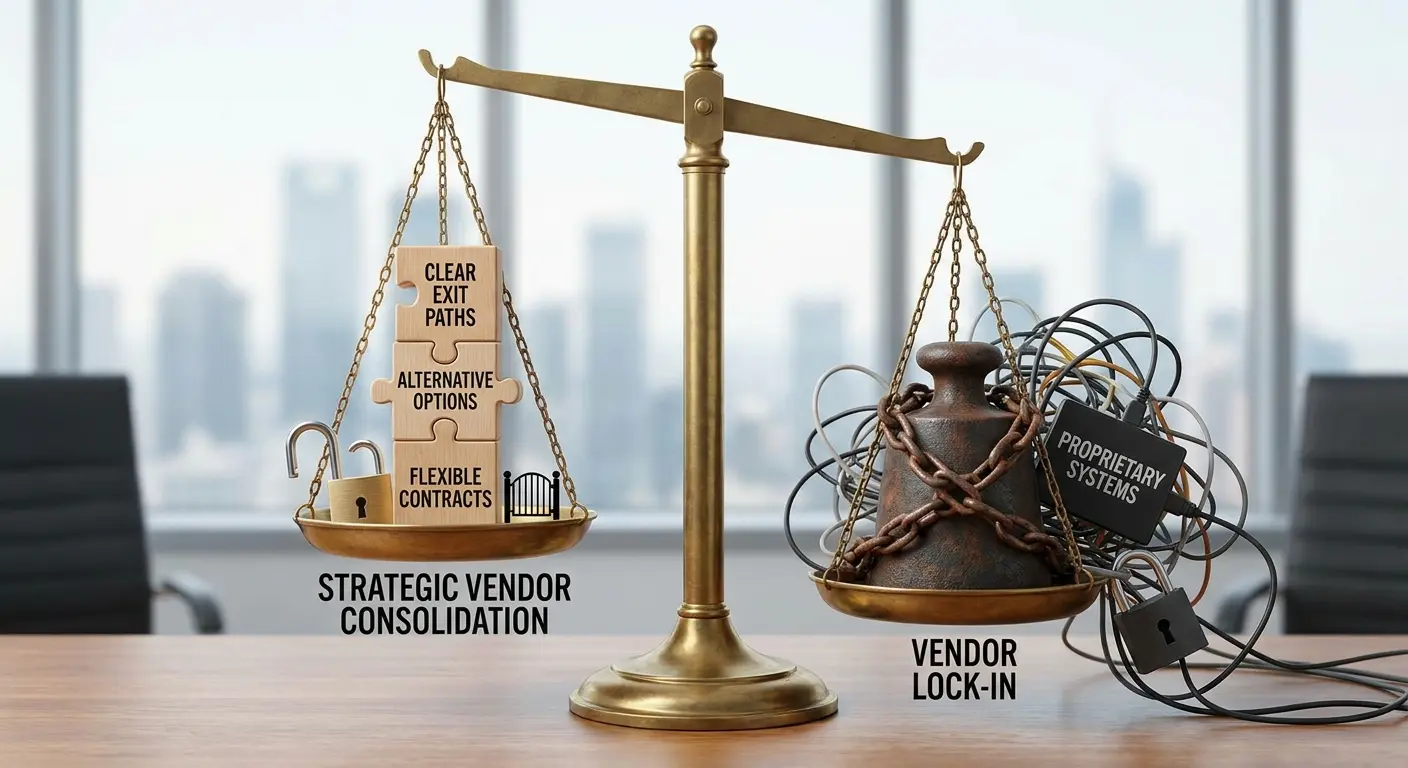
Vendor consolidation doesn't mean vendor lock-in if you structure it correctly. The fear of lock-in prevents many procurement teams from consolidating even when consolidation would solve operational problems. But consolidation and lock-in are different things.
Lock-in happens when switching costs become prohibitive and the vendor knows it. Strategic consolidation happens when you concentrate vendor relationships to gain operational efficiency while maintaining credible alternatives and clear exit paths.
The difference is in how you structure the relationship. Consolidation with clear performance metrics, defined exit criteria, and maintained alternatives gives you operational efficiency without surrendering leverage. You're choosing to work primarily with one vendor because it's operationally superior, not because you can't leave.
This represents a shift in IT procurement strategies from spreading risk through diversification to managing risk through structured relationships.
The Difference Between Consolidation and Dependency
Consolidation means choosing to concentrate vendor relationships for operational benefit. Dependency means you can't leave even if you want to.
You consolidate your hardware procurement with one primary vendor because it simplifies operations, improves support, and increases your account value. But you maintain a qualified secondary vendor and keep your procurement processes vendor-agnostic so switching remains feasible.
This is strategic consolidation. You're getting the operational benefits of a focused relationship while maintaining the leverage of credible alternatives.
Dependency looks different. You've built processes around vendor-specific tools, integrated deeply with proprietary systems, and allowed institutional knowledge to become vendor-specific. Switching would require rebuilding core operations, and the vendor knows it.
The distinction matters because procurement teams often avoid beneficial consolidation because they fear creating dependency. Understanding the difference allows you to capture consolidation benefits while avoiding dependency risks.
How to Consolidate While Maintaining Negotiating Power
Consolidation doesn't eliminate your negotiating power if you structure relationships correctly.
You move 80% of your hardware procurement to one vendor but maintain active relationships with alternatives. You build vendor-agnostic processes so switching is operationally feasible, not just theoretically possible. You set clear performance metrics and make contract renewals conditional on meeting them.
Your primary vendor gets the majority of your business, which makes you a strategic account. But they know the business is contingent on performance, not guaranteed by lock-in. This dynamic maintains competitive pressure even within a consolidated relationship.
Effective IT sourcing requires balancing consolidation with flexibility, which is why global procurement strategy frameworks emphasize maintaining qualified alternatives even within consolidated vendor relationships.
A healthcare technology company consolidated 85% of their global hardware procurement with a single vendor while maintaining qualified relationships with two regional alternatives. They structured the primary contract with quarterly performance reviews tied to specific metrics: 95% on-time delivery, 24-hour support response times, and maximum 5% price variance from market rates.
Every quarter, they processed 10-15% of orders through their alternative vendors to keep those relationships active and maintain current knowledge of competitive pricing. When their primary vendor missed delivery targets two quarters in a row, they had the data and relationships ready to credibly threaten a shift in volume. The vendor assigned a dedicated account team and improved performance within 30 days because they knew the alternative wasn't theoretical.
The key is making your alternatives credible. Your secondary vendors need to be qualified, not just listed. You need to maintain enough volume with them that they stay engaged. And your team needs to maintain enough familiarity with their processes that switching is realistic.
None of that credibility exists if it was never written into the relationship in the first place — a vendor onboarding process that plans for the exit from day one is what makes an alternative real instead of theoretical.
Building Exit Paths Before You Need Them
Want to know the exact moment you lose negotiating leverage? It's when your vendor knows you can't leave.
And they always know. They can see it in how you use their tools, how deep your integrations go, how long it's been since you talked to their competitors.
So here's what I tell every procurement team: build your exit path on day one. Not when you need it. Day. One.
What does that actually look like?
Sarah, an IT director I work with, maintains what she calls her "escape file" for every major vendor. It's a Google Doc that lists:
- Which vendor would replace them (with contact info)
- Last time she got a quote from that vendor (updates every 6 months)
- Exactly what data would need migrating and how
- Which team members would need retraining and how long it'd take
- Total estimated cost and timeline to switch
She's never had to use it. But every vendor knows it exists. And that changes every negotiation.
One vendor tried to increase prices by 35% at renewal. She opened the escape file during the call and started reading from it. "So we'd need about 6 weeks to transition to [Competitor]. I got a quote from them last month, actually, and they're 20% cheaper than your new pricing..."
The vendor found budget flexibility real quick.
The time to build exit paths is when you don't need them, not when you do.
You're consolidating with a primary vendor. Before you shift significant volume, you document exactly what switching would require: data migration steps, process changes, team retraining needs, and timeline estimates. You maintain this documentation and update it regularly.
This exercise does two things. First, it ensures switching remains feasible by preventing the gradual accumulation of switching costs. Second, it gives you negotiating leverage because you can demonstrate that leaving is realistic, not theoretical.
Vendor Exit Path Documentation Template
Maintain this documentation for any consolidated vendor relationship:
Vendor Information
- Vendor name and primary contact
- Contract term and renewal date
- Current monthly/annual volume
- Services provided
Alternative Vendors
- Qualified alternative vendor names
- Current relationship status (active/dormant)
- Last order date with each alternative
- Capability gaps compared to primary vendor
Switching Requirements
- Data export procedures and formats
- Asset management system changes needed
- Process documentation that needs updating
- Team members requiring retraining
- Estimated timeline for full transition
- Estimated cost of switching (hours + direct costs)
Maintained Capabilities
- Processes kept vendor-agnostic
- Data maintained in portable formats
- Team knowledge maintained across vendors
- Regular alternative vendor engagement activities
Performance Triggers
- Metrics that would initiate exit planning
- Threshold violations that accelerate timeline
- Escalation procedures before exit
- Decision authority for exit activation
Last Review Date: [Update quarterly]
Vendors treat you differently when they know you've planned your exit. You're not threatening to leave. You're demonstrating that leaving is a real option you've thought through, which changes the power dynamic in every negotiation.
Modern IT sourcing recognizes that the best vendor relationships are the ones either party can leave, but neither wants to.
Building Procurement Systems That Scale With Distributed Teams
Let me tell you about Marcus.
Marcus was hired to run sales for APAC. Started on a Monday. His laptop was supposed to arrive Friday before his start date.
It didn't. Because procurement didn't account for customs delays. Or the fact that the approved vendor didn't actually ship to Malaysia. Or that the "standard" laptop configuration didn't include the right power adapter.
Marcus spent his first week using his personal laptop, couldn't access half the systems he needed, and missed two client calls because he couldn't get VPN working on a non-company device.
The procurement team hit their SLA. The laptop was ordered within 24 hours of approval. It shipped within 5 business days. Every box was checked.
Marcus quit after six weeks. Exit interview said "felt set up to fail from day one."
That laptop cost $1,800. Replacing Marcus cost $45,000 in recruiting fees plus three months of lost productivity.
But hey, the SLA was green.
Distributed teams expose every weakness in centralized procurement models because distance amplifies delays and coordination challenges. Your procurement system was built for a world where everyone worked in the same location, equipment could be staged centrally, and IT support was down the hall.
Remote work breaks all those assumptions. Equipment needs to ship to home offices across different countries. Support happens asynchronously across time zones. Onboarding can't wait for equipment to arrive because the new hire is starting tomorrow regardless of whether their laptop has shipped.
Scaling procurement for distributed teams isn't about doing the same things faster. It's about redesigning procurement systems around distributed-first principles: speed over process, automation over approval chains, and regional flexibility over global standardization.
Effective IT procurement management requires fundamentally different approaches when your team spans continents instead of floors.
Why Your Procurement SLAs Don't Match Remote Reality
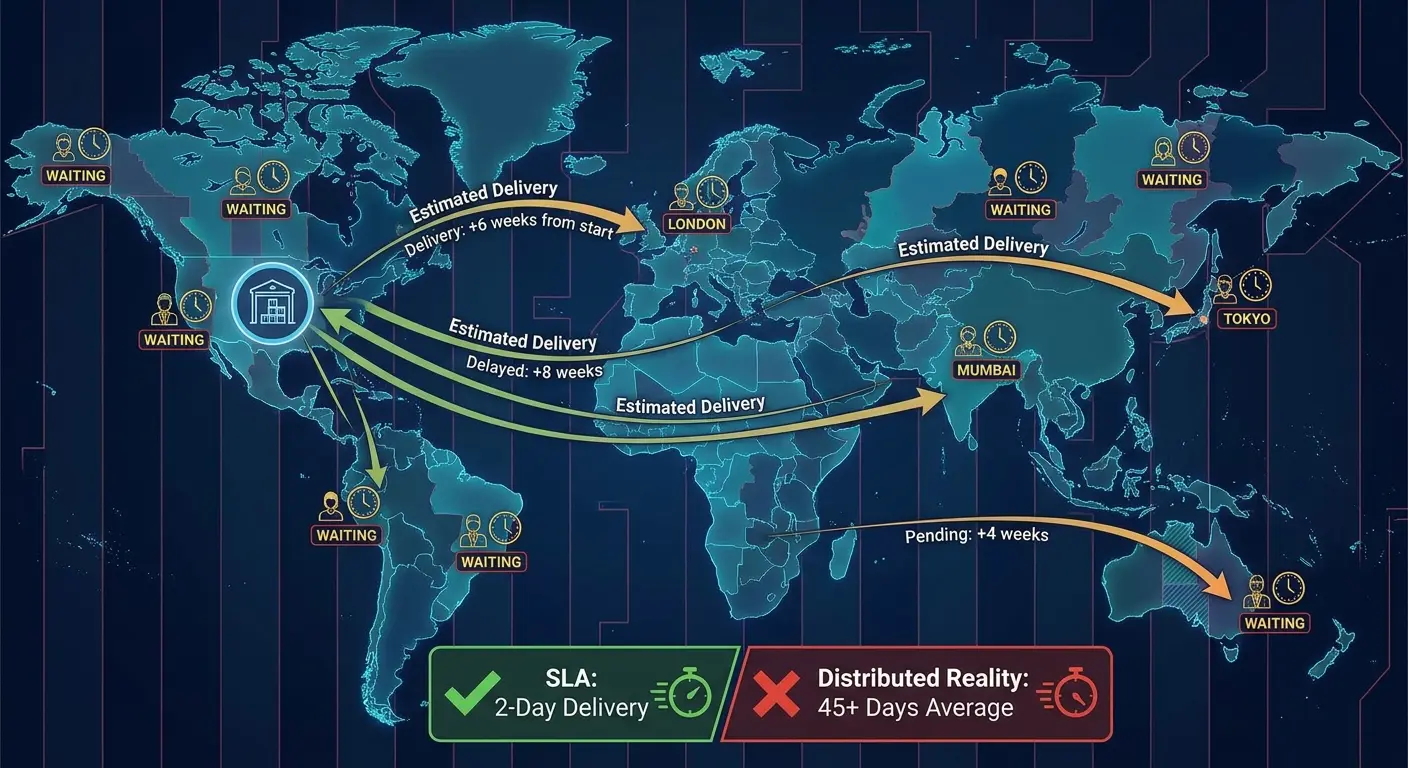
Your procurement SLA promises equipment delivery within five business days of order approval. That SLA was designed for office delivery in your primary markets.
A new hire in Australia starts next Monday. Your IT procurement process takes three days for approvals, then five days for delivery. But you're shipping internationally, which adds customs delays and extends delivery to two weeks. Your SLA is meaningless for this scenario.
You're measuring the wrong thing. The SLA tracks internal process speed, but distributed teams care about time-to-productivity. A laptop that arrives two days after someone starts is a failure even if it meets your SLA.
Modern IT procurement service models must account for global delivery timelines, which is why understanding global IT procurement best practices is essential for distributed team success.
Distributed teams need procurement systems designed around employee start dates, not internal process timelines. That means working backward from when someone needs equipment, not forward from when procurement receives the request.
The Automation Gap in Distributed Procurement
Centralized procurement relied on manual coordination because everyone was accessible. Distributed procurement breaks when you depend on synchronous communication across time zones.
A procurement request needs IT approval, but your IT lead is eight time zones away. The approval sits in their inbox overnight, adding a full day to your timeline. Multiply this across every approval step and timezone combination, and simple requests take weeks.
Automation isn't optional for distributed procurement. It's the only way to maintain velocity when synchronous coordination is impossible. Automated approvals based on predefined criteria, automated vendor selection based on delivery location, automated order routing based on regional inventory.
The procurement teams that scale with distributed work are the ones that eliminated approval bottlenecks through automation, not the ones that tried to make manual processes work across time zones.
Rethinking your IT procurement process for distributed teams means identifying every manual handoff and asking whether it could be automated based on rules and criteria.
Regional Flexibility vs. Global Consistency
You want global consistency in your procurement operations. Distributed teams need regional flexibility.
Your global standard laptop isn't available in certain markets with acceptable lead times. Your preferred vendor doesn't ship to some countries. Your standardized configurations don't account for regional power requirements or keyboard layouts.
Forcing global consistency creates operational problems that local teams have to solve. They wait longer for equipment, deal with compatibility issues, and work around limitations that regional vendors could easily address.
The alternative is regional procurement flexibility within global guardrails. Set standards for security requirements, budget limits, and compliance needs, but let regional teams choose vendors and specific solutions that work in their markets.
This approach trades some global consistency for regional effectiveness. You're acknowledging that distributed operations require distributed decision-making, and procurement systems need to support that reality.
How GroWrk Solves the Distributed Procurement Problem
Full disclosure: this is why we built GroWrk.
I got tired of watching companies struggle with the same problems: distributed teams, fragmented vendors, slow procurement, equipment showing up late (or not at all).
GroWrk handles the whole thing: vendor relationships, global shipping, device management, the works. One system that works everywhere.
Is it the right solution for everyone? No. Some companies are big enough that building this in-house makes sense. Some are small enough that the current mess is manageable.
But if you're in that middle zone: distributed team, growing fast, procurement is becoming a bottleneck, it's worth looking at.
You're trying to scale IT procurement across distributed teams, and the traditional approach isn't working. Equipment arrives late, regional vendors complicate your operations, and your procurement team is drowning in coordination work.
GroWrk handles global IT procurement and device management for distributed teams. We manage vendor relationships across regions, automate the procurement workflow from order to delivery, and ensure equipment arrives before employees start, regardless of location.
GroWrk's IT procurement solutions eliminate the coordination burden of multi-vendor management while maintaining regional delivery speed and global visibility.
You get one system that works globally without forcing regional compromises. Your team stops coordinating across multiple vendors and time zones. Your new hires get equipment on time, every time.
Or don't. Either way, fix the vendor fragmentation problem. It's costing you more than you think.
When Standardization Becomes a Liability
I'm going to contradict myself for a second.
Earlier, I talked about the value of consolidation and standardization. Now I'm telling you standardization becomes a liability.
Both things are true. That's what makes this hard.
Standardization is great until it isn't. The trick is knowing when you've crossed that line. And most companies don't realize they've crossed it until they're miles past it.
Here's my test: if your team spends more time justifying exceptions to your standards than they spend managing the standards themselves, your standards have become the problem.
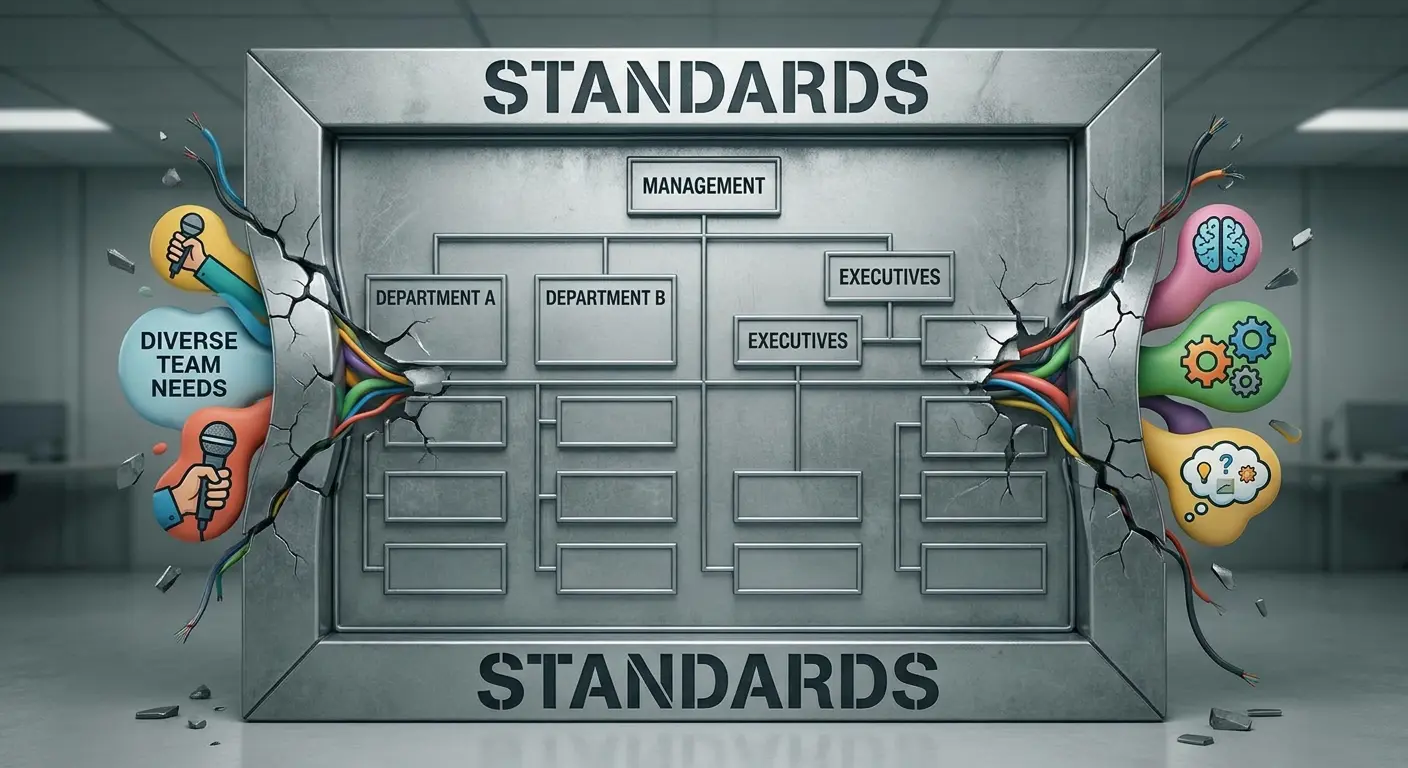
Standardization reduces complexity and cost, but it also reduces flexibility and responsiveness. Procurement teams standardize everything they can: hardware models, software versions, vendor relationships, and approval processes. Each standardization decision trades flexibility for efficiency.
That trade-off works until your business needs change faster than your standards can adapt. Suddenly, your standardized approach is preventing teams from getting what they need, and you're choosing between maintaining standards or enabling the business.
The problem isn't standardization itself. It's treating standards as permanent rather than provisional. Standards should evolve with business needs, not constrain them. When standardization becomes dogma, it transforms from an efficiency tool into a barrier that slows down the organization it's meant to serve.
The Standardization Trap Most Procurement Teams Fall Into
You standardize on Dell laptops because it simplifies inventory, support, and IT purchase processes. Three years later, a design team needs MacBooks for software compatibility, but your standards don't allow it.
The request goes through exception processes, requires executive approval, and takes months to resolve. Meanwhile, the design team can't do their work effectively because they're using tools that weren't designed for their needs.
Your standardization solved a real problem: procurement complexity. But it created a new problem: organizational inflexibility. The standard became more important than the outcome it was supposed to enable.
This happens because standards calcify over time. They start as practical decisions based on current needs, then become policies that outlive their usefulness. Nobody revisits whether the standard still makes sense because changing standards is harder than maintaining them.
How Standards Slow Down Global Expansion
You've standardized your IT purchasing for your primary markets. Then you expand into new regions where your standards don't work.
Your standard laptop model isn't available in Southeast Asia with acceptable lead times. Your preferred vendor doesn't operate in Latin America. Your standardized software licensing doesn't account for regional pricing variations or local compliance requirements.
You can force your standards into new markets, but it creates operational friction. Longer lead times, higher costs, and frustrated local teams who know there are better local options you won't consider.
Or you can create regional exceptions, which undermines the whole point of standardization. Now you're managing multiple standards across different regions, and the complexity you eliminated through standardization comes back in a different form.
The core issue is that standardization assumes operational consistency across your organization. Global operations are inherently inconsistent, and standards designed for one context often fail in others. We dig into how distributed teams are actually buying hardware across regions in the state of global IT hardware procurement.
When Employee Experience Breaks Against Standardization
Your procurement standards prioritize cost and operational efficiency. Your employees prioritize tools that help them work effectively.
These priorities conflict more often than procurement teams acknowledge. You've standardized on mid-range laptops that meet 80% of use cases. But developers need more processing power, designers need better displays, and executives need lighter devices for travel.
Each group requests exceptions. You approve some and deny others based on criteria that seem arbitrary to employees. The denied requests create frustration. The approved exceptions create complexity. You're back to managing the variability you tried to eliminate through standardization.
The deeper problem is that standardization in IT procurement often means standardizing to the middle. You choose solutions that work adequately for most people but aren't optimal for anyone. This approach minimizes procurement complexity while maximizing user frustration.
Balancing IT procurement best practices with employee needs means recognizing that some variability serves the business better than rigid consistency.
Final Thoughts
Look, I get it. You're doing everything the best practices say to do. Multiple vendors for leverage. Standardized processes. Careful controls.
And it's not working.
Because those best practices were written for a different world. One where everyone worked in the same building. Where IT needs were predictable. Where "fast" meant five business days, not five hours.
That world doesn't exist anymore.
The companies winning at IT procurement now? They've thrown out half the playbook. They've consolidated vendors everyone said they should diversify. They've automated approvals everyone said needed human oversight. They've given regional teams freedom everyone said would create chaos.
And it's working. Because they're optimizing for the world that exists, not the one that used to.
IT procurement strategy discussions focus on vendor management, cost optimization, and process efficiency. Those elements matter, but they're not where most procurement operations break down.
The breakdown happens in the relationships you've structured, the standards you've calcified, and the processes you've optimized for control instead of velocity. Your vendor fragmentation creates coordination costs that exceed the savings from competitive pricing. Your multi-vendor strategy introduces failure modes you didn't anticipate. Your vendor-neutral policies prevent the partnerships that drive real value.
I've watched procurement teams struggle with these issues while focusing on symptoms rather than causes. You're negotiating better contracts while your vendor architecture creates operational chaos. You're standardizing processes while your business needs are diverging. You're optimizing for centralized control while your teams are distributed globally.
Rethinking IT procurement strategy means questioning the assumptions that shaped your current approach. Vendor diversity isn't always risk mitigation. Standardization isn't always efficiency. Control isn't always more valuable than speed.
The procurement teams that succeed with distributed work are the ones that rebuilt their approach around new realities: consolidated vendor relationships that trade breadth for depth, flexible standards that adapt rather than constrain, and automated systems that work at the speed of business rather than the speed of approval chains.
Your vendor relationships should enable your operations, not complicate them. Your standards should evolve with your business, not freeze it in place. Your procurement processes should match the pace your organization operates at, not the pace they were designed for.
Start here:
Track coordination time for one month. Not procurement time. Coordination time. Every minute spent managing vendor relationships, switching between portals, reconciling invoices, coordinating deliveries. You need to see the real cost before you'll believe it.
Map your approval process against actual rejection rates. How many approval steps do you have? How many times has each step rejected something in the last year? Kill any step that hasn't caught a real problem in 12 months.
Calculate your time-to-productivity for distributed hires. From "we need to hire someone in [country]" to "they're fully productive with all equipment." If it's more than two weeks, your procurement process is costing you money.
List your vendor relationships in order of volume. Then ask: what would it take to move 80% of your volume to the top vendor? Not 100%. 80%. What's actually stopping you?
Find one standard that everyone hates and kill it. Not modify it. Kill it. See what happens. (Spoiler: probably nothing bad.)
The uncomfortable truth:
Most procurement teams know their processes are broken. They know the vendor fragmentation is a problem. They know the approval chains are too slow. They know the standardization is too rigid.
But changing it feels risky. The current approach is defensible. You can point to best practices. You can show you're following the framework. If something goes wrong, you're covered.
Changing means taking responsibility. If you consolidate and the vendor screws up, that's on you. If you kill approval steps and someone orders the wrong thing, that's on you. If you give regional teams flexibility and they go rogue, that's on you.
So most teams don't change. They optimize around the edges. They add another tool to manage vendor complexity instead of reducing the complexity. They automate the approval process instead of questioning whether the approvals are necessary. They standardize the exceptions instead of reconsidering the standards.
And they wonder why procurement is still a bottleneck.
Here's what I actually believe:
The companies that win at IT procurement in the next five years won't be the ones with the best vendor scorecards or the most sophisticated approval workflows.
They'll be the ones that made procurement invisible. Where new hires get equipment before they start without thinking about it. Where teams get what they need without fighting with process. Where procurement is so fast and frictionless that nobody talks about it.
That's not about better vendor management. It's about rethinking whether you need to manage vendors the way you do.
Some of you will read this and change nothing. That's fine. Your current approach is defensible, and defensible feels safe.
Some of you will read this and blow up your entire procurement operation. That's probably too far. Don't do that.
But some of you, maybe 10%, will read this and think "okay, what's one thing I can test?"
Start there. Pick one thing. Test it for 90 days. Measure what actually happens, not what you're afraid might happen.
My bet? You'll find out your vendor relationships have been costing you way more than money. And fixing them is simpler than you thought.
Just not easier.
Understanding procurement in IT means recognizing that the frameworks built for centralized, office-based operations don't translate to distributed, global teams. The opportunity isn't in optimizing your existing approach. It's in recognizing that the approach itself needs to change.
What is IT procurement in the modern era? It's the system that either enables your distributed team to move fast or the bottleneck that slows everything down. Which one it becomes depends on whether you're willing to challenge the vendor relationships, standards, and processes you've been protecting.
The vendor fragmentation you've accepted as normal is costing you more than competitive pricing could ever save. The multi-vendor coordination that feels like diligent risk management is creating risks you're not measuring. The standardization that simplified operations five years ago is preventing the flexibility your business needs today.
We've built GroWrk around a different model of IT sourcing: one that recognizes distributed teams need speed, global reach, and simplified vendor relationships more than they need traditional procurement controls designed for a different era.
Your procurement strategy should work for your team, not against them. The relationships you've built with vendors should unlock value, not create coordination overhead. The standards you maintain should enable consistency where it matters while allowing flexibility where it doesn't.
The choice isn't between control and chaos. It's between procurement systems designed for how work used to happen and systems designed for how it happens now.
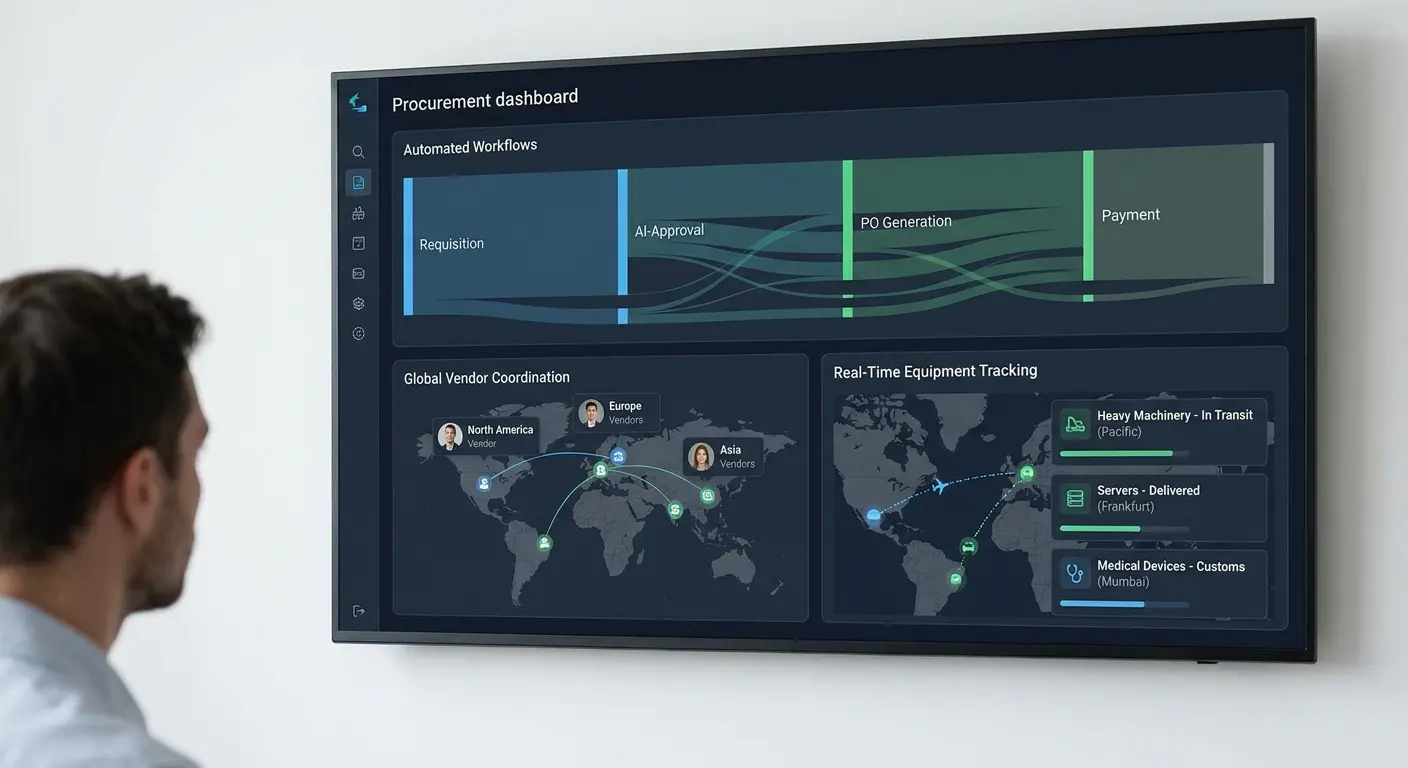
Building an IT procurement strategy that scales
A durable IT procurement strategy plans for the full device lifecycle, not just the purchase. Ground your IT procurement strategy in vendor consolidation, predictable logistics, and clear ownership, and revisit the IT procurement strategy as the team grows across regions. The strongest IT procurement strategy treats deployment and retrieval as first-class concerns.
Measure your IT procurement strategy by time-to-productivity and total cost, not unit price alone, so the IT procurement strategy you build actually reflects how distributed teams work.