



A few weeks of this newsletter have been about AI in IT operations. This one is about AI’s shadow — the thing it’s quietly doing to the price of every device you buy. While everyone watched the models, the AI boom reached into the supply chain and changed the cost of hardware overnight. Last week was the first invoice. It won’t be the last.
Laptop procurement built on last month’s prices is now a margin leak with no alarm attached. When DRAM contract prices rise roughly 98% in a single quarter, the gap between the cost you were quoted and the cost you actually pay stops being a rounding error and becomes the whole budget line. The fix isn’t a bigger budget — it’s laptop procurement for remote teams that behaves like a live signal: which active quotes are about to expire, which open orders are exposed to a price change before they ship, and which lead times are slipping into the next price tier. Companies that keep running procurement as a quarterly ritual will keep finding out on the invoice. The ones running it as a same-day signal will protect margin and move first.
The signal: Apple raised first. Everyone else is right behind it.
This week, Apple raised prices across nearly its entire hardware line — MacBook Air, MacBook Pro, iPad, Vision Pro, HomePod, Apple TV — in a single move. Some configurations jumped by as much as $300; the Mac Studio by more. The iPhone, Apple Watch, and AirPods were spared this round, though analysts widely expect the iPhone to follow at its fall launch.
Here’s the part that matters: this isn’t an Apple decision. It’s a market condition. In the same window, Microsoft, Dell, Lenovo, Acer, Asus, Samsung, and Sony have all raised prices or signaled increases. Apple was simply the first major brand to stop absorbing the cost and pass it to customers.
The cause is memory. AI data centers are consuming the world’s DRAM and NAND faster than it can be manufactured. According to TrendForce, DRAM contract prices rose roughly 98% quarter-over-quarter in Q1 2026 and are projected to climb another 58–63% in Q2. The industry has a name for it: RAMageddon.
The real problem isn’t the dollar amount. It’s the timing.
Most companies run hardware procurement as a periodic, point-in-time process. You plan a refresh once or twice a year. You collect quotes, get budget approved, place orders, and assume the price you were quoted is the price you’ll pay. That assumption held for a decade, because consumer hardware prices only ever drifted down or held flat.
That assumption is now broken. In a market moving 60–100% per quarter, the gap between “quoted” and “paid” is no longer rounding error — it’s the whole budget line.
Reactive procurement was a tolerable habit when prices were stable. In a volatile memory market, it’s a margin leak with no alarm attached.
Three invisible ways volatility eats the budget
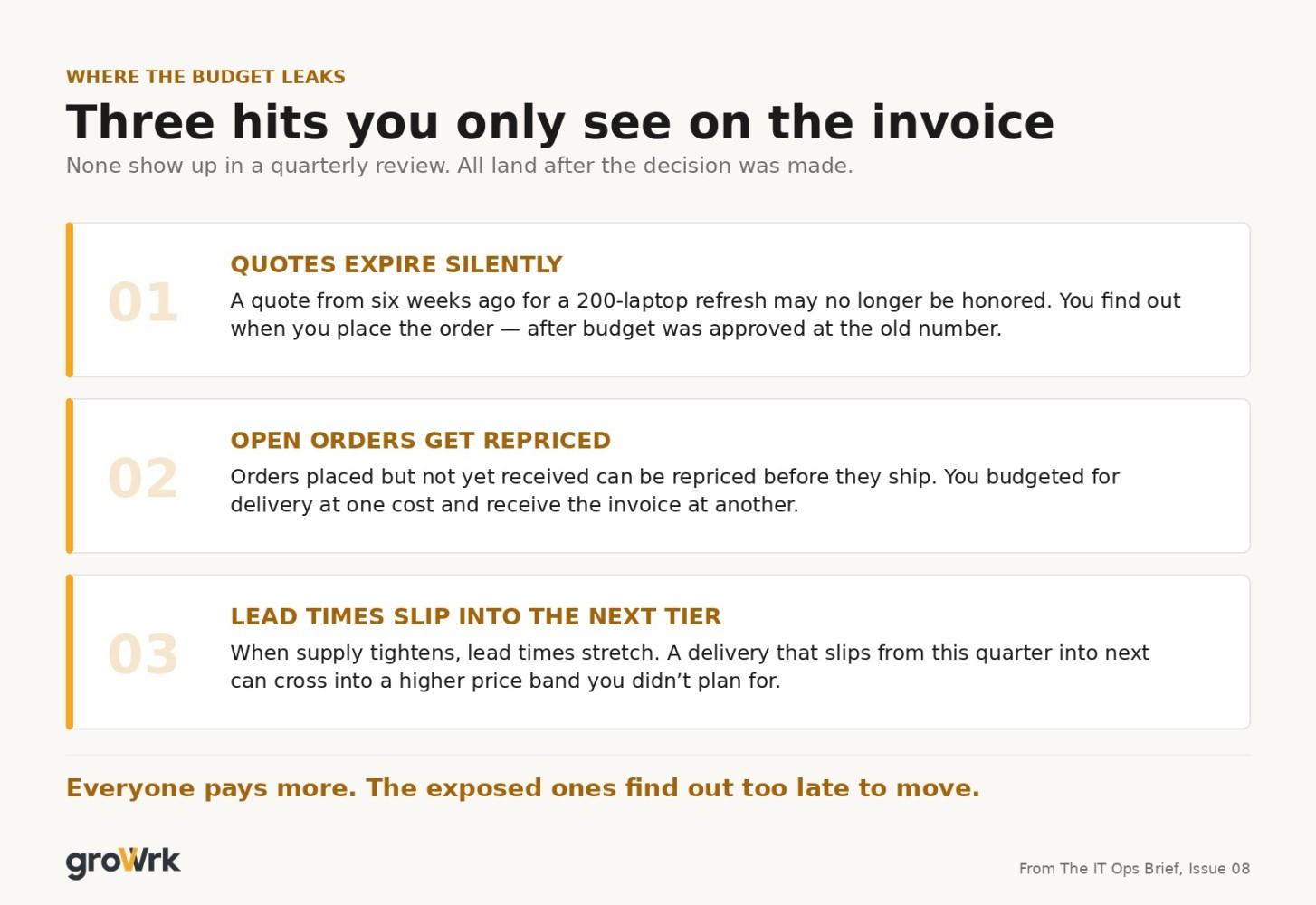
The damage shows up in three places, and none of them are on a quarterly procurement review. All of them hit after the decision was already made.
1. Quotes expire silently
A quote you got six weeks ago for a 200-laptop refresh may no longer be honored. You find out when you go to place the order — after the budget was approved at the old number.
2. Open orders get repriced
Orders you’ve placed but haven’t received can be repriced before they ship, depending on the vendor’s terms. You budgeted for delivery at one cost and receive the invoice at another.
3. Lead times slip into the next price tier
When supply tightens, lead times stretch — and a delivery that slips from this quarter into next can cross into a higher price band you didn’t plan for.
The companies getting hurt aren’t the ones paying more. Everyone is paying more. They’re the ones finding out after the fact, with no time to move, negotiate, or reprioritize.
Treat procurement as a live signal, not a calendar event
Your IT and Finance teams should be able to answer four questions today — not next quarter:
- Which of our active quotes are about to expire or be repriced?
- Which open orders are exposed to a price change before they ship?
- Where are lead times slipping — and which deliveries are at risk of crossing into a higher price tier?
- What’s the total budget exposure across all of the above, right now?
If answering those takes a week of someone pulling spreadsheets from three vendors, you’ve already lost the window. In this market, the value isn’t in the report — it’s in the speed. A signal you can act on the same day is worth more than a perfect analysis you finish after the price has moved again.
And the immediate, practical move: if you have hardware purchases planned in the next 30–60 days, pull them forward. The window before the next adjustment is already closing. Waiting is now the expensive option.
Where same-day visibility actually comes from
Most procurement “visibility” is a dashboard you check quarterly. That’s not visibility in a market like this — it’s a rear-view mirror. What actually protects margin is knowing, the same day, which quotes are exposed, which orders are at risk, and where lead times are moving across every vendor and every country you operate in.
That’s the infrastructure we’re building at GroWrk: real-time fleet and IT procurement visibility, supplier intelligence across our global vendor network, and workflows that turn a market shift into a decision you can make immediately instead of discovering on the invoice. I’ll be straight about it — parts of this are live today and parts we’re still building. But the direction is exactly what last week proved companies need: procurement that behaves like a signal, not a quarterly ritual.
The reason we can build it is the same reason any of this works: we already sit in the execution layer, buying and deploying devices across 150+ countries. The market data isn’t bolted on from outside — it’s a byproduct of operating in the supply chain every day, alongside the rest of our global IT asset management stack.
One stat: who’s actually buying the world’s memory
~70% — the share of the world’s memory chip output now being consumed by data centers in 2026, per industry estimates, as Samsung, SK Hynix, and Micron reallocate capacity toward high-bandwidth memory for AI accelerators.
That single reallocation is why a laptop costs more this month than last. The AI boom didn’t just change software — it reached into the supply chain and repriced the hardware everyone runs on, and consumer-grade memory is at the back of the line.
The increase isn’t the risk. Finding out after the fact is. The companies that keep treating hardware procurement as reactive will keep getting surprised — quarter after quarter, because there will be more of these. The ones that build proactive, same-day visibility will protect margin, move first, and be ready for the next adjustment.
If you want to see what real-time procurement visibility looks like for your fleet and geographies — including where your current orders are exposed — we’ll walk through it with you.