




Here's what usually happens: Someone in IT notices you've got 50 old laptops gathering dust in a closet. Cue the scramble. Where do we recycle these? Who wipes the drives? Can we sell them?
You're asking the wrong questions. The problem started two years ago when you bought those laptops without thinking about what you'd do with them later. I've seen this play out dozens of times. Companies treat ITAD as an end-of-life problem when it's actually a procurement design flaw.
When you build your IT procurement and lifecycle management without disposition baked in from the start, you create expensive inefficiencies that no recycling vendor can fix later. Understanding what is ITAD from a lifecycle perspective changes everything about how you approach it.
What You Need to Know
ITAD problems originate in procurement decisions, not disposal processes. Data security extends beyond drive wiping to include firmware, peripheral storage, and cloud-connected devices. Environmental compliance reporting requires granular chain-of-custody documentation most companies don't maintain.
Financial recovery rates suffer when you lack real-time asset condition data throughout the lifecycle. Reverse logistics complexity multiplies with remote workforces and global teams. Regulatory compliance varies drastically by jurisdiction, creating fragmentation risks.
Employee offboarding without integrated ITAD workflows leads to ghost assets and security vulnerabilities. Embedding disposition protocols into initial asset tracking systems prevents downstream chaos.
The Procurement Blind Spot: Why Disposition Starts Before Purchase
Your procurement team probably evaluates vendors based on price, specs, delivery speed, and maybe warranty terms. Resale value three years from now? The availability of certified recyclers in the 47 countries where you have remote employees?
Those factors rarely make it into the decision matrix.
This creates a mismatch between what you buy and what you can efficiently dispose of later. Some hardware depreciates faster in secondary markets. Certain manufacturers offer solid buyback programs while others leave you searching for third-party buyers. Proprietary components make refurbishment difficult. Regional variations in e-waste infrastructure mean that a laptop easy to recycle in Germany becomes a logistical headache in Brazil.
I've seen companies standardize on equipment that seemed cost-effective upfront, only to discover they'd chosen models with poor resale value and limited recycling options in key markets. Organizations that implement comprehensive IT procurement strategies from the start avoid these costly mistakes. The price advantage evaporated when disposition costs spiked.
I watched this happen to a client last year. Their CFO was proud of himself. He'd negotiated $300 off per laptop by going with some off-brand manufacturer. Saved $60K on the purchase.
Fast forward three years. They're trying to collect laptops from employees in Thailand, Vietnam, Indonesia. Every recycler they contact says the same thing: "We don't handle those batteries. Special hazmat fee: $200 per unit."
That $60K savings? Gone. Plus another $40K in disposal costs they never saw coming. Meanwhile, their competitors who had purchased mainstream brands were recovering $200-$400 per device and finding certified recyclers in every deployment region.
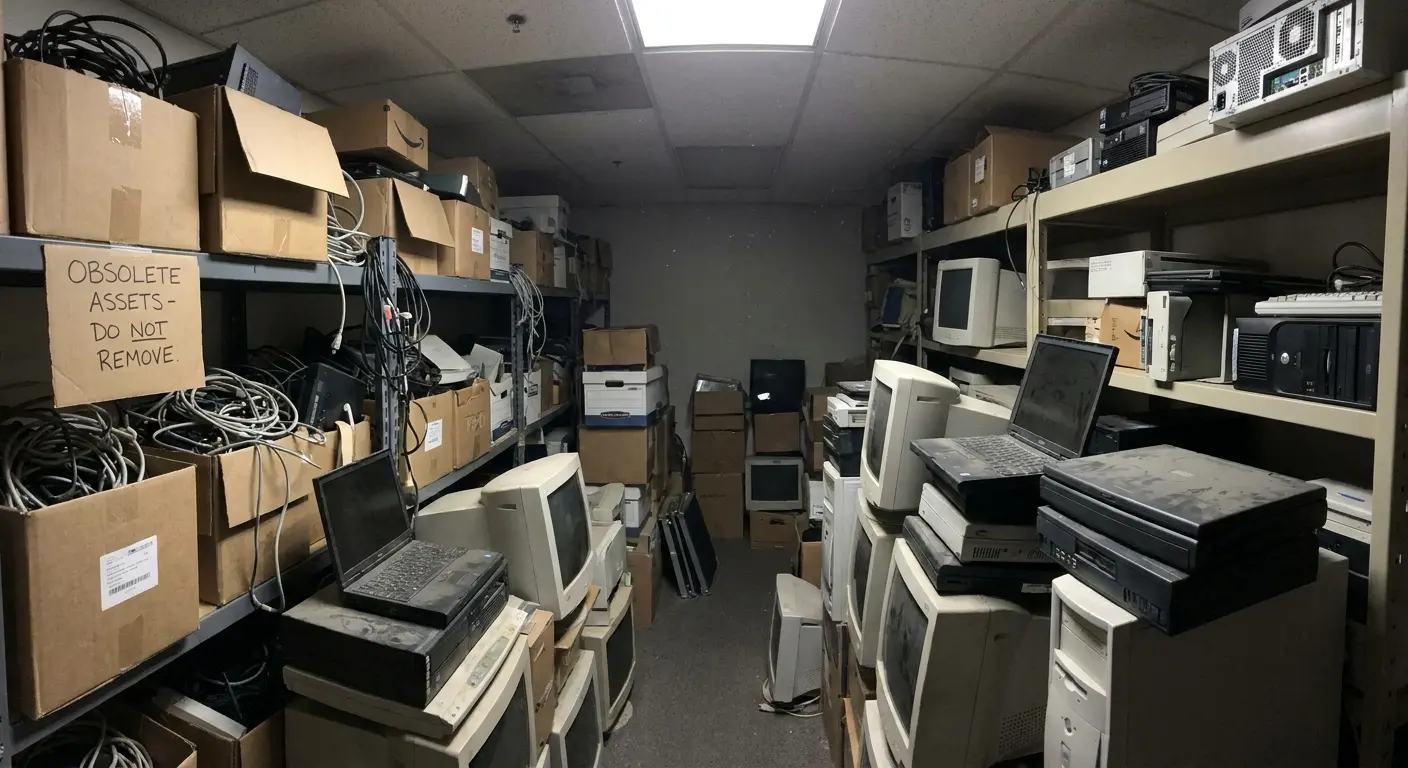
Purchase agreements matter too. Vendor buyback clauses, trade-in programs, and take-back schemes can cut ITAD complexity in half, but you need to negotiate these terms during procurement, not after assets reach end-of-life. Once you've already bought 500 laptops without a buyback agreement, you've lost that leverage.
The relationship between procurement choices and ITAD services becomes clear when you examine specific decision points. Each hardware selection ripples forward through the entire lifecycle.
| Procurement Factor | Impact on ITAD | Questions to Ask Before Purchase |
|---|---|---|
| Hardware Brand | Affects resale value, recycler acceptance, parts availability | Does this brand maintain strong secondary market value? Are certified recyclers available in all deployment regions? |
| Component Standardization | Determines batching efficiency, sanitization complexity | Can we standardize on this configuration across all users? Does it use proprietary components that complicate recycling? |
| Vendor Agreements | Enables buyback programs, trade-in options, take-back schemes | Does the vendor offer end-of-life buyback? What are the terms and geographic limitations? |
| Regional Infrastructure | Affects recycling options, shipping costs, compliance | Are R2 or e-Stewards certified facilities available where we deploy this equipment? |
| Warranty Terms | Influences repair vs. replace decisions | Does warranty coverage extend long enough to defer disposition? Are repairs handled locally or require shipping? |
Hardware Standardization Reduces Disposition Complexity
Variety kills efficiency in IT asset disposition. When your asset inventory includes twelve different laptop models, eight monitor types, and a mix of peripherals from various manufacturers, you can't batch process disposition. Each equipment type requires different data sanitization protocols, has distinct resale channels, and follows separate recycling procedures.
Standardization creates economies of scale in disposition. Bulk lots of identical equipment command better resale prices. Recyclers offer volume discounts for homogeneous batches. Data wiping becomes more efficient when you're working with consistent hardware configurations.
You also reduce the knowledge burden on your IT team. They become experts in the specific sanitization requirements, common issues, and optimal disposition channels for your standardized equipment rather than constantly researching procedures for one-off devices. Working with experienced ITAD companies streamlines this process further.
Regional Infrastructure Should Influence Global Hardware Decisions
Your employees work across different continents, but your procurement probably doesn't account for regional variations in ITAD infrastructure. E-waste regulations, certified recycler availability, and secondary market maturity vary wildly by geography.
Choosing hardware that's easy to dispose of in North America but difficult to recycle in Southeast Asia creates operational headaches. You end up shipping equipment across borders for disposition (expensive and environmentally questionable) or using non-certified local vendors (compliance risk).
Smart procurement evaluates whether certified ITAD providers exist in all regions where you deploy equipment. Can you find R2 or e-Stewards certified recyclers in every country? Are there active secondary markets for the hardware you're buying? Do local regulations impose specific manufacturer requirements?
These questions need answers before purchase orders get approved, not when equipment reaches end-of-life and you're scrambling to find compliant disposition options. We dig into how distributed teams make these regional buying calls in the state of global IT hardware procurement.
Data Security Isn't Just About Wiping Drives
Everyone knows you need to wipe hard drives before disposing of laptops. Yeah, that's the baseline. The problem is that data doesn't only live on primary storage anymore.
Printers have hard drives that cache documents. Multifunction devices store contact lists, scan histories, and network credentials. Smartphones and tablets maintain data in embedded storage that survives factory resets if not properly sanitized. Firmware on laptops, servers, and networking equipment can contain configuration data, certificates, and cached credentials.
I've audited ITAD processes where companies religiously wiped laptop drives but sent printers to recyclers without checking for stored data.
Those printers contained months of scanned financial documents, HR records, and confidential communications.
A financial services firm disposed of 50 multifunction printers during an office consolidation. Their IT team followed standard protocols for wiping laptop and desktop hard drives but treated the printers as passive peripherals. Six months later, during a routine security audit, they discovered that each printer's hard drive had stored copies of every scanned and faxed document from the previous 18 months. This included W-2 forms, signed contracts with Social Security numbers, and confidential client financial statements. The printers had been sold to a secondary market buyer who resold them to various small businesses. The firm faced regulatory scrutiny and had to set up a costly notification program for potentially affected individuals.
The shift to cloud-connected devices amplifies this risk. Smart monitors, webcams, and even some keyboards now have embedded processors and storage. IoT devices used in office environments collect and cache data locally. Your secure IT asset disposition process needs to account for every device that might store information, not just the obvious ones.
What actually needs to get wiped:
Laptops, Desktops, Tablets Wipe primary storage using NIST 800-88 compliant methods. Sanitize BIOS/UEFI firmware settings. Clear TPM (Trusted Platform Module) if present. Remove and document all user accounts. Verify removal of cached credentials and certificates. Check for secondary storage like SD cards and SIM cards.
Printers and Multifunction Devices This is where companies screw up constantly. That printer has a hard drive. It's been caching every document you've scanned for the last two years. Remove and wipe internal hard drives. Clear address books and fax logs.
External Storage Wipe all USB drives, external HDDs, and removable media. Don't skip the flash drives sitting in desk drawers.
Docking Stations and Smart Monitors Clear stored configurations and network settings. Factory reset and clear any stored profiles.
Network Equipment Clear configuration files and logs. Remove stored credentials and certificates. Reset to factory defaults. Verify removal of VPN configurations.
Mobile Devices Factory reset isn't enough. You need cryptographic erase. Remove SIM cards and SD cards. Verify iCloud/Google account removal. Clear MDM enrollment.
Firmware and Embedded Systems Require Specialized Sanitization
Here's what most IT teams miss: wiping the hard drive doesn't touch the firmware. Your BIOS still has configuration data. The management engine still has cached credentials. Embedded controllers still store network settings.
Wipe the drive all you want. You're leaving data behind in places you didn't even know existed.
Standard drive wiping tools don't touch firmware. You need different procedures to sanitize BIOS/UEFI settings, management engine firmware, and embedded controller storage. These areas can contain hardware identifiers, network configurations, and cached authentication credentials.
Most companies don't have documented procedures for firmware sanitization. IT teams wipe drives and call it done, leaving data exposure risks in components they didn't even know stored information. Secure IT asset disposition services address these gaps systematically.
You need to either develop internal expertise in firmware sanitization or work with ITAD partners who have specific protocols for different device types. This isn't something you can improvise during disposition. It requires planned procedures, specialized tools, and verification steps.
Peripheral Devices Create Blind Spots in Data Sanitization
Monitors, webcams, headsets, and other peripherals seem passive, but many modern versions have onboard storage and processing. USB devices can contain malware or cached data. Docking stations store configuration settings.
External hard drives and flash drives obviously contain data but sometimes get overlooked in ITAD processes because they're not categorized as "computers."
You need an inventory system that tracks all peripherals, not just primary devices. Your disposition workflow should include sanitization steps for every peripheral type you deploy, with specific procedures based on what data each device type might store. IT asset destruction becomes necessary when sanitization isn't feasible or sufficient.
This also means your procurement team needs to understand the data implications of the peripherals they buy. Choosing simpler peripherals without embedded storage reduces your sanitization burden later.
The Environmental Reporting Gap Nobody Talks About
Your sustainability report probably includes a statistic about what percentage of IT assets get recycled. That number is almost certainly less accurate than you think.
Most environmental reporting around IT asset recycling relies on vendor attestations rather than item-level tracking. Your recycling partner provides an aggregate report saying they processed X tons of equipment, and you report that as your recycling rate. You don't actually know which specific assets went where, what happened to each component, or whether materials were genuinely recycled or just exported to regions with lax environmental standards.
This isn't necessarily fraud. It's a data problem. Most companies lack the tracking systems to maintain chain-of-custody documentation from asset deployment through final material recovery. You know you sent equipment to a recycler, but the paper trail ends there.
Try answering your board's questions with that data. You can't.
What percentage of materials were recovered versus landfilled? Where did components end up geographically? How much equipment was refurbished versus shredded? Most organizations can't answer these questions with specificity.
Certification Doesn't Equal Transparency
R2 and e-Stewards certifications provide important baseline assurances that recyclers follow responsible practices. They don't provide asset-level tracking data.
A certified recycler can process your equipment according to high standards while still leaving you unable to report specific outcomes for specific assets. Certification tells you the recycler has good processes. It doesn't automatically give you the granular data needed for detailed environmental reporting. ITAD vendors vary significantly in their reporting capabilities.
You need to explicitly contract for detailed reporting and chain-of-custody documentation. This costs more than basic recycling services, which is why many companies skip it. They get certification as a proxy for transparency without actually achieving transparency.
Scope 3 Emissions Reporting Requires Disposition Data You Probably Don't Have
Scope 3 emissions tracking is becoming a real pain for ITAD. Your sustainability team now wants to know the carbon footprint of every laptop you recycle. Transportation, processing, material recovery, all of it.
Good luck getting that data from your recycling vendor. Most can't provide it. The ones who can charge extra for the reporting.
You need to track not just that equipment was recycled, but the emissions associated with transportation, processing, and material recovery operations. Without this information, your Scope 3 calculations for ITAD rely on broad industry averages rather than actual operational data.
Getting this data requires integrating emissions tracking into ITAD vendor contracts and your own asset management systems. You need vendors who can provide emissions data for specific assets, not just aggregate estimates. You need internal systems that connect individual assets to specific disposition events and associated emissions.
Very few companies have built this level of integration. Most are using rough estimates and hoping that's sufficient as reporting requirements tighten.
Actual processing locations for each material stream
| Environmental Reporting Element | What Most Companies Track | What's Actually Needed for Transparency |
|---|---|---|
| Recycling Rate | Aggregate tonnage sent to certified recyclers | Item-level disposition outcomes (recycled vs. refurbished vs. landfilled) |
| Material Recovery | Vendor attestation of responsible practices | Specific material recovery percentages by component type |
| Chain of Custody | Initial handoff to recycler | Complete tracking from collection through final material processing |
| Geographic Destination | Country where recycler operates | |
| Emissions Impact | Industry average estimates | Actual transportation distances, processing methods, and energy consumption |
| Compliance Verification | Recycler certifications (R2, e-Stewards) | Third-party audits of specific asset batches with documented outcomes |
Financial Recovery vs. Actual Asset Value (And Why You're Losing Money)
You bought laptops for $1,200 each three years ago. They still work fine. You assume they're worth something meaningful in the secondary market.
Then you try to sell them and discover they're worth $150 each. If you're lucky. If you can find a buyer at all.
What happened? You missed the optimal resale window, didn't account for condition degradation, and lacked current market intelligence about what your specific equipment configuration actually commands in secondary markets.
Most companies make disposition decisions based on outdated assumptions about asset value. You think equipment retains value longer than it does. You don't track how condition issues (battery degradation, cosmetic damage, component failures) erode resale value. You don't monitor secondary market pricing for your specific hardware configurations.
And it's costing you real money. Equipment that could have sold for $400 eighteen months ago now sells for $150, or sits unsold because you priced it based on outdated market data. Understanding IT asset disposition from a financial perspective requires better data throughout the lifecycle.
Condition Tracking Throughout the Lifecycle Enables Better Disposition Decisions
Financial recovery depends heavily on asset condition, but most companies only assess condition when they're ready to dispose of equipment. By then, you're discovering problems (broken screens, failing batteries, missing components) that you could have addressed earlier or factored into disposition timing.
Real-time condition tracking changes the calculation. When you know a laptop's battery is degrading or a monitor has developed dead pixels, you can make informed decisions about whether to repair, replace, or sell immediately before condition deteriorates further. Organizations using IT asset management best practices build this tracking into their standard workflows.
This requires integrating condition assessments into regular IT operations, not treating them as a disposition-phase activity. Helpdesk tickets, repair records, and user reports all provide condition data that should feed into asset value calculations.
You also need systems that can translate condition data into financial projections. Knowing a battery is at 60% health is useful. Knowing that reduces resale value by approximately $40 enables better decision-making.
Market Timing Matters More Than You Think
Secondary market values for IT equipment fluctuate based on new product releases, market supply, and demand cycles. Selling right before a new model launches tanks your recovery rate. Selling when market supply is low maximizes value.
Most companies ignore market timing entirely. You dispose of equipment based on internal refresh cycles without considering whether it's a good or bad time to sell that particular hardware. IT asset disposition projects suffer when market dynamics get overlooked.
A tech company with 400 employees ran a standard three-year refresh cycle for MacBook Pros. They disposed of their entire 2019 fleet in October 2022, right after Apple announced the M2 Pro models. Secondary market prices for Intel-based MacBooks dropped 35% within two weeks of the announcement. Had they disposed of the equipment in August, before the announcement, they would have recovered an additional $180 per unit. Across 400 laptops, that timing cost them $72,000 in lost recovery value. Their competitors who monitored Apple's product cycle and accelerated disposition by two months captured significantly higher returns.
Building market awareness into disposition planning requires either developing internal expertise or working with ITAD partners who actively track secondary market conditions. You need to know when to accelerate disposition to catch a favorable market window and when to hold equipment briefly because values are temporarily depressed.
This sounds complicated, but the financial impact is significant. The difference between good and bad market timing can easily be 20-30% of recovery value across a large disposition project.
Reverse Logistics: The Operational Nightmare You're Underestimating
Collecting equipment from an office is straightforward. You schedule a pickup, the recycler sends a truck, everything gets loaded in an afternoon. Done.
Collecting equipment from 300 remote employees across 40 countries is a completely different problem.
You need to coordinate individual shipments, navigate international shipping regulations, manage customs documentation, track packages, handle employee non-compliance, and somehow maintain chain-of-custody for security and compliance purposes.
The operational burden of reverse logistics now exceeds the complexity of actual disposition for many companies. I've seen organizations spend more time and money getting equipment back from employees than they recover through resale or save through proper recycling. See how Upwork centralized device logistics across 30+ countries with GroWrk.
Remote work made this ten times worse. When your workforce was office-based, ITAD logistics were centralized and efficient. With distributed teams, you've got hundreds of individual collection events, each with its own complications.
International Shipping Creates Compliance and Cost Challenges
Shipping IT equipment internationally triggers customs requirements, import/export regulations, and potential duties or taxes. E-waste regulations vary by country, affecting what you can ship where. Some jurisdictions restrict cross-border movement of electronic waste entirely.
You need to understand regulations in every country where you have employees. Can you ship used equipment out of that country? What documentation is required? Are there restrictions on specific device types or components?
Many companies discover these constraints only when trying to execute IT asset disposition for international employees. By then, you're scrambling to find compliant solutions, often at premium costs.
The alternative is using local disposition services in each country, which creates its own challenges around vendor management, quality assurance, and consistent data security practices across multiple providers.
Employee Cooperation Isn't Guaranteed
Your ITAD process assumes employees will promptly return equipment when requested.
That assumption breaks down regularly.
Remote employees ignore return requests, delay shipments, claim they never received packaging materials, or simply disappear with equipment when leaving the company. Each instance creates a gap in your asset inventory and potentially a security or compliance risk. Implementing proper equipment retrieval processes prevents these common failures.
You need processes that create accountability and consequences for non-return. This means integrating ITAD into offboarding workflows with clear timelines, tracking mechanisms, and escalation procedures. It also means building costs of non-return into your financial models because some percentage of equipment will never come back.
Some companies withhold final paychecks or expense reimbursements until equipment is returned and verified. Others charge employees for unreturned assets. Both approaches create HR complications but may be necessary to achieve acceptable return rates.
Compliance Fragmentation Across Global Operations
GDPR requires you to demonstrate data deletion with specific documentation. California's e-waste regulations ban certain disposal methods. China restricts cross-border data transfers even on decommissioned equipment. Healthcare regulations demand particular sanitization standards. Financial services rules require audit trails that consumer companies don't need.
You're not dealing with one compliance framework. You're juggling dozens, and they don't always align cleanly.
A disposition process that satisfies EU requirements might fall short of what Singapore demands. Methods acceptable in one US state violate regulations in another. Industry certifications that matter for healthcare clients mean nothing in retail contexts.
This fragmentation forces you to either build multiple parallel ITAD processes (expensive and operationally complex) or find the highest common denominator across all applicable regulations (often more restrictive and costly than necessary for some jurisdictions).
Most companies end up with a messy hybrid: some standardized processes, some jurisdiction-specific exceptions, and some gaps where they're unknowingly non-compliant because they didn't realize a particular regulation applied. Understanding what is it asset disposition in a global context means grappling with this complexity. Enterprise ITAD operations face these challenges at scale.
Data Residency Rules Complicate International ITAD
Some jurisdictions prohibit moving data outside their borders, even on equipment headed for disposition. This creates problems when your ITAD partner operates centralized processing facilities in a different country.
You can't just ship equipment to a recycler in another country without first ensuring data has been sanitized to the satisfaction of local data residency requirements. For some regulations, this means data destruction must happen in-country before equipment leaves.
This requires either maintaining relationships with sanitization vendors in multiple countries or having internal capabilities to perform compliant data destruction before shipping equipment for disposition. Both options add cost and complexity.
The rules get even messier when equipment has moved between countries during its lifecycle. A laptop deployed in Germany, used by an employee who relocated to Brazil, then returned for disposition in the US might be subject to overlapping data protection requirements from all three jurisdictions.
Audit Requirements Vary Drastically
Some regulations require detailed audit trails showing exactly what happened to each asset. Others accept aggregate reporting. Some demand third-party verification. Others allow self-attestation.
Healthcare organizations need audit trails that satisfy HIPAA. Financial services firms need records that meet SEC or FINRA requirements. Government contractors face FAR compliance. Each has different documentation standards, retention periods, and verification requirements. The ITAD industry has developed specialized expertise to navigate these variations.
Building an audit system that satisfies the most stringent requirements protects you across the board, but it's expensive. You're maintaining documentation and verification processes that many of your assets don't legally require.
The alternative is tracking which compliance frameworks apply to which assets and maintaining different audit processes accordingly. This is theoretically more efficient but operationally complex and prone to errors where assets get processed under the wrong framework.
Employee Offboarding Creates ITAD Chaos
An employee gives two weeks notice. HR starts the offboarding process. IT gets notified at some point (maybe immediately, maybe days later, maybe not until after the employee is gone). Equipment return gets requested. The employee may or may not comply promptly. The laptop eventually comes back (hopefully). Someone wipes it (probably). Asset records get updated (sometimes).
Every step in that chain is a potential failure point.
Failures happen constantly.
I've seen companies discover months after an employee's departure that equipment was never returned. Or it was returned but never wiped. Or it was wiped but not removed from asset tracking. Or it was removed from tracking but still assigned to the former employee in the device management system, creating security vulnerabilities. A thorough employee offboarding process addresses these integration gaps systematically.
These failures stem from treating offboarding and ITAD as separate processes. HR owns offboarding. IT owns equipment. Nobody owns the integration between them, so the integration doesn't work reliably. ITADs processes fail when this coordination breaks down.
Timing Mismatches Create Security Windows
HR completes offboarding and revokes system access on an employee's last day. The laptop doesn't get returned for another two weeks.
During that gap, you have a device with cached credentials, stored data, and potentially active VPN configurations sitting in an ex-employee's possession.
Even if you've disabled their account, the device itself represents a security risk. Local files remain accessible. Cached credentials might allow limited access. Physical possession of the device enables attacks that remote access controls can't prevent.
You need processes that ensure equipment return happens before or concurrent with final offboarding, not as an afterthought. This requires coordination between HR and IT, with clear timelines and accountability.
Some companies make equipment return a prerequisite for final pay or benefits processing. Others use deposits or agreements signed at hire that create financial consequences for non-return. The specific mechanism matters less than ensuring the integration is built into the process rather than ad-hoc.
Voluntary Departures vs. Involuntary Terminations Require Different Protocols
When someone quits, you usually have time to coordinate equipment return. When someone gets fired, you need immediate asset recovery to prevent data theft or sabotage.
Most ITAD processes don't distinguish between these scenarios. You use the same equipment return procedures regardless of departure circumstances, which is inadequate for high-risk terminations.
Involuntary terminations need same-day equipment recovery when possible. This means having processes for remote lockdown, local IT support for in-person recovery, or expedited shipping for remote employees. You also need immediate data sanitization or device disablement to prevent data exfiltration during the return period.
Building these capabilities requires planning. You can't improvise secure rapid recovery during a termination event. You need established procedures, pre-positioned shipping materials, relationships with local support providers, and clear authorization protocols.
Here's what actually needs to happen when someone quits:
Day 1: HR tells IT. Not day 3. Not "whenever." Same day. System generates equipment inventory assigned to departing employee. IT sends initial equipment return instructions. Shipping materials ordered and sent to employee's location (if remote). Return deadline set based on last working day.
During notice period: Daily automated reminders sent to employee regarding equipment return. IT schedules equipment pickup or provides return shipping labels. Manager confirms employee has received and acknowledged return instructions. Asset management system flags all assigned equipment as "pending return."
Final day: HR confirms all equipment returned before processing final pay. IT performs immediate inventory check of returned items. Data sanitization initiated on all returned devices. Remote wipe triggered for any unreturned devices. Asset records updated to reflect return status.
Post-departure: Unreturned equipment escalated to HR and legal within 48 hours. Financial hold placed on final payments until equipment recovered. Device tracking and recovery procedures initiated. Security team notified of any unreturned devices containing sensitive data.
Building Disposition Into Your Asset Tracking From Day One
You can't make smart disposition decisions if you don't know what you're disposing of.
That sounds obvious, but most companies have massive gaps in asset knowledge when equipment reaches end-of-life. That gap is really a lifecycle tracking problem, which we unpack in the state of IT lifecycle management.
You might know you have a laptop to dispose of, but do you know its purchase date, original cost, warranty status, repair history, current condition, compliance requirements based on what data it handled, and current secondary market value for that specific configuration? Probably not all of those things.
This information gap forces suboptimal decisions. You can't evaluate whether to repair or replace if you don't know repair history. You can't price equipment accurately for resale without knowing condition. You can't choose appropriate sanitization protocols without knowing what compliance frameworks apply.
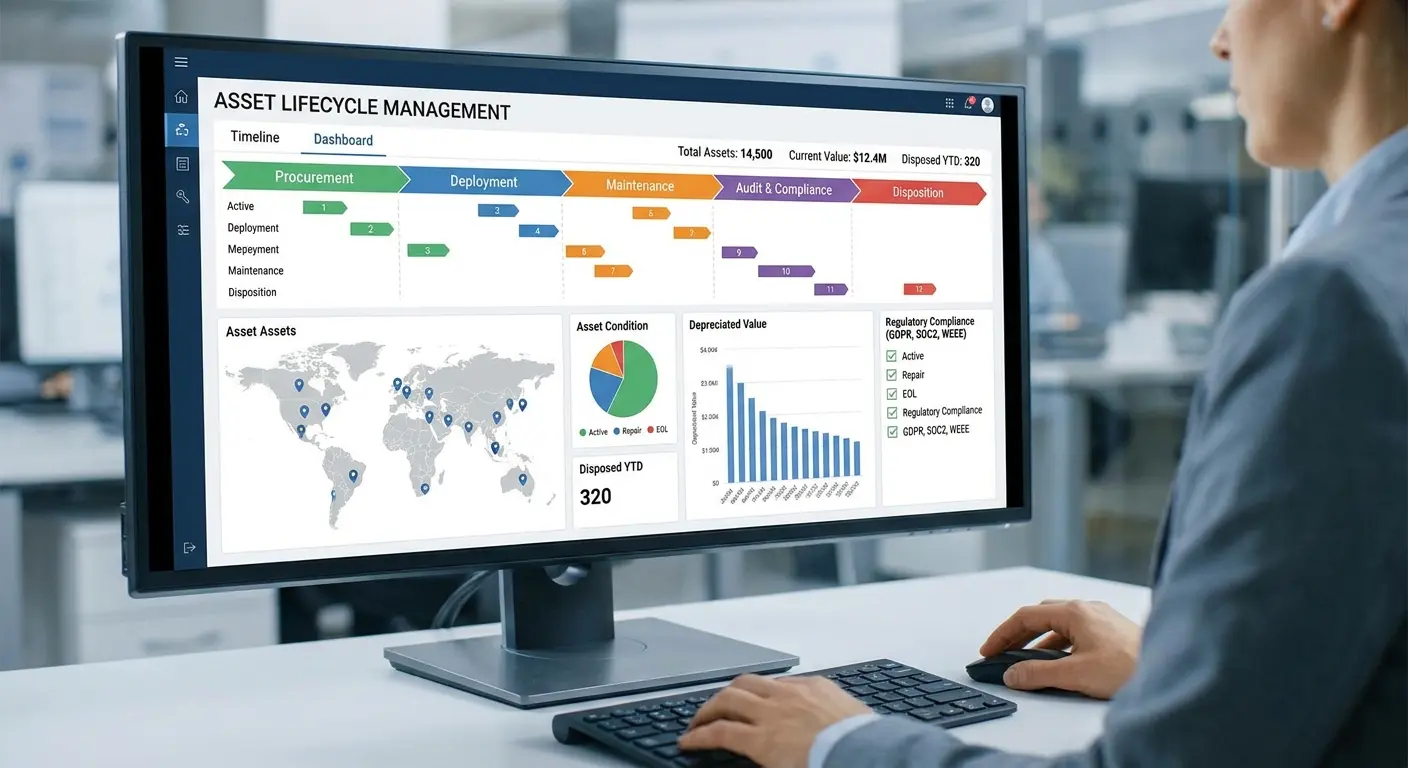
The solution isn't better disposition processes. It's better lifecycle tracking that makes disposition information available when you need it. Working with an experienced ITAD provider helps, but internal tracking remains essential.
Purchase Data Determines Disposition Options Years Later
What you capture at purchase affects what you can do at disposition. Recording warranty terms, buyback agreements, and vendor take-back options creates opportunities you can use later. Failing to document these details means rediscovering them years later (if the information is even still accessible).
Your asset tracking system should capture everything that might influence disposition decisions: purchase price (for depreciation and value calculations), vendor and model (for identifying resale channels and recycling options), warranty and service agreements (for determining repair vs. replace decisions), and any contractual terms related to returns or buybacks.
Most asset management systems capture some of this information but not all of it, and often not in ways that make it easily accessible for disposition planning. You need structured data fields that support queries like "show me all assets with active buyback agreements" or "identify equipment where warranty coverage makes repair cost-effective."
Condition Tracking Enables Predictive Disposition Planning
Waiting until disposition to assess condition means making decisions with incomplete information. Tracking condition throughout the lifecycle enables proactive planning.
Every repair ticket, hardware replacement, and user complaint provides condition data. Battery health metrics, storage capacity, performance benchmarks, and physical damage reports all indicate asset condition trajectory. Aggregating this information creates a condition profile that predicts when equipment will reach end-of-useful-life and what condition it will be in at that point. IT asset disposition solutions use this data for smarter planning.
This enables forward planning. You can forecast disposition volumes, predict recovery values, and identify equipment that should be retired early because condition degradation is accelerating. You can also catch equipment that's still in excellent condition and might command premium resale prices if disposed of proactively rather than waiting for complete end-of-life.
Building this capability requires integrating helpdesk systems, device management tools, and asset tracking into a unified view of asset health. Most companies have these systems but don't connect them in ways that support condition-based disposition planning.
High-intensity users degrade equipment faster. Light users keep equipment in better condition longer. Tracking usage patterns helps predict optimal disposition timing for specific assets rather than relying solely on age-based refresh cycles.
A laptop that's been used heavily for video editing and rendering might be ready for disposition after two years. An identical laptop used primarily for email and documents might have several more years of useful life. Age-based refresh cycles ignore these differences and lead to disposing of equipment that still has significant value or continuing to use equipment that's become unreliable.
Usage data comes from multiple sources: login patterns, application telemetry, performance metrics, and battery cycle counts. Synthesizing this information into actionable disposition timing recommendations requires analytics capabilities most asset management systems don't provide out of the box.
How GroWrk Addresses the Procurement-to-Disposition Gap
Full disclosure: this is why we built GroWrk. I got tired of watching companies (including ones I worked at) completely botch ITAD because nobody designed their systems for remote teams.
You're trying to use processes built for offices. Doesn't work when you've got people in 40 countries.
When you manage IT procurement, deployment, and lifecycle through our platform, disposition isn't an afterthought you figure out later. It's part of the workflow from the beginning.
We capture all the purchase data that matters for disposition: vendor terms, buyback options, warranty details, compliance requirements. We track condition throughout the lifecycle through integrated device management and user reporting. We maintain chain-of-custody documentation that satisfies audit requirements across different regulatory frameworks. When it's time for disposition, you're not starting from scratch. You have complete asset history and current market intelligence to make informed decisions. Our IT asset disposition services handle everything from collection to final processing.
The reverse logistics problem that makes ITAD so difficult for distributed teams? We've built global infrastructure specifically for that. We handle equipment collection from remote employees across 150+ countries, manage international shipping and customs, and coordinate timing with offboarding workflows. You're not figuring out how to get a laptop back from an employee in Vietnam. We've already solved that problem.
For companies managing distributed teams, trying to build all this infrastructure internally doesn't make sense. We've already done it, and we handle disposition as part of lifecycle management rather than as an isolated service you need to coordinate separately. As an ITAD company focused on remote work challenges, we've eliminated the integration gaps that create most disposition headaches.
Here's the Bottom Line
You can't recycle your way out of bad procurement decisions.
Better recycling vendors won't fix this. More rigorous data wiping won't fix this. You need to fix how you buy equipment in the first place.
ITAD fails for most companies because they're trying to solve it at the wrong point in the asset lifecycle. Disposition requirements aren't influencing procurement decisions, lifecycle tracking doesn't capture information needed for smart disposition choices, and ITAD processes aren't integrated with the operational workflows (like employee offboarding) where they need to connect.
Fixing IT asset disposition means redesigning how you think about IT asset lifecycle management from procurement forward. It means tracking different data, making different vendor decisions, and building different integrations between systems that currently operate independently.
This is hard work, which is why most companies keep limping along with ITAD processes they know are inefficient, risky, and expensive. The complexity of fixing it seems overwhelming compared to just muddling through.
You don't have to build everything at once. Start by identifying which of these gaps creates the most pain in your current ITAD process. Is it reverse logistics? Compliance fragmentation? Poor financial recovery? Lack of asset data? Pick one area and build better integration there. Each improvement makes subsequent changes easier because you're building connected capabilities rather than isolated fixes.
The companies getting ITAD services right aren't doing anything magical. They're just treating it as a lifecycle design problem rather than an end-of-life execution problem. Once you make that mental shift, the solutions become clearer, even if putting them in place takes time.
Working with an ITAD provider who understands these upstream dependencies helps accelerate the transition. You need partners who can integrate with your procurement, track assets throughout deployment, manage global reverse logistics, and provide the granular reporting that modern compliance and sustainability requirements demand. Data center IT asset disposition follows similar principles but at infrastructure scale.
The future of IT asset disposition isn't better recycling technology or more efficient drive wiping. It's better integration across the entire asset lifecycle so that disposition becomes a natural extension of how you manage technology rather than a crisis you handle after equipment has already become a problem.
Start there. Everything else gets easier.