




Last issue I argued about AI in IT operations — what’s real and what’s a badge. This week is the unglamorous foundation underneath all of it: your data. Because the smartest system in the world is worthless if the inventory it’s reasoning over is fiction. And in most distributed companies, it is.
Most distributed companies have an asset inventory that is 20–30% wrong, and the gap widens every month. The cause isn’t negligence — it’s structural. Inventory is captured once, at the moment of purchase, and then the real world starts editing it without telling anyone. The fix isn’t a better spreadsheet or a stricter policy; it’s architectural. Global IT asset management only stays accurate when the system that deploys, supports, and recovers your devices is the same system that records them. Stop maintaining an inventory. Start generating one.
The signal
Ask any IT leader at a distributed company how accurate their asset inventory is, and watch the pause before they answer. The honest ones say “70%, maybe.” The number is almost always worse than they think — and the gap widens every month.
This isn’t negligence. It’s structural. Inventory is captured once, at the moment of purchase, and then the real world starts editing it without telling anyone.
The problem: how an inventory becomes fiction
Here’s how an inventory becomes fiction, step by step.
A device is procured. It gets logged — make, model, serial, assigned user. That record is accurate for exactly one day: the day it was created.
Then reality goes to work. The laptop gets reassigned when someone changes teams, and nobody updates the row. An employee leaves and the device doesn’t come back, but the record still says “assigned, active.” A contractor in another country gets a machine that was never properly logged in the first place. A device dies and gets replaced, and now there are two rows where there should be one. A new hire’s laptop is drop-shipped by a local vendor and never makes it into the central sheet at all.
None of these are dramatic failures. Each is a small, ordinary drift. But they compound. Within a year, a distributed company’s asset inventory has quietly diverged from reality by 20–30%, and no single person is responsible for the gap because no single event caused it.
The reason this matters is that everything downstream inherits the error.
Security and compliance
Your SOC 2 or ISO audit asks you to account for every device that touches company data. An inventory that’s 75% accurate means a quarter of your audit trail is guesswork. In a breach, the device you can’t account for is the one that hurts. This is also where MDM and device management stops being optional — it’s the enforcement layer the inventory depends on.
Finance
You’re budgeting refreshes, depreciation, and procurement off a number that’s wrong. You over-buy because you can’t find what you already own, and you write off devices you assume are gone that are actually sitting in a drawer.
Operations
Every offboarding, every refresh, every security investigation starts with “wait, where is that device actually?” — a question your system of record should answer and can’t.
The root cause is always the same: inventory is treated as a record to maintain, separate from the work that changes it.
Someone is supposed to remember to update the spreadsheet after every deployment, reassignment, and recovery. At scale, across countries, that someone doesn’t exist — and even when they do, manual updates lag reality.
The operator takeaway: stop maintaining, start generating
The fix isn’t a better spreadsheet, a stricter policy, or a quarterly “true-up” that’s stale the week after you finish it.
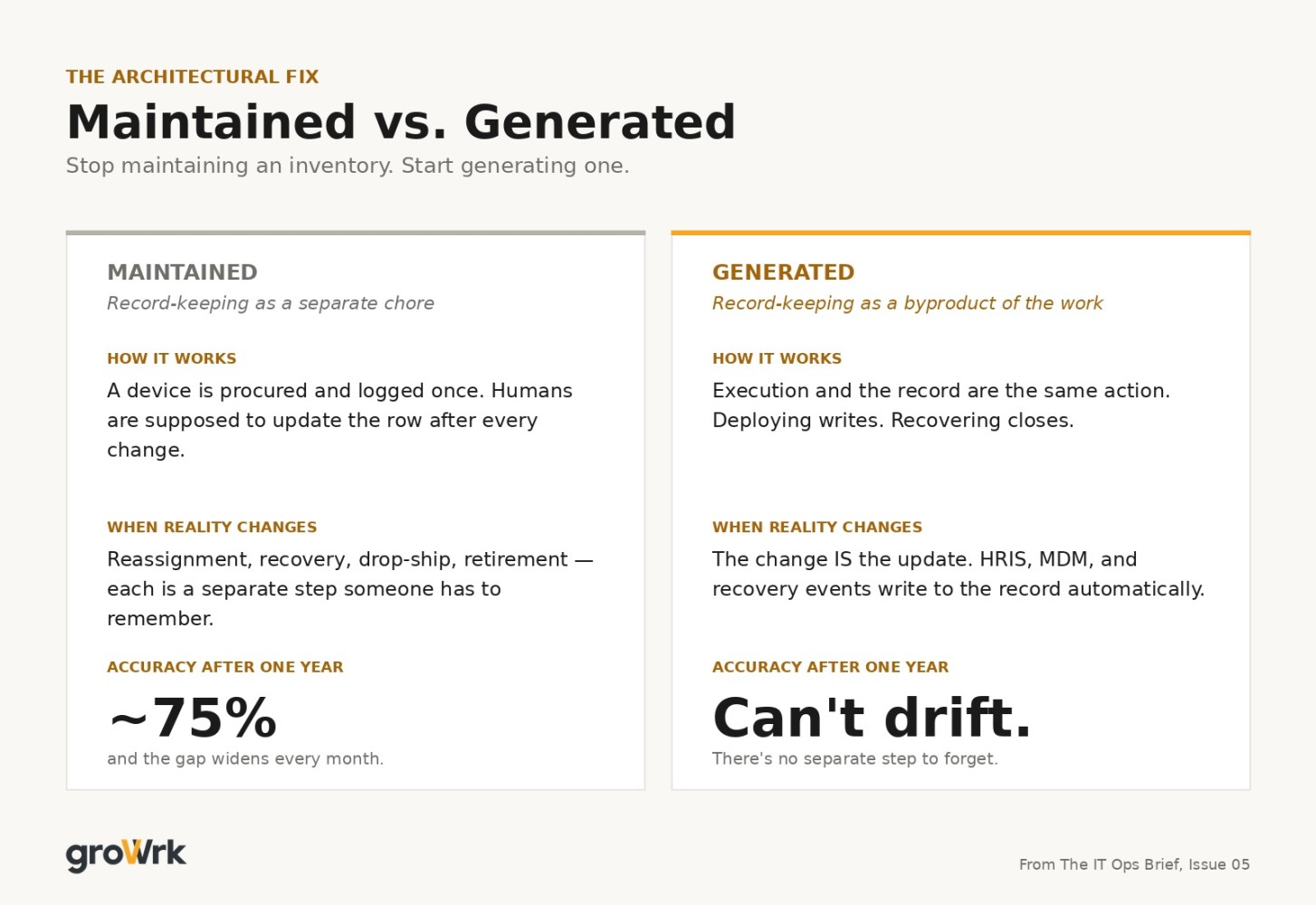
The fix is architectural: the system that deploys, supports, and recovers your devices should be the same system that records them.
When execution and record-keeping are the same action, the inventory can’t drift — because there’s no separate step to forget. A device deployed updates the record because deploying it is the update. A device recovered closes the record because recovery is the closing event. Reassignment, replacement, retirement — each is captured as a byproduct of the work, not a chore appended to it.
Concretely, push for three things:
- Single system of record tied to execution — the inventory is an output of the lifecycle system, not a parallel document.
- Event-driven updates — HRIS, MDM, and recovery events write to the record automatically, no human transcription.
- Reconciliation by default — what’s recorded is continuously checked against what’s actually checked in, deployed, or recovered, so drift surfaces immediately instead of at audit time.
If your inventory lives in a spreadsheet that humans update after the fact, assume it’s wrong and plan accordingly. If it’s a byproduct of a system that actually moves the devices, you can trust it.
One GroWrk lens
This is also, quietly, where a lot of “AI-powered visibility” falls apart — so it’s worth one honest sentence. A model can give you a beautiful dashboard, but it can’t report truth from data that was never reconciled. Accuracy in IT doesn’t come from analytics on top; it comes from execution underneath.
At GroWrk, inventory isn’t a thing customers maintain — it’s a byproduct of the lifecycle running. When we deploy a device, it’s recorded. When we recover one, the record closes, with a chain of custody and a data-destruction certificate attached. Because the same system does the work and keeps the record, there’s no drift to clean up. The inventory is accurate for the same reason the work got done: they’re the same event.
That’s the unglamorous foundation under everything else — including any AI / MCP layer you eventually want to put on top of it.
One stat
20–30% — the typical gap between a distributed company’s recorded asset inventory and what’s actually deployed in the field, after roughly a year of ordinary drift (reassignments, unrecovered devices, drop-shipped machines never logged).
Put differently: in a 300-device fleet, that’s 60–90 devices your system of record is wrong about. Some are write-offs you’re still depreciating. Some are active devices holding company data that your audit can’t account for. All of them are decisions being made on bad data.
(Illustrative estimate drawn from patterns across distributed deployments, not a single benchmarked study — but ask your own team how confident they are in the number, and watch the pause.)
If you can’t say with confidence how accurate your asset inventory is, that uncertainty is the problem — and it’s costing you in audits, budgets, and security exposure you can’t see precisely because the data is wrong.
We’re happy to show you what an inventory that can’t drift actually looks like for your fleet size and geographies.