



A confession to open with: last week I watched our pilot offboard employees in three countries from a single typed sentence. It worked — and it’s a pilot, not a product I can hand you today; I’ll be precise about that. But the more I sat with how it worked, the clearer the real story of AI in IT operations became — which is not the story most vendors are selling you.
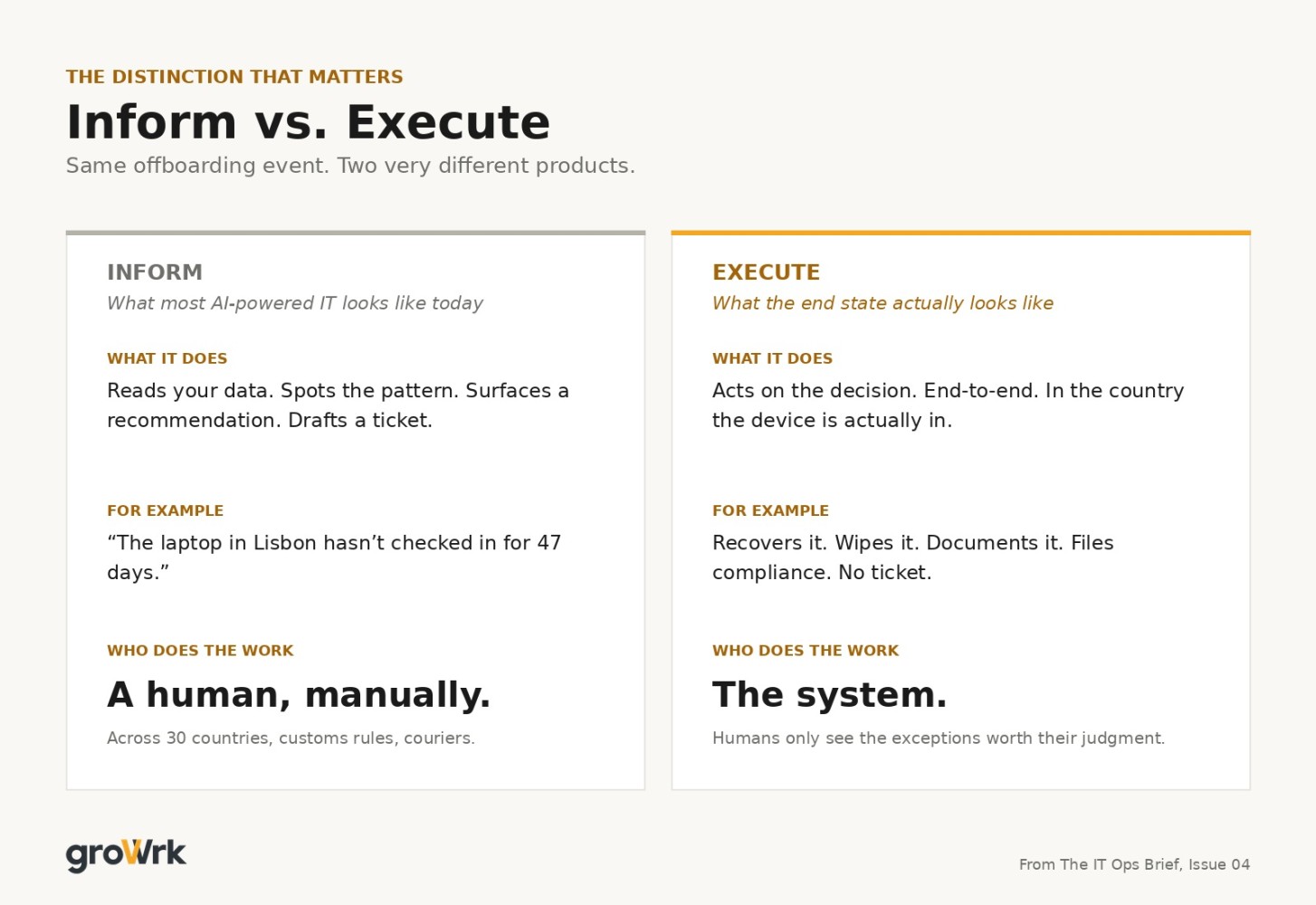
Every IT vendor now claims AI. The right question isn’t whether a tool uses AI — it’s what the AI is sitting on top of. Most “AI-powered IT” today informs: it reads your data, spots a pattern, drafts a ticket. The promise people think they’re buying is execute: a system that handles the work end-to-end across every country you operate in. That promise needs an AI / MCP layer sitting on real infrastructure — the couriers, customs handlers, data-destruction processes, and exception paths the model alone cannot provide. Inform vs. execute is the one distinction that cuts through every demo.
Every IT vendor now has an AI feature
Every product page has the badge. Every demo opens with it.
The market is saturated — and saturation is itself the signal. When everyone claims the same advantage, the claim stops being an advantage. “We use AI” now carries roughly the information content of “we use the cloud.” True, table stakes, and no longer a differentiator.
The interesting question isn’t whether a tool uses AI. It’s what the AI is sitting on top of.
The problem with most “AI-powered IT”
Most “AI-powered IT” is intelligence bolted onto a dashboard. It reads your data, spots a pattern, surfaces a recommendation. It tells you a laptop in Lisbon hasn’t checked in. It flags that an offboarding is overdue. It drafts a ticket.
That’s genuinely useful. It’s also where most of it stops.
Because the hard part of IT operations was never knowing what to do. Any competent IT lead already knows the laptop needs to come back, the access needs to be revoked, the device needs to be wiped and documented. The hard part is doing it — across multiple countries, each with its own logistics, customs rules, courier networks, and compliance standards.
A model that tells you what’s wrong, and then hands the actual work back to a human, hasn’t removed the bottleneck. It’s narrated it.
This is the distinction that matters: inform vs. execute. Most AI in IT today informs. It makes humans slightly faster at the same manual work. The promise people think they’re buying — the system that just handles it — requires something the model alone can’t provide: the infrastructure to act in the physical world, in every country you operate in, including when things go wrong.
And things go wrong constantly. The address is stale. Customs holds the shipment. The ex-employee won’t answer. A country has a data rule the others don’t. The exceptions are the job. A model that only works on the happy path isn’t running your operations — it’s demoing them.
The operator takeaway
When you evaluate an “AI-powered” IT tool, separate two things that vendors deliberately blur.
The model
This is the intelligence layer, and it is commoditized. The same foundation models are available to every vendor, including yours. Nobody has a durable edge here, and anyone implying they do is selling you the wrong thing.
The infrastructure
The ability to actually execute the model’s decisions in the real world — across procurement, deployment, device management, and retrievals. This is rare, expensive, and slow to build. It’s the courier contracts, the customs handling, the certified data destruction, the local compliance, and above all the exception paths for when reality doesn’t cooperate.
So the question to ask in every demo is blunt:
“Can it execute, or can it only inform?”
Make them show you. Not the recommendation — the action. Ask what happens when the device doesn’t come back. Ask who handles customs in the country you actually operate in. Ask to see the exception path, not the happy path. The answer tells you whether you’re buying a system that does the work, or a smarter dashboard that watches you do it.
One GroWrk lens
I’ll be honest about where we are, because the credibility of everything I just wrote depends on it.
We built GroWrk in the wrong order on purpose. The infrastructure first — the ability to procure, deploy, recover, wipe, and document devices in 150+ countries, with the exception handling that real operations demand. Years of unglamorous work. Then the natural-language layer on top, via our AI / MCP layer.
Last week, in a pilot, that layer let us offboard employees in three countries from a single instruction. No ticket, no dashboard, no coordinator. The system executed end-to-end and a human only needed to look at the one case that genuinely required judgment.
I want to be precise: this is a pilot, not something I can switch on today. That distinction matters, because the gap between a working pilot and a hyped demo is exactly the honesty this whole argument depends on.
That’s the end state we’re building toward: you describe the outcome, the system does the work, and human attention is reserved for the exceptions that actually need it. We’re not all the way there — there are still parts of the lifecycle where judgment beats automation, and pretending otherwise would be exactly the hype I’m arguing against.
But the direction is real, and it’s only possible in this order. You cannot natural-language your way to an outcome the underlying system can’t execute. The AI is the easy part. The infrastructure underneath is the company.
One stat
The foundation models behind most “AI-powered” IT tools are available to every vendor in the category — the same handful of APIs, the same commoditized layer.
What isn’t available off the shelf: the ability to execute a decision in 150+ countries, including the exception paths when a device doesn’t come back, customs holds a shipment, or a country’s data rules differ from its neighbor’s.
One of those is a feature. The other is years. Don’t confuse the model with the moat.
If a vendor is leading their pitch to you with AI, ask the one question that cuts through it: can it execute, or can it only inform?
And if you want to see what natural-language IT operations actually look like — not a demo, a working system, honest about where humans still step in — we’ll show you.