



A few weeks ago I argued that the real test of AI in IT operations is whether it can execute, not just inform. This issue goes one level deeper, into the part that’s actually hard, and actually defensible. Because executing on the happy path is easy. The whole game is what happens on the unhappy one.
Every AI demo works. That’s the problem. Demos show the happy path — the 80% of cases where everything goes right. The job, the cost, and the risk all live in the 20% where things go wrong: stale addresses, silent ex-employees, customs holds, and country-specific data rules. A model that only handles the happy path has automated the cheap part and left you the expensive one. That’s why AI in IT needs a global ops layer, not just a model — a real global IT asset management stack underneath, with exception paths in every country you operate in.
The signal: every demo works flawlessly
Every IT vendor is racing to bolt AI onto their product, and every demo works flawlessly. That should make you suspicious, not impressed.
A demo is a curated happy path. It shows you the 80% of cases where everything goes right. But anyone who has actually run IT operations knows the truth: the 80% was never the problem. The job — the cost, the risk, the 2 a.m. escalations — lives in the 20% where things go wrong.
The signal isn’t that AI can handle IT. It’s that almost no one is showing you what their AI does when IT doesn’t cooperate.
The problem: exceptions are the job
Here’s the uncomfortable math of IT operations: the exceptions aren’t a rounding error. They’re the majority of the actual work.
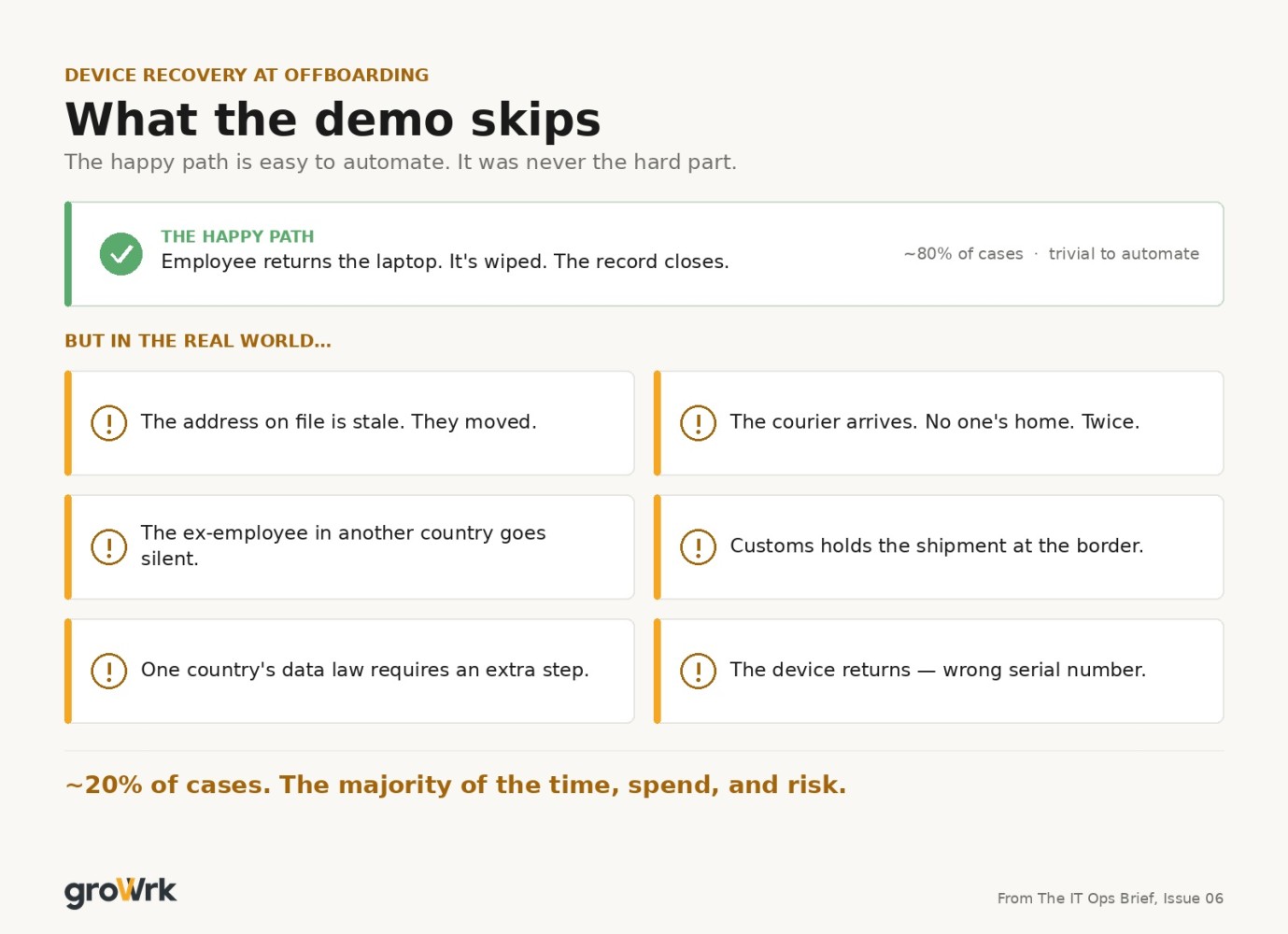
Consider device recovery at offboarding across a distributed company. The happy path — employee returns the laptop promptly, it’s wiped, the record closes — is genuinely easy to automate. But in the real world:
- The address on file is stale because the person moved.
- The courier arrives and no one’s home, twice.
- The ex-employee in another country stops responding entirely.
- Customs holds the return shipment for reasons specific to that border.
- One country’s data-handling law requires a step the others don’t.
- The device comes back, but it’s a different serial than the record shows.
Each of these is an exception. None is exotic. Together, they’re most of the cost and nearly all of the risk in the process. And here’s what matters: a model that only works when none of these happen has automated the part that was never hard, and left you the part that was.
This is the trap in most “AI-powered IT.” The intelligence layer is real — it can detect, predict, recommend, even draft the next action. But intelligence without an execution layer underneath stalls at the exact moment intelligence stops being enough. The AI tells you the courier missed the pickup. Then what? If the answer is “a human takes over and does everything from here,” you haven’t removed the work. You’ve added a notification to it.
The deeper issue is that exceptions can’t be solved by a better model. They’re solved by infrastructure — a courier network that actually operates in that country, a relationship that can escalate a customs hold, a compliance process that knows the local rule, and a human in the loop precisely where judgment is irreducible. None of that comes from the AI. All of it has to exist underneath.
The operator takeaway
Evaluate automation by its exceptions, not its demo.
When any vendor shows you AI-powered IT, the happy-path demo tells you almost nothing — it’s table stakes, and everyone passes it. The real evaluation is a set of unhappy-path questions.
- What happens after the alert? When your AI detects a problem, does it act, or does it hand the work back to my team?
- Show me the exception path. What does the system do when the courier misses, the address is wrong, the person won’t respond?
- Where’s the human, and where isn’t it? Good automation pulls a human in for genuine judgment calls — and only those. If a human is required on every case, it’s not automation. If a human is required on none, it’s not honest.
- Do you actually operate where I operate? Detecting a problem in a country you can’t execute in is worthless. Ask about the specific geographies you care about.
A vendor who can answer these has run real operations. A vendor who deflects to the demo hasn’t. The willingness to talk openly about where automation breaks is, paradoxically, the strongest signal that it works.
One GroWrk lens
I’ll be direct about why this is the issue I most wanted to write.
The reason we built GroWrk infrastructure-first — years of unglamorous work on couriers, customs, compliance, and chain of custody across 150+ countries before any of the AI — is that we knew the exceptions were the real product. The model on top is commoditized; everyone will have the same one. What’s defensible is the layer that survives the 20%: the contracted courier in a country most vendors don’t touch, the escalation path for the unresponsive ex-employee, the country-by-country compliance handling, and a human pulled in exactly where judgment beats a script.
We’re piloting natural-language control over this via our AI / MCP layer now, and what makes it trustworthy isn’t that it’s smart. It’s that when something breaks — and it does — there’s a real operation underneath that catches it, and an honest escalation when judgment is genuinely required. That’s not a hedge. It’s the whole point. Automation you can trust is automation that’s honest about its own exceptions.
You cannot natural-language your way out of a customs hold. You can only have built the thing that handles it.
One stat
In distributed device operations, the happy path is roughly 80% of cases and a small fraction of the cost. The remaining ~20% of cases — the exceptions — drive the majority of the time, spend, and compliance risk in the entire process.
Which means an “AI” that only handles the happy path has automated the cheap part and left you the expensive one.
If a vendor is selling you AI, don’t ask to see it work. Ask what happens when it breaks — and whether there’s a real operation underneath to catch it.
If you want to see automation that’s honest about its exceptions and actually handles them — across the countries you operate in — we’ll show you.